
.png "Arunachal Pradesh Moves to Operationalise 1978 Freedom of Religion Law as Draft Rules Finalised Amid Support and Opposition")
Arunachal Pradesh Moves to Operationalise 1978 Freedom of Religion Law as Draft Rules Finalised Amid Support and Opposition
.png)
The committee, formed to frame operational guidelines for a law that has remained largely inactive for nearly five decades, completed its final deliberations during its fourth meeting held on June 4 at the Civil Secretariat in Itanagar. After reviewing inputs from multiple stakeholders, the panel adopted several amendments before approving the final draft.
According to the official minutes, the Chairman of the committee, Justice Brojendra Prasad Katakey (Retd.), noted that despite repeated attempts to build consensus, the Arunachal Christian Forum (ACF) did not submit any formal proposal during the process and also did not participate in the final meeting. The minutes further recorded that Shri Tarh Miri, Chief Advisor of the ACF and a member of the HPC, remained absent from the proceedings.
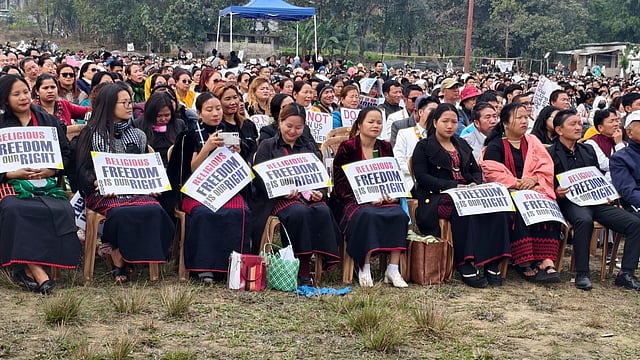
The move comes amid intensifying opposition from the Arunachal Christian Forum, which on June 2 issued a 15-day ultimatum to the state government demanding an immediate halt to the rule-framing exercise under the APFRA, 1978. In its memorandum to the Chief Minister, the organisation expressed concern that the implementation of the Act’s provisions could have serious implications for constitutional rights, religious freedom, social harmony, and peaceful coexistence in the state.
The ACF has alleged that the process has progressed without adequate consultation with key stakeholders, including religious organisations, civil society groups, and citizens. It has called for an immediate suspension of the rule-making exercise, a public declaration halting the process, and a broader consultation on the possible repeal of the Act. The organisation has also described the law as “discriminatory and divisive,” claiming that it disproportionately affects the Christian community in the state.
Despite these objections, the HPC saw broad support from representatives of indigenous, cultural, and religious organisations along with government officials, who endorsed the draft rules and recommended their early submission to the state government. Among the key revisions, Rule 3 has been amended to extend the time for reporting religious conversion from one week to “as soon as possible, but not later than three months.” Similarly, Rule 4 introduces a three-month limitation period for filing complaints.
To address concerns raised during consultations, the committee also inserted a clarification under Rule 9 stating that the APFRA rules are not directed against any specific religion and are applicable equally to all faiths and communities without discrimination.
The finalisation of the draft rules marks the culmination of months of consultations involving indigenous organisations, community representatives, legal experts, government departments, and religious groups. The committee was formed following renewed demands from indigenous bodies seeking enforcement of the long-dormant legislation, which they argue is necessary to protect cultural identity and traditional belief systems.
The APFRA, enacted in 1978 and granted Presidential assent, was originally designed to prohibit religious conversions carried out through force, fraud, or inducement. However, due to the absence of operational rules, it remained largely unenforced for decades. The law prescribes penalties including imprisonment of up to two years and fines up to ₹10,000 for violations.
The issue regained prominence after indigenous organisations, including the Indigenous Faith and Cultural Society of Arunachal Pradesh (IFCSAP), urged the government to implement the Act, arguing that it is essential to safeguard indigenous faiths and prevent forced or induced conversions among tribal communities.
In September 2024, the Gauhati High Court directed the state government to frame and notify the necessary rules for the Act, accelerating the current exercise. Chief Minister Pema Khandu has maintained that the rules are being framed in compliance with the court’s directive and are intended to protect the unique tribal heritage of the state while preventing coercive or fraudulent conversions.
As the report is prepared for submission, the issue continues to generate strong debate across Arunachal Pradesh, reflecting a deep divide between those supporting its implementation as a safeguard for indigenous identity and those who view it as a potential threat to religious freedom and social harmony.
0 Response to "Arunachal Pradesh Moves to Operationalise 1978 Freedom of Religion Law as Draft Rules Finalised Amid Support and Opposition"
Post a Comment
Disclaimer Note:
The views expressed in the articles published here are solely those of the author and do not necessarily reflect the official policy, position, or perspective of Kalimpong News or KalimNews. Kalimpong News and KalimNews disclaim all liability for the published or posted articles, news, and information and assume no responsibility for the accuracy or validity of the content.
Kalimpong News is a non-profit online news platform managed by KalimNews and operated under the Kalimpong Press Club.
Comment Policy:
We encourage respectful and constructive discussions. Please ensure decency while commenting and register with your email ID to participate.
Note: only a member of this blog may post a comment.