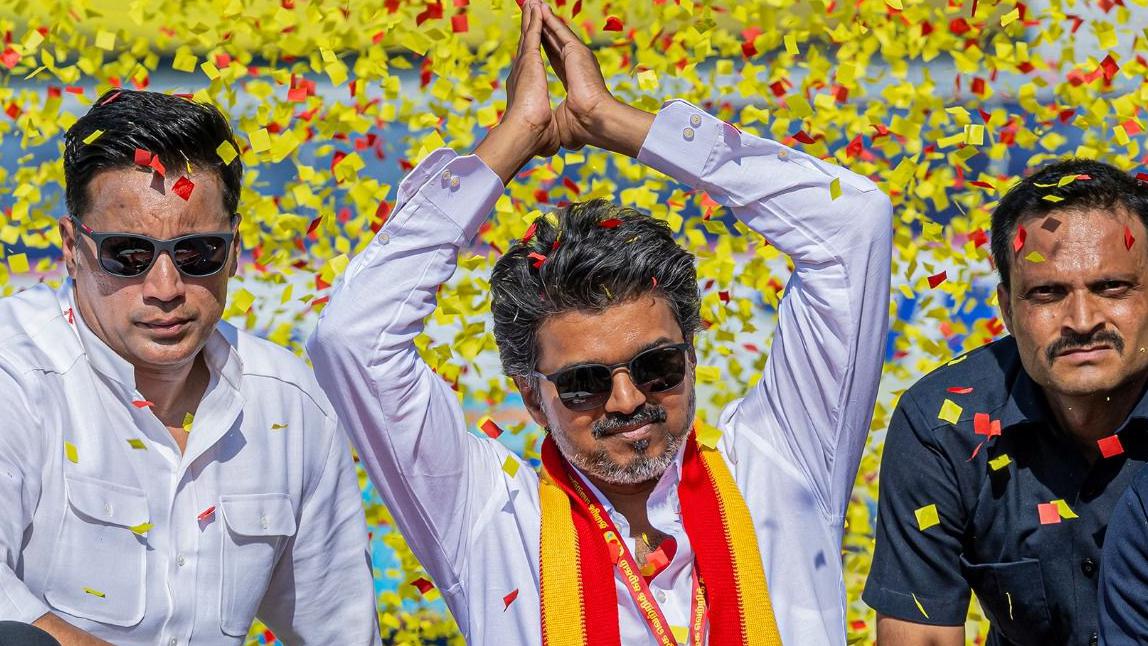
Nihar Nalini Saranagi, Countercurrents, May 10, 2026, Chennai: On May 10, 2026 — the very day this piece is being written — Joseph Vijay took oath as the ninth Chief Minister of Tamil Nadu. The fanfare was part Rajinikanth blockbuster, part Periyar homage.
Tamil Nadu has always processed politics through a cinematic lens. It is not a bug; it is a feature. MGR and Jayalalithaa governed for a combined four decades by fusing reel heroism with real power. When Vijay announced the formation of Tamilaga Vettri Kazhagam (TVK) in February 2024 and declared he would contest the 2026 assembly elections solo — in all 234 constituencies — the sceptics laughed. Kamal Haasan’s Makkal Needhi Maiam had flamed out. Vijayakanth’s DMDK had faded. The Dravidian duopoly of DMK and AIADMK had strangled challengers for 59 unbroken years since 1967.
Nobody is laughing now. TVK emerged as the single largest party on May 4, 2026, ending that 59-year Dravidian monopoly with a voter turnout of 85.1% — the highest in the state’s history. Vijay stitched together post-results support from Congress, CPI, CPI(M), VCK, and IUML, landing just at the 118-seat majority mark. His first public address as Chief Minister carried exactly the cinematic weight his electorate expected: measured, emotional, pledging that he would “not deceive people with false promises.” Casual? Perhaps. But strategically calibrated for a Tamil audience that reads public emotion as a credibility signal, not a performance flaw.
Tamil Nadu sends 39 members to the Lok Sabha. In 2024, the DMK-led Secular Progressive Alliance swept all 39. That sweep was a critical pillar of the I.N.D.I.A. bloc’s tally against the BJP. With TVK now governing the state in an alliance that includes Congress, CPI, and CPI(M), the national arithmetic for 2029 begins to look different — and more volatile.
Congress’s letter of support to Vijay explicitly extended the understanding to the 2029 Lok Sabha elections — a declaration that rattled the BJP. Analysts quoted in The Federal noted that this arrangement “will certainly worry the BJP to some extent,” particularly if a Vijay-led government delivers even reasonably competent governance and solidifies its electoral alliance. The BJP had initially made welcoming noises toward Vijay precisely because they hoped his anti-DMK positioning might crowd out Congress in the state. That bet has now clearly failed. A TVK-Congress-Left axis governing Tamil Nadu heading into 2029 is a formidable opposition bloc in one of India’s most politically literate and electorally decisive states.
The Centre’s discomfort was telegraphed early. Governor Rajendra Vishwanath Arlekar insisted Vijay prove his majority to the Raj Bhavan even before being invited to form the government — a constitutionally dubious demand for the undisputed single-largest-party leader. Political observers read this as a BJP pressure tactic, attempting to peel away Vijay’s fragile coalition before it could take office. It didn’t work. Vijay was sworn in on the morning of May 10. The vote of confidence is due on or before May 13.
This Centre-state friction will not diminish. Tamil Nadu under TVK will be an ideologically hostile terrain for the BJP — TVK’s founding resolution explicitly named the BJP as an “ideological opponent” and Vijay famously declared that the BJP “may sow seeds of poison elsewhere, but not in Tamil Nadu.” A combative Raj Bhavan, disputes over fiscal federalism, and battles over language policy are all but inevitable. Each confrontation will generate national headlines and frame the BJP as the aggressor against a popular, democratically legitimate state government. That is a political gift for the opposition heading into 2029.
Clear-eyed analysis demands acknowledging the unknowns. TVK’s cabinet is largely made up of political novices — the price of a party that is barely two years old. Governance, not glamour, will determine Vijay’s staying power. His wafer-thin majority — sitting at exactly 118 in a 234-member house — leaves him vulnerable to floor-crossing pressure and coalition arithmetic. The Congress, as analysts at The Quint note, retains the option of returning to DMK’s fold if the Vijay alliance under-delivers; it has done so before. The DMK under MK Stalin, bruised but not broken, will be a relentless opposition force.
History also counsels humility. MGR succeeded because he built a mass welfare machinery — ration shops, noon-meal schemes — that outlasted his stardom. Jayalalithaa survived and thrived because she proved administratively ruthless. Vijay’s prototype is still unwritten. The state — and the nation — is watching whether the screen hero can write a different kind of script.
Tamil Nadu’s politics have always punched above their weight in national imagination — from Periyar’s social reform legacy to the Dravidian model’s welfare economics. What Vijay has engineered, however, is something structurally new: the first successful breaking of a 59-year duopoly by a non-Dravidian party, using a combination of digital mobilisation, youth energy, Christian minority appeal, and a promise of clean-slate governance.
If he governs even adequately, TVK could become the anchor of a renewed southern opposition front heading into 2029 — one that allies with Telangana’s BRS remnants, Kerala’s Left, and perhaps Karnataka’s Congress to present a cohesive federalist challenge to BJP’s northern dominance. That is speculative. But it is no longer implausible.
The silver screen has delivered its hero to the CM chair. Whether the mass masala becomes serious statecraft — that is a sequel nobody has written yet.

0 Response to "The Star Has Landed. Now What? Vijay’s Rise Marks a Major Shift in Tamil Nadu Politics"
Post a Comment
Disclaimer Note:
The views expressed in the articles published here are solely those of the author and do not necessarily reflect the official policy, position, or perspective of Kalimpong News or KalimNews. Kalimpong News and KalimNews disclaim all liability for the published or posted articles, news, and information and assume no responsibility for the accuracy or validity of the content.
Kalimpong News is a non-profit online news platform managed by KalimNews and operated under the Kalimpong Press Club.
Comment Policy:
We encourage respectful and constructive discussions. Please ensure decency while commenting and register with your email ID to participate.
Note: only a member of this blog may post a comment.