
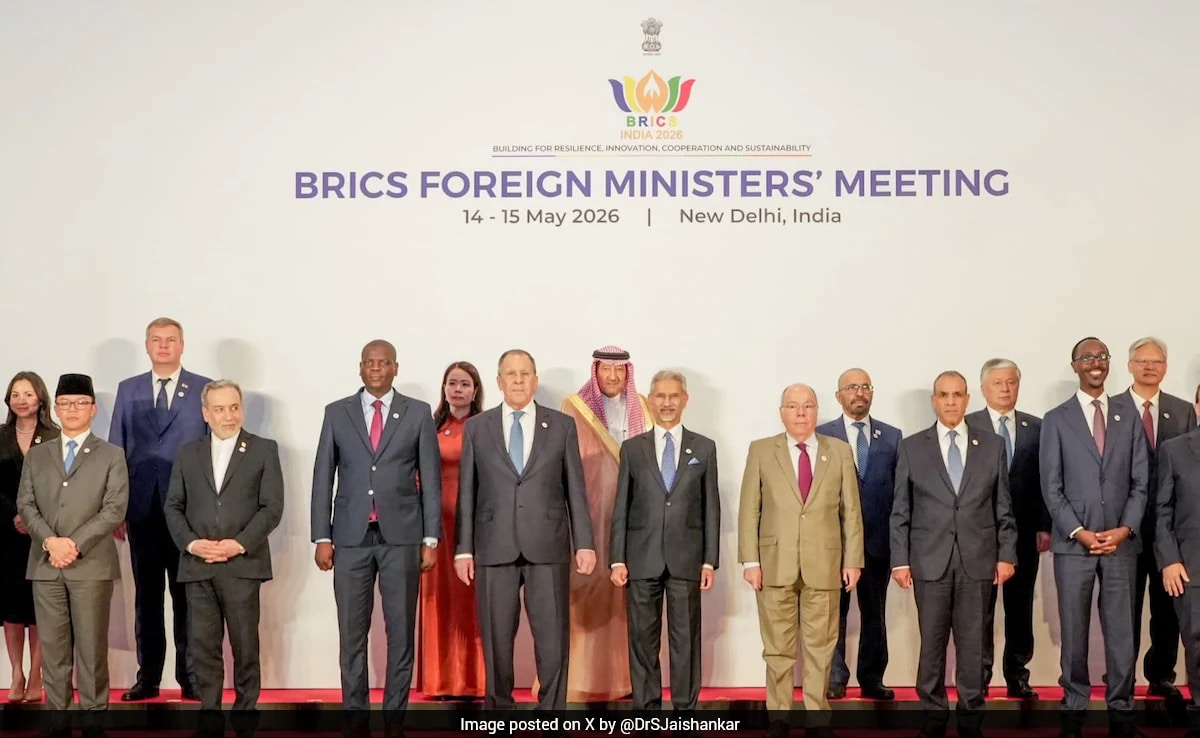
India Raises Concerns Over West Asia Crisis at BRICS Meet
In his address at the opening day of a two-day BRICS conclave in New Delhi, External Affairs Minister S Jaishankar asserted, without naming specific nations, that respect for sovereignty and territorial integrity must anchor international relations, maintaining that “dialogue and diplomacy” offer the only sustainable path to conflict resolution.
Jaishankar said India stands ready to contribute constructively towards de-escalation efforts and to support initiatives aimed at restoring stability, while noting that “peace cannot be piecemeal” and “it is essential to uphold international law, protect civilians, and avoid targeting public infrastructure”.
He also underlined the importance of new members “fully” appreciating and subscribing to the BRICS consensus mechanism on various important issues, remarks that came amid sharp differences between the United Arab Emirates (UAE) and Iran over the West Asia conflict.
It is learnt that there were heated exchanges between Iranian Foreign Minister Abbas Araghchi and UAE Minister of State for Foreign Affairs Khalifa Shaheen Al Marar during one of the two sessions at the conclave, and Russian Foreign Minister Sergey Lavrov intervened to cool tempers.
Iran and the UAE have been sparring in recent weeks over Iran’s alleged attacks on energy infrastructure in the UAE, which has resulted in BRICS failing to come out with a consensus statement on the West Asia crisis.
BRICS, originally comprising Brazil, Russia, India, China and South Africa, expanded in 2024 to include Egypt, Ethiopia, Iran and the UAE, with Indonesia joining in 2025.
“It is essential for the smooth advancement of BRICS that later members fully appreciate and subscribe to the BRICS consensus on various important issues,” Jaishankar said.
In his remarks, he also strongly pitched for ensuring safe and unimpeded maritime flows through the Strait of Hormuz and the Red Sea, and voiced concerns over the “grave humanitarian implications” of the conflict in Gaza.
Besides Araghchi and Lavrov, Brazilian Foreign Minister Mauro Vieira, Indonesian Foreign Minister Sugiono and South Africa’s Minister for International Relations Ronald Lamola were among the senior leaders attending the meeting.
“The conflict in West Asia merits particular attention. Continuing tensions, risks to maritime traffic and disruptions to energy infrastructure highlight the fragility of the situation,” Jaishankar said.
He said safe and unimpeded maritime flows through international waterways, including the Strait of Hormuz and Red Sea, remain vital for global economic well-being.
“A sustained ceasefire, humanitarian access, and a credible pathway towards a durable and peaceful resolution remain essential. India supports a two-state solution where the Palestine issue is concerned,” he said.
“India stands ready to contribute constructively to de-escalation efforts and to support initiatives aimed at restoring stability,” Jaishankar said.
Without naming any country, he also underlined the need for addressing what he called “the increasing resort to unilateral coercive measures and sanctions inconsistent with international law and the UN Charter”.
“Such measures disproportionately affect developing countries. These unjustifiable measures cannot substitute dialogue, nor can pressure replace diplomacy,” he said.
The External Affairs Minister, referring to “unprecedented geopolitical and economic uncertainty” facing the world, said these developments are weakening growth prospects and deepening vulnerabilities.
“Many of these issues have far-reaching consequences beyond their immediate region. Their impact is particularly severe for emerging markets and developing countries, through pressures on energy, food and fertiliser security, supply chain disruptions, inflationary trends and constraints on growth,” he said.
In this context, BRICS solidarity assumes particular significance, he added.
0 Response to " India Raises Concerns Over West Asia Crisis at BRICS Meet"
Post a Comment
Disclaimer Note:
The views expressed in the articles published here are solely those of the author and do not necessarily reflect the official policy, position, or perspective of Kalimpong News or KalimNews. Kalimpong News and KalimNews disclaim all liability for the published or posted articles, news, and information and assume no responsibility for the accuracy or validity of the content.
Kalimpong News is a non-profit online news platform managed by KalimNews and operated under the Kalimpong Press Club.
Comment Policy:
We encourage respectful and constructive discussions. Please ensure decency while commenting and register with your email ID to participate.
Note: only a member of this blog may post a comment.