
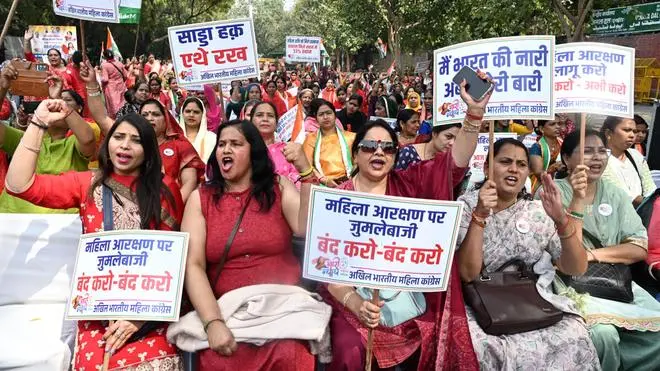
From Promise to Pause: Why the Women’s Reservation Push Stalled in 2026
Reform or Strategy? Unpacking the Politics Behind the Women’s Reservation Delay
KalimNews, Kalimpong, 19 April 2026 : India marked a significant moment in its democratic journey in 2023 with the passage of the Women’s Reservation Bill, formally known as the Nari Shakti Vandan Adhiniyam.
The law set out to reserve one-third of seats in the Lok Sabha, state legislative assemblies, and the Delhi Legislative Assembly for women, with an additional provision ensuring that one-third of the seats already reserved for Scheduled Castes and Scheduled Tribes would be allocated to women within those categories. Framed as a transformative step toward inclusive governance, it also introduced a 15-year time limit and a system of rotating reserved constituencies after each delimitation cycle.
Yet, despite being passed unanimously in Parliament, the law was structured in a way that delayed its actual implementation. Instead of coming into force immediately, it was tied to two conditions: the completion of the next national Census and a subsequent delimitation exercise to redraw constituency boundaries.
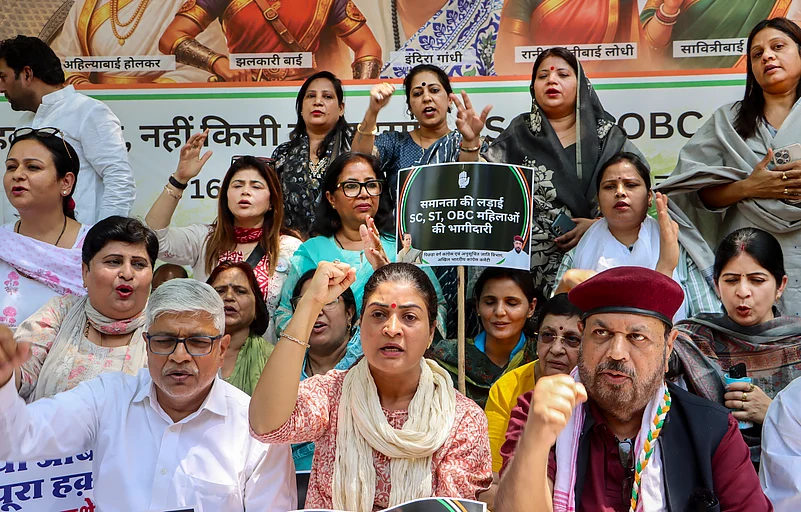
This design effectively meant that the benefits of the law would not be seen in the immediate electoral cycle, pushing its likely implementation to around the 2029 general elections. Critics pointed out that while the law appeared progressive on paper, these built-in conditions postponed its real impact, raising questions about whether political consensus existed more in principle than in practice.
The roots of this legislation go back decades. Earlier attempts in 1996, 1998, 1999, and 2008 had failed to fully materialize, even though the idea of women’s reservation had already been successfully implemented at the grassroots level through the 73rd Constitutional Amendment and the 74th Constitutional Amendment. The 2023 Act was therefore seen as the long-awaited extension of this principle to higher legislative bodies. However, by linking its enforcement to future administrative exercises, it left a gap between legislative intent and practical execution.
In 2026, this gap became the center of political action. During a politically charged period that coincided with key assembly elections, the government introduced a fresh set of proposals, including the Delimitation Bill, 2026 and the Constitution (131st Amendment) Bill, 2026. These were presented as a way to operationalize women’s reservation sooner by removing the dependency on a future Census and instead using the 2011 Census data to initiate delimitation. The package also proposed a major expansion of Lok Sabha seats from 543 to 850. In effect, this was an attempt to convert a delayed promise into a time-bound political reality.
However, on 18 April 2026, the constitutional amendment required to enable this fast-tracked implementation failed to secure the mandatory two-thirds majority in the Lok Sabha. This outcome revealed that while the broader goal of women’s representation remained widely accepted, the political consensus fractured when it came to the method of execution.
From the opposition’s perspective, several concerns drove their resistance. They argued that using outdated Census data could distort representation and fail to reflect current population realities. The proposed increase in parliamentary seats and the redrawing of constituencies raised fears of shifting political balance between states, especially between regions with differing population growth rates. There were also apprehensions that combining women’s reservation with such a large-scale restructuring of the electoral map could indirectly benefit the ruling party by reshaping constituencies in its favor. For many opposition leaders, the issue was not the reservation itself but the conditions attached to its implementation.
Interestingly, resistance was not limited to opposition benches alone. Some allies within the ruling National Democratic Alliance also expressed reservations and either opposed or withheld full support. Their concerns ranged from the potential loss of influence in newly delimited constituencies to uncertainties about how seat expansion would affect regional representation. For smaller coalition partners, the fear of political marginalization in a significantly enlarged Lok Sabha was a critical factor.
On the other hand, the ruling government defended the move as a necessary and pragmatic step. It argued that waiting indefinitely for a new Census could delay women’s reservation for years, and that using available data was a practical solution to ensure timely implementation. The proposed seat expansion, according to the government, was intended to accommodate population growth and ensure fairer representation overall. From this viewpoint, the 2026 bills were positioned as an effort to overcome procedural bottlenecks rather than as a political maneuver.
The truth behind the failure to secure a two-thirds majority appears to lie somewhere in between these competing narratives. The idea of women’s reservation itself did not divide Parliament; rather, it was the intersection of this reform with broader structural changes—delimitation, seat expansion, and data usage—that created friction. The timing of the proposal, introduced during an election-sensitive period, further intensified political skepticism, with many viewing it through the lens of electoral strategy rather than purely institutional reform.
India’s push for women’s political representation did not begin in 2023—and it certainly does not end with the stalled developments of 2026. While the Nari Shakti Vandan Adhiniyam remains a valid and active law, it has not yet been implemented in the Lok Sabha or state legislative assemblies because its enforcement is still tied to the completion of a future Census and the delimitation process. In that sense, the law exists constitutionally, but its core promise at the national and state level is still awaiting execution.
However, it would be inaccurate to say that women’s reservation is entirely absent in India’s political system today. In fact, it has already been functioning—quite effectively—at the grassroots level for decades. The foundation for this was laid by the 73rd Constitutional Amendment and the 74th Constitutional Amendment, which made it mandatory to reserve at least one-third of seats for women in Panchayats and urban local bodies. Over time, many states went even further, increasing this quota to 50% for women.
States such as West Bengal, Bihar, Rajasthan, Madhya Pradesh, Kerala, Maharashtra, and Odisha have already implemented 50% reservation for women in local governance. This means that millions of women across rural and urban India are already participating in governance as elected representatives in panchayats and municipalities. In this way, the spirit of women’s reservation is not only active but deeply embedded at the grassroots level.
What the 2023 law aims to do is extend this success upward—from local governance to state assemblies and Parliament. But the delay in implementation, along with the failure of the 2026 amendment to secure a two-thirds majority, has created a gap between intent and impact. There is currently no alternative or indirect mechanism through which the 33% reservation is being applied in the Lok Sabha or state legislatures. It will only come into force once the constitutional conditions are fulfilled or if a new political consensus emerges to modify those conditions.
So, the reality today is layered. On paper, India has already committed itself to one of the most significant gender reforms in its political history. On the ground, women are already exercising political power in large numbers at the local level. But at the highest levels of decision-making—Parliament and state assemblies—the reform remains in waiting, shaped by legal conditions, political negotiations, and unresolved debates over implementation.
In the end, the failure of the 2026 amendment highlights a fundamental reality of democratic politics: even widely supported reforms can stall when they are tied to larger questions of power, representation, and trust. The Nari Shakti Vandan Adhiniyam remains a valid and important constitutional commitment, but its journey from law to lived reality continues to be shaped by negotiation, disagreement, and the complex dynamics of Indian politics.
0 Response to "From Promise to Pause: Why the Women’s Reservation Push Stalled in 2026"
Post a Comment
Disclaimer Note:
The views expressed in the articles published here are solely those of the author and do not necessarily reflect the official policy, position, or perspective of Kalimpong News or KalimNews. Kalimpong News and KalimNews disclaim all liability for the published or posted articles, news, and information and assume no responsibility for the accuracy or validity of the content.
Kalimpong News is a non-profit online news platform managed by KalimNews and operated under the Kalimpong Press Club.
Comment Policy:
We encourage respectful and constructive discussions. Please ensure decency while commenting and register with your email ID to participate.
Note: only a member of this blog may post a comment.