
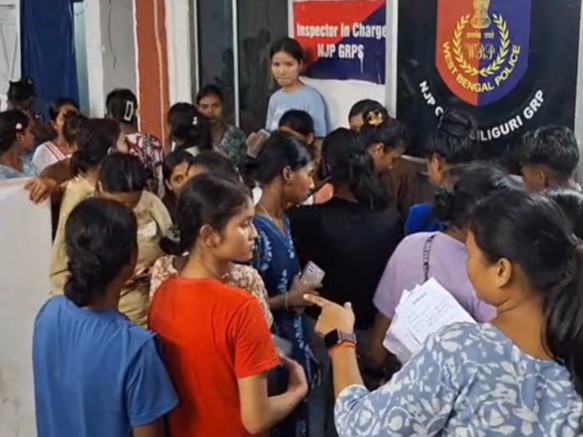
56 Women Rescued from Suspected Human Trafficking Racket at New Jalpaiguri Station
The authorities became suspicious after noticing the women’s travel arrangements and the presence of two individuals who were escorting the group. The women had boarded the train without valid tickets, and the escorts had falsely written seat numbers on the women’s hands in an attempt to mislead them about their travel plans. Upon questioning, the women were unable to provide legitimate travel documents or job offer letters. When asked about their intended destination, the responses were inconsistent, leading the GRP and RPF officials to act swiftly.
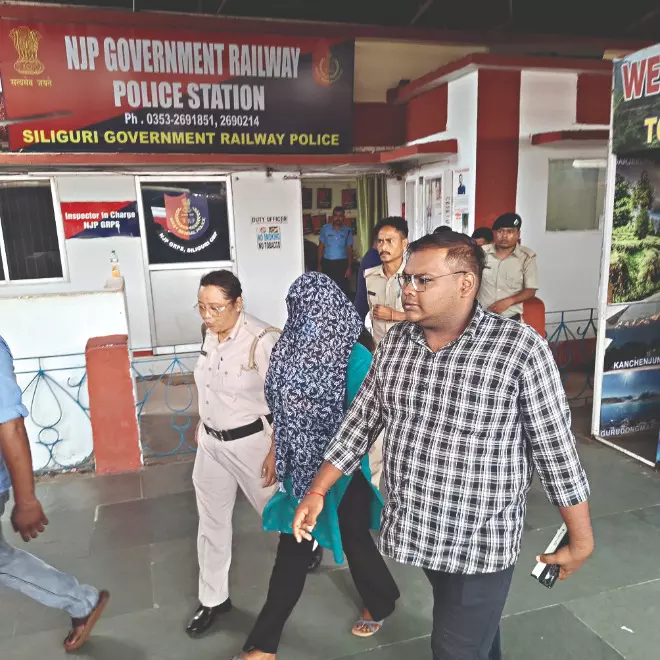
The two individuals accompanying the women were identified as Jitendra Kumar Paswan from South Bengal and Chandrima Kar from Siliguri. Both individuals were arrested on the spot after they failed to provide satisfactory answers regarding the women’s travel plans. They were charged under Section 143(3) of the Indian Penal Code (IPC) for human trafficking. During their interrogation, it was revealed that the women had been recruited through agents who promised them jobs in Bangalore but instead planned to exploit them in other regions.
The authorities have since launched an in-depth investigation into the trafficking network. The women were reportedly trained under the guise of employment opportunities, having attended a so-called "self-help" training center in Siliguri. This center, which was claimed to be affiliated with the Central Government’s skill development programs, was being used as a front to lure vulnerable women from remote tea garden areas in North Bengal. The training center, located near Bhabesh More under the Dabgram-Fulbari block, promised women jobs in hotel management, but investigators discovered no official documents or certifications supporting these claims.
Further inquiries revealed that after the women completed their training in Siliguri, they were meant to be sent to destinations in South India, including Tamil Nadu, where they would have been forced into prostitution. The authorities believe that this trafficking operation may be part of a larger, organized network exploiting women from impoverished rural and tea garden areas in West Bengal.
The rescued women, hailing from the Jalpaiguri, Cooch Behar, and Alipurduar districts, were all given medical checks and safely returned to their families after the authorities made necessary arrangements. The police have confirmed that the women were unaware of the actual nature of their journey and had been deceived by the false promises of well-paying jobs in Bangalore.
Following the rescue, local activists, including Raju Nepali, an anti-human trafficking campaigner, highlighted the new modus operandi of traffickers, who now operate under the guise of government-sponsored projects. Nepali pointed out that these trafficking networks often exploit the lack of employment opportunities in rural areas, particularly in the Dooars region, where many women are lured by false promises of a better life in the cities.
Authorities have also raised concerns about the misuse of government projects like the West Bengal Society for Skill Development and the Din Dayal Upadhyay Gramin Koushalya Yojna, which were reportedly used by traffickers as cover for their operations. The investigation has raised serious questions about the vulnerability of individuals in remote areas and the exploitation of government initiatives by criminal elements.
The incident has also prompted state and local authorities to review the effectiveness of such “self-help” centers and their possible role in human trafficking. The GRP and RPF, along with local police, are working together to uncover the full extent of the trafficking racket and identify other individuals involved in the operation.
Deputy Superintendent of Railway Police, Parijat Sarkar, confirmed that further investigations are underway. The two accused individuals have been presented in Jalpaiguri court and will face charges related to human trafficking. The authorities have assured that they will continue to monitor and address the growing problem of human trafficking, especially in regions where vulnerable individuals are being targeted by traffickers.
The successful rescue of the 56 women serves as a stark reminder of the ongoing battle against human trafficking and the importance of vigilance and quick action by law enforcement agencies.
0 Response to " 56 Women Rescued from Suspected Human Trafficking Racket at New Jalpaiguri Station"
Post a Comment
Disclaimer Note:
The views expressed in the articles published here are solely those of the author and do not necessarily reflect the official policy, position, or perspective of Kalimpong News or KalimNews. Kalimpong News and KalimNews disclaim all liability for the published or posted articles, news, and information and assume no responsibility for the accuracy or validity of the content.
Kalimpong News is a non-profit online news platform managed by KalimNews and operated under the Kalimpong Press Club.
Comment Policy:
We encourage respectful and constructive discussions. Please ensure decency while commenting and register with your email ID to participate.
Note: only a member of this blog may post a comment.