
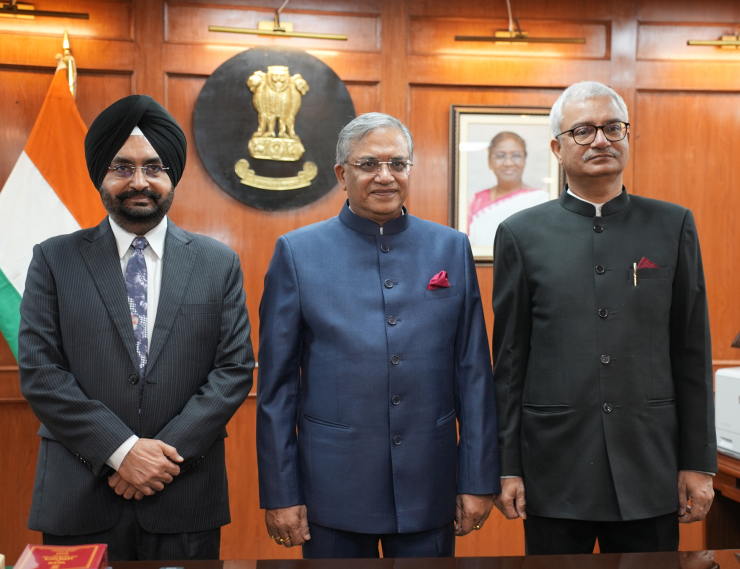
Cracks at the Poll Body: Two Election Commissioners Repeatedly Red-Flag Voter Roll Overhaul and Institutional Conduct
The heart of the internal deadlock lies in the constitutional structure of the multi-member Commission. Under Article 324, bolstered by Supreme Court precedent in T.N. Seshan v. Union of India (1995) and Section 18 of the 2023 Chief Election Commissioner and Other Election Commissioners Act, all three commissioners hold equal status, with the Chief Election Commissioner serving merely as first among equals. Decisions must follow consensus or a majority vote, and internal work allocations require unanimous agreement. Instead, Sandhu and Joshi—who together form the statutory majority—recorded that Chief Election Commissioner Gyanesh Kumar frequently bypassed the full Commission, treating unilateral decisions as institutional policy.
The objections peaked when both commissioners took the extraordinary step of writing separately to Cabinet Secretary T.V. Somanathan after an unapproved work re-allocation granted Senior Deputy Election Commissioner Maneesh Garg broader oversight over administrative and digital workflows, an order the two commissioners promptly rescinded. This escalated friction culminated in a full-bench meeting on September 9, 2026—the Commission's first complete gathering in four months.
Crucial objections raised by the two commissioners challenge the legality of major electoral adjustments:
Unauthorised Changes to Form 6: New voter applicants were required to declare whether their parents or grandparents figured in previous SIR records. Both Joshi and Sandhu warned that modifying Form 6 without statutory amendments passed by Parliament violated Section 28 of the 1950 Representation of the People Act, yet the requirement remained active on the digital portal.
Mass Voter Deletions and Mysterious Appeals in West Bengal: In West Bengal alone, where the SIR led to the deletion of over 2.2 million names, approximately 1.61 million appeals were lodged before judicial tribunals challenging decisions to retain or restore voters. Commissioner Sandhu explicitly placed on record that neither the commissioners nor the state's Chief Electoral Officer were informed about who authorised or filed these mass appeals on the ECI's behalf.
Centralised Monopoly Over Electoral Databases: Statutory responsibility for voter roll additions, deletions, and modifications rests with local Electoral Registration Officers (EROs). Both commissioners red-flagged an aggressive centralisation within ECINet and ERONet, revealing that field officers across states—such as in Goa, where 97 eligible electors were blocked from entry—were stripped of their statutory operating access under administrative directives issued by central IT leadership.
- First Formal Dissent on Unapproved Orders- October 28, 2025
Commissioner Sandhu formally notes that official letters and directives are being issued under the Commission's name without prior approval from the full bench.
- Surge of Procedural Objections- April 16, 2026
On a single day, four separate objections are registered: Sandhu points out learning of critical IT portals via media reports and cites unauthorised ECI communications; Joshi flags that commissioners receive neither agendas prior to meetings nor minutes afterward, alongside unapproved official foreign travel.
- Reiterated Notice on Official Communications- April 24, 2026
Commissioner Joshi reiterates that no public or administrative notices may be disseminated in the ECI's name without adhering to Article 324 and the 2023 Act.
- Red-Flagging Statutory Breaches in Form 6- May 16–19, 2026
Joshi officially warns that Form 6 cannot legally demand ancestry roll verifications without statutory rule amendments by the government; Sandhu endorses this finding three days later.
- Alarm Over Database Centralisation-May 29 – July 13, 2026
Joshi cautions against centralising the voter database away from local Electoral Registration Officers and urges an external technical audit, which Sandhu endorses in July.
- Escalation to the Cabinet Secretary- July 29–30, 2026
Both commissioners dispatch separate letters to Cabinet Secretary T.V. Somanathan challenging unilateral internal administrative reorganisations, subsequently striking down the work reallocation order.
- Challenging West Bengal Appeals and IT Restrictions-August 12–14, 2026
Sandhu questions who authorised 1.61 million tribunal appeals in Bengal, brands the persisting Form-6 revisions unlawful, and records that field registration officers are being improperly blocked from accessing central databases.
The disclosures have ignited broader legal and political scrutiny. Constitutional scholars and former electoral chiefs have termed the internal fracturing severe, noting that under Indian jurisprudence, an electoral revision that curtails the adult franchise without statutory consensus cuts at the very heart of representative governance. In response to the investigative findings, the Election Commission released a statement describing the internal memos as ordinary deliberative exchanges, asserting that divergent viewpoints, technical inputs, and draft-stage notes reflect healthy internal checks and balances within a multi-member body. However, as the third phase of the revision exercise progresses across 19 states and union territories, the documented dissent of two sitting commissioners has firmly placed the integrity of voter roll governance in the national spotlight.
0 Response to "Cracks at the Poll Body: Two Election Commissioners Repeatedly Red-Flag Voter Roll Overhaul and Institutional Conduct"
Post a Comment
Disclaimer Note:
The views expressed in the articles published here are solely those of the author and do not necessarily reflect the official policy, position, or perspective of Kalimpong News or KalimNews. Kalimpong News and KalimNews disclaim all liability for the published or posted articles, news, and information and assume no responsibility for the accuracy or validity of the content.
Kalimpong News is a non-profit online news platform managed by KalimNews and operated under the Kalimpong Press Club.
Comment Policy:
We encourage respectful and constructive discussions. Please ensure decency while commenting and register with your email ID to participate.
Note: only a member of this blog may post a comment.