
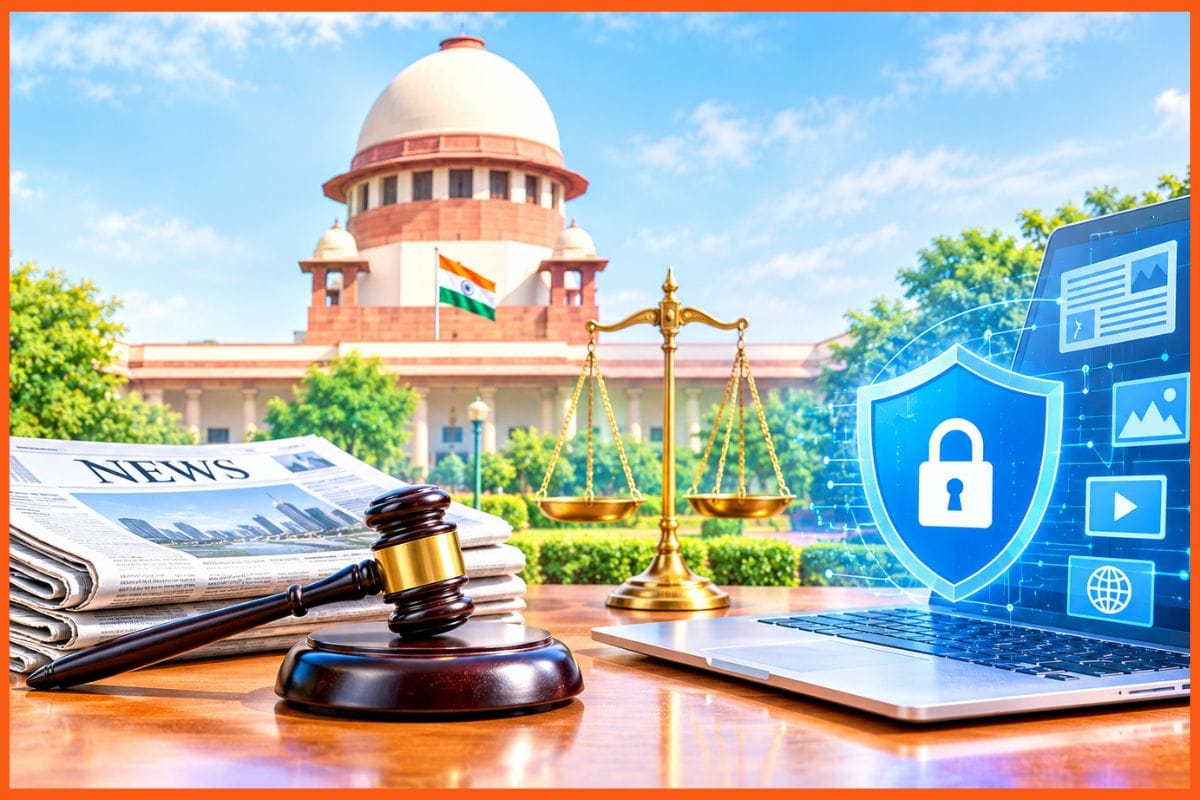
Supreme Court Seeks Response on DNPA Plea Regarding Digital Personal Data Protection Act
PTI, Oct 27, 2026, New Delhi : Newsrooms will shut down if journalists are made to seek permission before publishing information under the Digital Personal Data Protection (DPDP) Act and the DPDP Rules, the Digital News Publishers Association (DNPA) told the Supreme Court on Tuesday.
A bench comprising Chief Justice of India Surya Kant and Justices Joymalya Bagchi and V Mohana took note of the submissions and the petition of the DNPA comprising 21 digital news publishers, including companies owned by both the Ambani group and the Adani group, and issued notices to the Union ministries of Law and Justice, and Electronics and Information Technology (MeitY).
The matter has been listed for further hearing on November 17 along with pending ones. At the outset, senior advocate Madhavi Divan, appearing for DNPA, also urged the bench to consider the stay application, saying that the absence of an exemption for journalistic activities could fundamentally change how news is gathered and reported.
"This is perhaps the first comprehensive petition by what we call legacy media. There has been some debate over citizen journalists. We are the traditional, conventional legacy media," she said. The senior lawyer said that requiring journalists to seek permission from individuals before publishing information about them could undermine the functioning of newsrooms. She also raised concerns about the amendment to Section 8(1)(j) of the Right to Information (RTI) Act, which deals with the disclosure of personal information held by public authorities.
The absence of a journalistic exemption amounts to pre-censorship of the press and could have serious consequences for news coverage, she said. "We have raised the argument concerning exemptions as well. Otherwise, newsrooms will shut down if we have to ask for permission.
"It is a complete regime of pre-censorship. We have to ask your permission if we report on you. How can that ever be? What is news otherwise? If we report something wrong, incorrect or inaccurate, we must face the consequences," she said. Divan said earlier laws had excluded journalism and questioned why the exemption had not been retained.
"When the court examines this Act in detail, it will find that it was not meant for journalism at all. In fact, the earlier versions excluded journalism. We do not know why this has happened. Clearly, it was not meant for us," she said.
The plea sought striking down several provisions of the data protection law and its accompanying rules as unconstitutional, saying that the absence of an exemption for journalistic activities could seriously impede news reporting, undermine investigative journalism and compromise the confidentiality of sources. The plea sought direction declaring that "the substituted clause (g) of Section 8(1) of the Right to Information Act, 2005, which brought into force through Section 44(3) of the DPDP Act, 2023, is ultra vires the Constitution".
Several media organisations, including Network18 and NDTV, which are owned by the Ambani and the Adani groups respectively, are part of the DNPA and its members also include The Indian Express, Times Internet, The Hindu, India Today, Zee Media, ABP Pvt Ltd, Malayala Manorama, Mathrubhumi, Amar Ujala, Eenadu Television Pvt Ltd and others.
0 Response to "Supreme Court Seeks Response on DNPA Plea Regarding Digital Personal Data Protection Act"
Post a Comment
Disclaimer Note:
The views expressed in the articles published here are solely those of the author and do not necessarily reflect the official policy, position, or perspective of Kalimpong News or KalimNews. Kalimpong News and KalimNews disclaim all liability for the published or posted articles, news, and information and assume no responsibility for the accuracy or validity of the content.
Kalimpong News is a non-profit online news platform managed by KalimNews and operated under the Kalimpong Press Club.
Comment Policy:
We encourage respectful and constructive discussions. Please ensure decency while commenting and register with your email ID to participate.
Note: only a member of this blog may post a comment.