
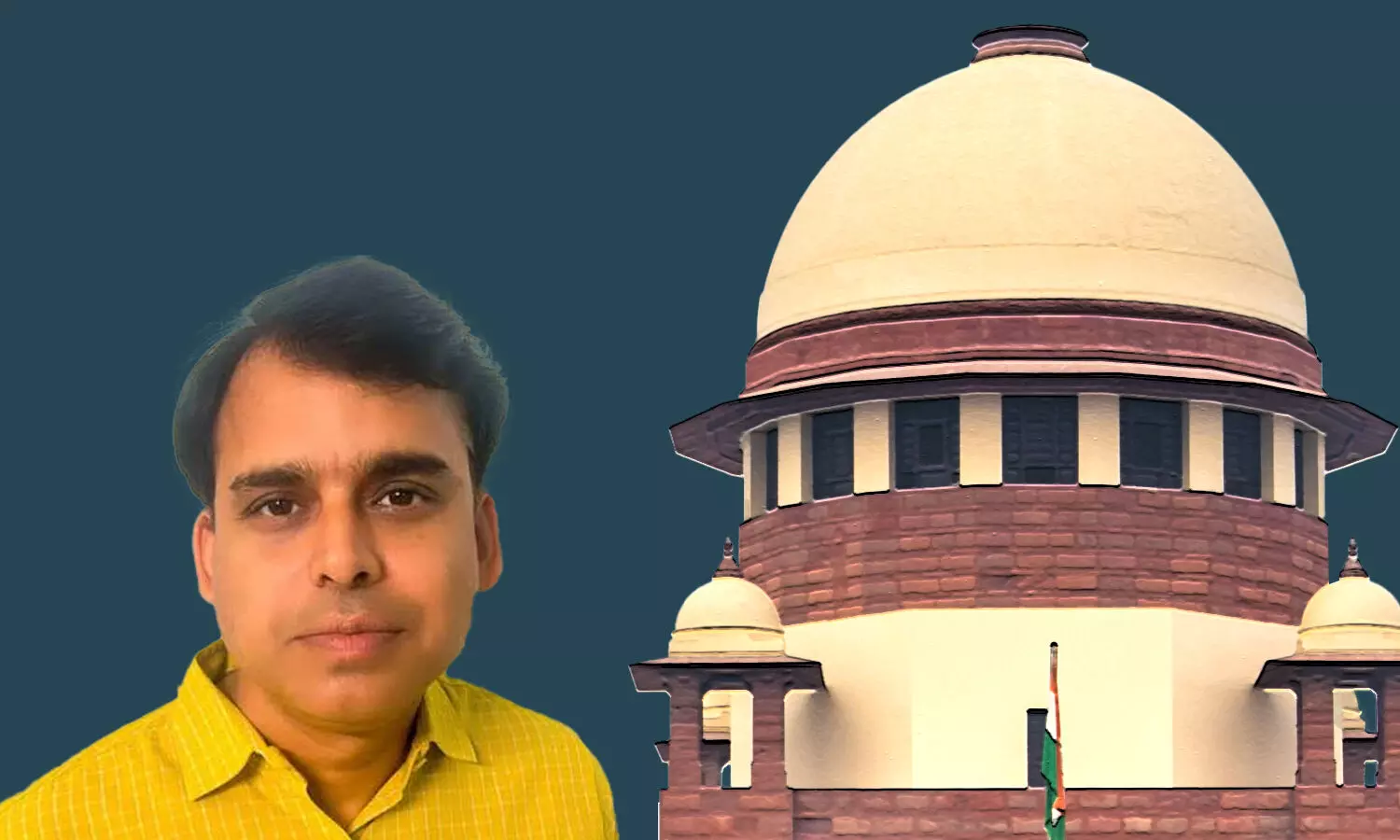
Supreme Court Makes Protection from Coercive Action Absolute for Journalist Abhishek Upadhyay
A Bench of Chief Justice of India Surya Kant and Justice Joymalya Bagchi quashed an August 22 notice issued by the Ghaziabad Police to social media platform X (formerly Twitter), seeking certain information and digital details of Upadhyay.
The Bench granted him liberty to challenge the FIR before the Allahabad High Court. It also granted him liberty to approach the court to seek mandatory guidelines for the collection of personal data by police during investigations.
The order came after senior counsel Pradeep Rai, appearing on behalf of Upadhyay, pointed out that although the FIR was lodged in August, the police had sought information from X dating back to June 1.
“You (police) have given them (X) notice to provide data from three months ago. That appears to be an overkill,” the Bench told the Uttar Pradesh counsel, making it clear that no confidential or personal data of the journalist could be obtained for the period preceding the alleged crime.
On August 25, the Supreme Court had granted interim protection from coercive action to Upadhyay.
Apprehending his imminent arrest, Upadhyay had moved the Supreme Court, challenging an FIR lodged against him by the Ghaziabad Police in connection with an alleged road rage incident.
Upadhyay, who runs a YouTube channel, alleged that a police team reached his residence late on August 20 and told him that a case had been registered at Indirapuram Police Station following allegations of road rage and abusive behaviour.
He alleged that the FIR was based on concocted allegations against him and that it was an attempt to harass him for his independent journalistic work.
The journalist contended that the FIR copy had not been supplied to him and that the police were forcing nearby shopkeepers to delete CCTV footage from the relevant period. He has sought the quashing of the FIR or, alternatively, the transfer of the investigation to an independent agency other than the Uttar Pradesh Police.
The FIR was lodged against Upadhyay in Ghaziabad over an alleged road rage incident, which he has claimed was fabricated in connection with his reporting on alleged corruption in Uttar Pradesh.
The alleged incident took place on August 18 near Shipra Mall in Ghaziabad, when a motorcyclist allegedly touched his car. He said the man subsequently called the police emergency helpline 112, and an FIR was registered later, he submitted.
Upadhyay alleged that the police team had visited his residence possibly to arrest him, and he requested the Ghaziabad Police to release CCTV footage of the alleged incident.
The petitioner submitted that he had previously reported on alleged irregularities in the handling of donations to the Ram Temple in Ayodhya and alleged corruption in the Uttar Pradesh Government.
0 Response to "Supreme Court Makes Protection from Coercive Action Absolute for Journalist Abhishek Upadhyay"
Post a Comment
Disclaimer Note:
The views expressed in the articles published here are solely those of the author and do not necessarily reflect the official policy, position, or perspective of Kalimpong News or KalimNews. Kalimpong News and KalimNews disclaim all liability for the published or posted articles, news, and information and assume no responsibility for the accuracy or validity of the content.
Kalimpong News is a non-profit online news platform managed by KalimNews and operated under the Kalimpong Press Club.
Comment Policy:
We encourage respectful and constructive discussions. Please ensure decency while commenting and register with your email ID to participate.
Note: only a member of this blog may post a comment.