
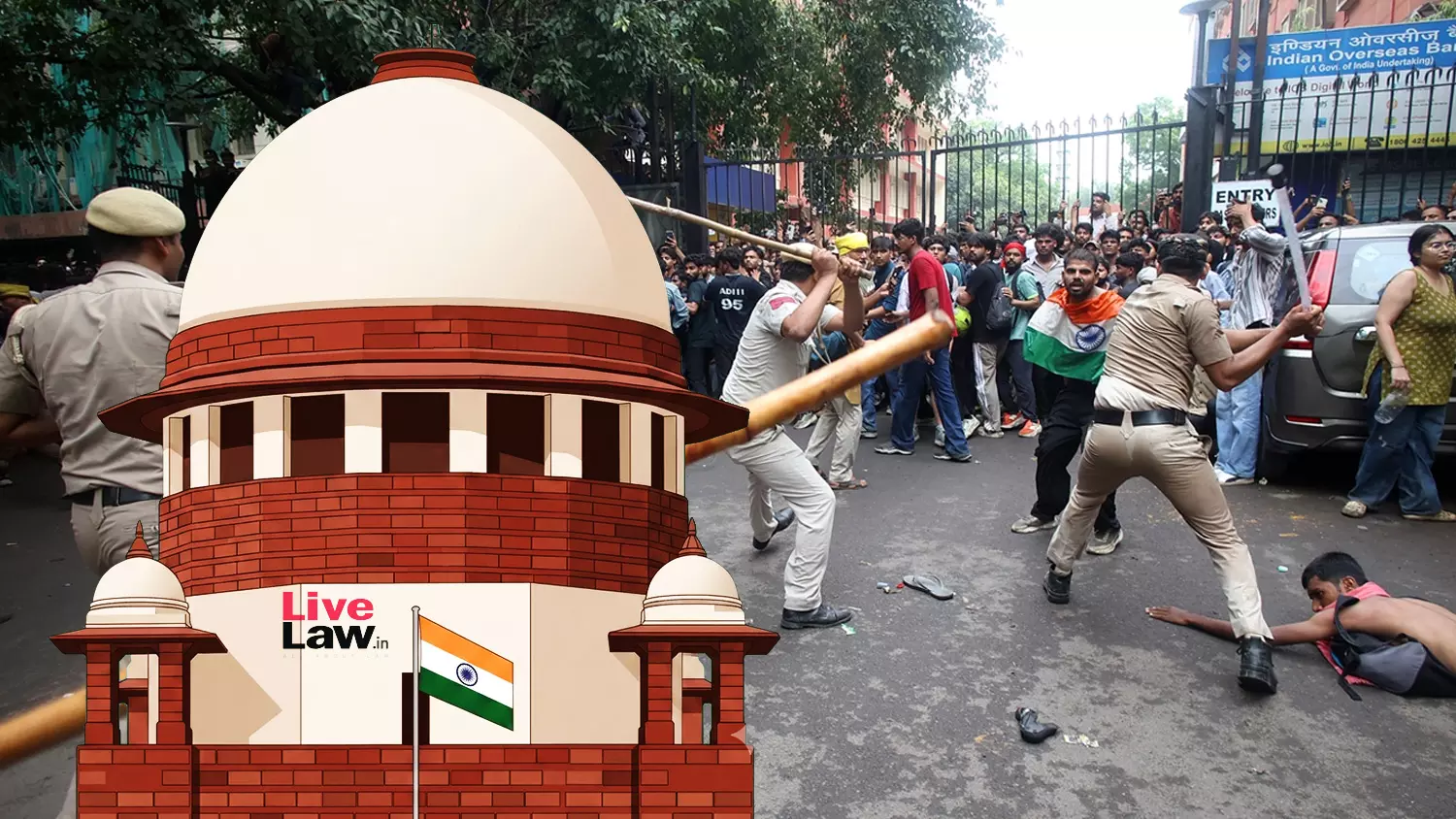
Supreme Court Clarifies States May Withdraw FIRs Against Student Protesters, Except in Serious Criminal Cases
The clarification was issued on Monday by a three-judge Bench headed by Chief Justice of India Surya Kant, along with Justice Joymalya Bagchi and Justice V. Mohana. The Bench modified its earlier order of July 28, explaining that the phrase "criminal antecedents" should be interpreted only as referring to individuals accused of serious and heinous crimes, and not those involved in minor or routine legal violations.
The Court observed that state governments are legally empowered to withdraw or close cases against student protesters wherever appropriate. It further clarified that only those accused of grave criminal offences should remain outside the scope of this relief.
The clarification came after senior advocates, including Gopal Sankaranarayanan and Abhishek Manu Singhvi, argued that the expression "criminal antecedents" in the earlier order was being interpreted too broadly. According to the petitioners, authorities were continuing criminal proceedings against students even when their previous records consisted only of minor offences, such as traffic violations or insignificant legal disputes. The Supreme Court accepted these concerns and made it clear that such minor matters should not be treated as criminal antecedents for the purpose of its earlier order.
Representing the Union Government, Solicitor General Tushar Mehta informed the Court that the Centre had already decided not to pursue criminal cases against protesting students except in instances involving serious criminal backgrounds. However, he sought clarity on whether such FIRs should be formally withdrawn by the governments or quashed through judicial proceedings.
During the hearing, senior advocate Shyam Divan, appearing for some of the petitioners, proposed that a former Chief Justice of India should be appointed to supervise the ongoing investigation. Responding to the suggestion, the Bench stated that it was considering two alternatives—either constituting a Special Investigation Team (SIT) comprising senior police officers or creating an independent committee headed by a retired judge to oversee the investigation.
The hearing also addressed concerns regarding the alleged use of pellet guns during the demonstrations near Jantar Mantar in New Delhi. Raising the issue, advocate Vrinda Grover urged the Court to examine the conduct of law enforcement agencies. The Bench responded by stating that it intends to establish a comprehensive protocol clearly defining the circumstances and procedures governing the use of pellet guns during public protests.
Senior advocate N. Hariharan also questioned the reported use of biometric surveillance and facial recognition technology by police authorities, arguing that such measures infringed upon the constitutional right to privacy of peaceful protesters.
Another serious allegation was placed before the Court by senior advocate Colin Gonsalves, who claimed that an advocate had been assaulted inside Delhi's Nizamuddin Police Station while attempting to meet detained protesters. Addressing the concern, Chief Justice Surya Kant remarked that police officers accused of using excessive force should not receive unwarranted protection. At the same time, he emphasized that individuals involved in serious criminal activities should not escape legal accountability merely by participating in a student protest.
After hearing all parties, the Supreme Court directed the Centre and the concerned state governments to submit their responses and scheduled the next hearing for August 18.
Meanwhile, the Cockroach Janata Party (CJP) welcomed the Supreme Court's clarification and urged the Central Government as well as BJP/NDA-ruled state governments to honour the assurances made to student protesters on July 25.
In an official statement, CJP chief spokesperson Saurav Das said the Court's clarification had removed all uncertainty surrounding the issue of FIRs. He stated that the protesting youth had fulfilled their responsibilities peacefully and responsibly, and it was now time for governments to implement their commitments fully and sincerely.
The party reiterated that it had supported students from the very beginning of the movement by providing legal assistance, medical aid, and other humanitarian support within its capacity. It also expressed gratitude to lawyers across the country who continued to represent and assist students facing legal proceedings arising from the protests.
According to the CJP, the party remains in close contact with senior representatives of the Union Government and is carefully monitoring developments across different states. It expressed confidence that the assurances made to students would now be implemented promptly following the Supreme Court's latest clarification.
The Court's observations are expected to have far-reaching implications for thousands of students who participated in demonstrations demanding accountability over the alleged NEET examination paper leak. While the judiciary has reaffirmed that peaceful protesters should not face unnecessary criminal prosecution, it has simultaneously made it clear that those accused of grave and heinous offences will continue to face legal action in accordance with the law.
0 Response to "Supreme Court Clarifies States May Withdraw FIRs Against Student Protesters, Except in Serious Criminal Cases"
Post a Comment
Disclaimer Note:
The views expressed in the articles published here are solely those of the author and do not necessarily reflect the official policy, position, or perspective of Kalimpong News or KalimNews. Kalimpong News and KalimNews disclaim all liability for the published or posted articles, news, and information and assume no responsibility for the accuracy or validity of the content.
Kalimpong News is a non-profit online news platform managed by KalimNews and operated under the Kalimpong Press Club.
Comment Policy:
We encourage respectful and constructive discussions. Please ensure decency while commenting and register with your email ID to participate.
Note: only a member of this blog may post a comment.