
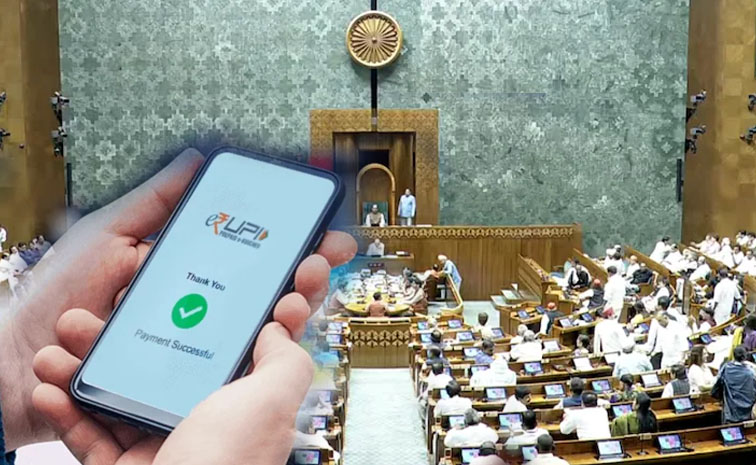
Lok Sabha Passes Bill Allowing Government to Notify Charges on Certain Digital Payment Modes
The amendment, passed by the House without discussion amid din, seeks to remove the existing legal provision that prevents banks and payment service providers from charging Merchant Discount Rate (MDR) on notified electronic payment modes.
Real-time payments made through RTGS and NEFT are done by paying a service charge.
However, UPI transactions have been exempted from such charges so far.
The proposed changes in the Payment and Settlement Systems Act are a part of comprehensive legislation on taxation, which was introduced in the House on Tuesday.
The Bill was passed through a voice vote in the Lok Sabha after the House resumed at 2 pm following the earlier adjournment.
As soon as the House reassembled, Finance Minister Nirmala Sitharaman moved the Taxation and Other Laws (Amendment) Bill, 2026, further to amend the Payment and Settlement Systems Act, 2007, and the Income Tax Act, 2025, and to amend the Finance Act, 2026, to be taken into consideration.
The government's approach aims to levy a small charge on digital payment services for consumers and small businesses while ensuring a sustainable revenue model for banks, payment service providers (PSPs), and payment infrastructure firms that drive the digital payments ecosystem.
"In the Payment and Settlement Systems Act, 2007, in Section 10A, for the words, figures and letters 'the electronic modes of payment prescribed under section 269SU of the Income-tax Act, 1961', the words 'one or more electronic modes of payment as the central government may, by notification, specify' shall be substituted with effect from the date of publication of this Act in the Official Gazette," the Bill said.
Section 10A of the Payment and Settlement Systems Act, 2007, prohibits banks and system providers from imposing any charges on electronic payments, while Section 269SU of the Income Tax Act requires large businesses with a turnover exceeding Rs 50 crore to accept payments through specific electronic modes, including RuPay debit cards and BHIM-UPI QR codes.
As on date, no bank or payment system provider could impose any charge upon anyone, either directly or indirectly, for using the electronic modes of payment prescribed under Section 269SU of the Income Tax Act, 1961.
Speaking on the issue, RBI Governor Sanjay Malhotra on Wednesday said it is "premature" to talk about MDR on payments through digital means.
Investment in public infrastructure like payments is necessary, he said, reiterating that someone will have to pay for it.
"The choices before us are simple: either the general public has to pay for it through taxes, or we have to levy the Merchant Discount Rate (MDR), following the 'user pays' model.
"Right now the government is getting us the amendment. Costs have to be paid by someone. We all want this public infrastructure to strengthen and become more efficient, etc. We continue to do that. That is our focus right now; let us wait and watch for further developments," Malhotra said.
0 Response to "Lok Sabha Passes Bill Allowing Government to Notify Charges on Certain Digital Payment Modes"
Post a Comment
Disclaimer Note:
The views expressed in the articles published here are solely those of the author and do not necessarily reflect the official policy, position, or perspective of Kalimpong News or KalimNews. Kalimpong News and KalimNews disclaim all liability for the published or posted articles, news, and information and assume no responsibility for the accuracy or validity of the content.
Kalimpong News is a non-profit online news platform managed by KalimNews and operated under the Kalimpong Press Club.
Comment Policy:
We encourage respectful and constructive discussions. Please ensure decency while commenting and register with your email ID to participate.
Note: only a member of this blog may post a comment.