

Devastating Nepal Flash Flood Leaves Hundreds Missing, Including 105 Indians; India Offers Full Relief Support
26 Aug 2026
Comment

KalimNews, Aug 26, 2026, Kathmandu: A devastating flash flood swept through Nepal’s northern Rasuwa district near the Tibet border on Wednesday, sending a massive surge of water through the Bhote Koshi River and causing widespread destruction across villages, roads, bridges, hydropower facilities and other critical infrastructure.
According to the Nepal Tourism Board’s preliminary assessment, 384 travellers—including 291 foreign nationals and 93 Nepali nationals—have been reported missing or remain unaccounted for following the disaster. Among the foreign nationals are 105 Indians, along with travellers from the United States, United Kingdom, Malaysia, South Africa, Australia and the Netherlands. The Tourism Board has stressed that the figures are preliminary and that authorities are still working to verify the whereabouts and safety of those listed.
The disaster struck in the Rasuwa district, particularly around the Timure and Syapru Besi areas, after the Bhote Koshi River suddenly surged at around 8:30–9 a.m. local time. The flooding also affected neighbouring areas, including parts of Nuwakot and Dhading. Roads and bridges were swept away, settlements were inundated, communications were disrupted and several hydropower projects sustained serious damage.
Early reports indicated a lower death toll, but the number of confirmed casualties has continued to change as rescue teams reach areas that were initially inaccessible. Later reports put the number of deaths at more than 30, while hundreds remain unaccounted for. Authorities have warned that the death toll could rise further as search-and-rescue operations continue. Because the situation is developing rapidly, casualty figures should be treated as provisional until officially confirmed.
The disaster has also caused major concern for foreign travellers, particularly those travelling toward Kailash Mansarovar and Gosainkunda. The Nepal Tourism Board said its initial list was compiled from information provided by 10 tourism and travel agencies. Officials, tourism authorities, guides, travel companies, police and security agencies are now working to establish the whereabouts of those who have lost contact with their families and tour operators. 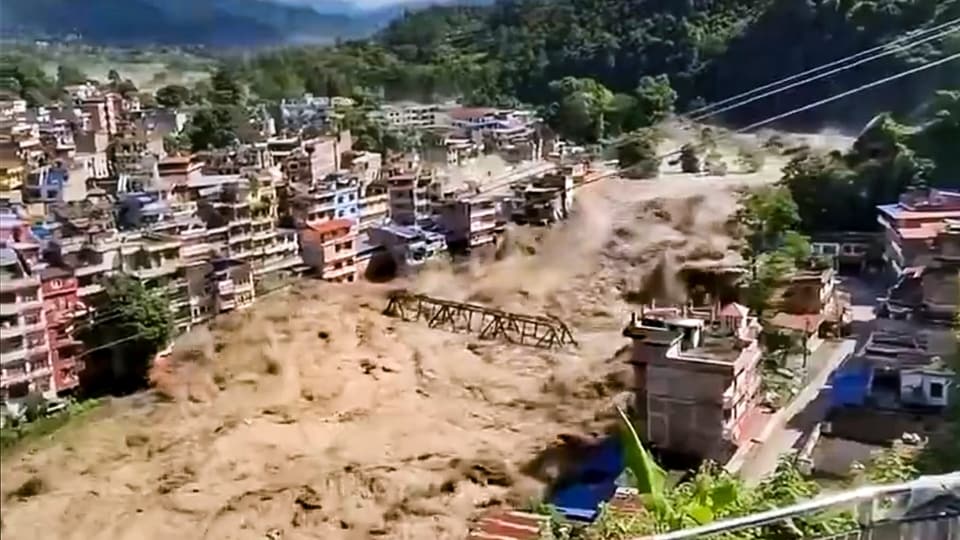
Among the 384 people initially listed as unaccounted for, the preliminary breakdown includes 291 foreign nationals and 93 Nepali nationals. India accounts for the largest number of foreign nationals, with 105 Indians listed, including non-resident Indians. The list also includes citizens of the United Kingdom, United States, Malaysia, South Africa, Australia and the Netherlands. Authorities have cautioned families against drawing conclusions from the preliminary list because some people may simply be unable to communicate due to the widespread loss of electricity, mobile networks and road access.
The disaster has prompted an urgent response from both Nepal and neighbouring countries. Indian Prime Minister Narendra Modi spoke with Nepal’s Prime Minister Balendra Shah and expressed condolences over the loss of life, while offering India’s full humanitarian and relief assistance to Nepal. India has indicated that it is prepared to provide whatever assistance is required as rescue and relief operations continue.
The Indian Embassy in Kathmandu has also issued emergency contact numbers for Indian nationals and their families seeking information about people affected by the floods. The reported emergency numbers are +977 985 131 6807 and +977 970 910 7500. The Nepal Tourism Board has separately provided its toll-free number 1234, hotline 1144, and Tourist Police number 9851289445 for assistance.
 |
| A CCTV footage shows people running away as wall of mud and water destroys buildings in a valley at Nepal-China border, in Gyirong, Tibet region, China, on August 26. Social Media/UGC/Reuters |
The scale of destruction has made rescue operations extremely difficult. Roads leading to the affected areas have been washed away or blocked by debris, while dangerous river conditions and unstable terrain have restricted access. Helicopters have been deployed, but strong winds, mountainous terrain, poor visibility and the continuing threat from floodwaters have made aerial rescue operations challenging. Nepal’s army and police have joined the search, with security personnel and other emergency responders working alongside local authorities.
Dramatic footage released by the Nepali Army and verified by international media shows people being rescued from rooftops and muddy areas. In some cases, survivors were winched from buildings or climbed into helicopters after attracting the attention of rescue aircraft. Several rescued people appeared to have suffered injuries and were covered in mud following the force of the floodwaters.
Security-camera footage has also captured the terrifying speed and power of the flood as water rushed through settlements near the Nepal-China border. People could be seen running from the approaching torrent while water and debris swept through areas in its path.
Verified video footage from the Trishuli Bazaar area of Nuwakot District in Bagmati Province, about 25 kilometres northwest of Kathmandu, has shown the Trishuli River suddenly swelling with enormous quantities of sediment-filled water. In one recording, the force of the flood tore a bridge from its supports and carried it downstream. Moments later, several nearby buildings collapsed under the pressure of the water. A second video from the same area showed the aftermath, with trees and buildings along the riverbank either destroyed, partially collapsed or covered in thick layers of sediment.
 |
| Mud covers a property following a flash flood at Trishuli in Nuwakot district, Nepal, August 26. Navesh Chitrakar/Reuters |
The human impact has been devastating for families and businesses in the region. Yee Liang, a Chinese businessman based in Kathmandu, told the BBC that his logistics company had seven container trucks in the affected area, operated by Nepali employees. He said the company had lost contact with all of them because there was no functioning signal in the area. He described the disaster as far more serious than the occasional landslides and mudslides that normally occur during Nepal’s rainy season.
Nepal Army spokesman Rajaram Basnet said rescue efforts were also under way to reach people in the village of Mailung. Nepal’s Ministry of Home Affairs warned of a potentially very high loss of life in Timure, Syabrubesi and Betrawati, while flooding also damaged the Trishuli hydropower project.
The disaster has had a particularly serious impact on Nepal’s hydropower infrastructure. At least a dozen hydropower projects have reportedly been damaged, while initial reports indicated that the destruction could affect a significant portion of Nepal’s electricity-generating capacity. The affected region is home to several hydropower projects that seek to harness the powerful rivers flowing through the Himalayan landscape.
60 Missing
One particularly alarming development concerns the 20-megawatt Langtang Khola Hydroelectric Project in Rasuwa. Nepal’s national news agency RSS reported that 60 employees working at the under-construction project were missing after the flood. The workers had reportedly been carrying out concrete construction inside a tunnel when the disaster struck, causing severe damage to the project site.
 |
| A flooded road following a flash flood in Galchhi in the Dhading district, Nepal, on Wednesday. Stringer/Reuters |
The causes of the sudden flood remain under investigation. Nepal’s Foreign Minister Shishir Khanal told parliament that an earthquake occurred at approximately 8:37 a.m. local time and that it may have triggered a large landslide or avalanche that blocked a river, ultimately causing a sudden release of water into the Bhote Koshi system. The United States Geological Survey recorded a magnitude 4.4 earthquake in the region at approximately the same time.
Scientists are also examining whether an ice-rock avalanche may have blocked the Lhende Khola River, allowing water to accumulate behind the blockage before suddenly bursting downstream into the Bhote Koshi River. Kathmandu University professor and climate researcher Rijan Bhakta Kayastha said this was part of a preliminary assessment based on discussions with scientists in Nepal and China. He also noted that the earthquake occurred on the Tibetan side around the same time. These explanations remain subject to further scientific investigation.
The floodwater reportedly came from the Tibet side and surged into Nepal through the Bhote Koshi River, affecting Rasuwa and other downstream districts. The disaster also caused serious disruption on the Chinese side of the border. Chinese state media reported significant impacts in Tibet, including damage around Gyirong County and the Gyirong border port, while officials warned of potentially major casualties. The full extent of the damage and loss of life on the Tibetan side remains unclear.
Chinese President Xi Jinping has ordered an intensive search-and-rescue operation for people missing after the disaster and directed authorities to strengthen emergency response efforts. Chinese authorities have mobilised rescue personnel and prepared emergency supplies, including tents, heating equipment, clothing and bedding, for affected communities.
The Red Cross has also activated an emergency response. Its regional office said emergency teams and volunteers were being mobilised in Nepal and relief supplies were being sent to affected areas. The International Federation of Red Cross and Red Crescent Societies has said it is prepared to support the response as necessary. The organisation has urged communities to remain alert and follow official safety instructions.
Nepal’s Prime Minister Balendra Shah has urged people living along rivers and in vulnerable areas to exercise extreme caution. Following an emergency meeting, he said that police and military personnel were joining rescue teams and that necessary steps were being coordinated with medical teams, scouts and the Red Cross.
Nepal’s Foreign Minister also told parliament that 26 police personnel, nine armed police officers and 44 members of the military were among those missing in the disaster. The loss of communication and the destruction of roads and bridges have made it difficult to establish the exact whereabouts of many people.
The disaster has also raised concerns downstream in India, particularly in Bihar and Uttar Pradesh, because several major rivers originating in or flowing through Nepal—including the Gandak, known as the Narayani in Nepal, and the Kosi—flow into Bihar.
Bihar authorities have placed vulnerable districts on heightened alert over the possibility of a sudden increase in the Gandak River’s water level. The state government’s Disaster Management Department warned that a flood wave of up to approximately three metres could enter the Gandak system, prompting officials to strengthen preparedness measures.
A high-level review meeting chaired by Bihar Chief Secretary Pratyaya Amrit brought together district magistrates and senior police officials from border and vulnerable districts. Authorities in West Champaran, East Champaran, Gopalganj, Saran, Muzaffarpur and Vaishali, along with other vulnerable districts including Sitamarhi and Sheohar, have been instructed to maintain close surveillance.
Officials have been directed to monitor the water levels of the Gandak and other rivers, embankments, low-lying areas, bridges and other vulnerable locations and to warn communities in advance if conditions deteriorate. The state has also prepared for the deployment of National Disaster Response Force teams, with additional teams and resources to be mobilised if required.
District administrations have been instructed to keep evacuation plans, boats, shelters and community kitchens ready. Authorities have also been asked to monitor the Gandak barrage, canals, embankments and other water-related infrastructure.
People have been urged not to panic but to remain vigilant, follow official advisories and avoid spreading rumours or unverified information. District administrations have been directed to conduct regular media briefings and monitor social media platforms to help prevent misinformation during the emergency.
The Nepal disaster comes after a deadly flood in the same broader region last year, when flooding following a glacial event on the Chinese side of the border killed 18 people. Officials have indicated that the scale of Wednesday’s disaster may be even greater, underscoring the continuing vulnerability of Himalayan communities to sudden floods, landslides, avalanches and other natural hazards.
As rescue operations continue on both sides of the Nepal-Tibet border, authorities are facing the difficult task of reaching isolated communities, identifying missing people, restoring communications and assessing the enormous damage to homes, roads, bridges and power infrastructure. The Nepal Tourism Board, Tourist Police, local administration, security agencies, travel companies and guides are continuing efforts to verify the status of the missing travellers.
The situation remains fluid, and the numbers of dead, missing and rescued are expected to change as search teams gain access to previously isolated areas. Families of missing travellers are being urged to rely on official information and emergency channels rather than unverified posts circulating on social media.
For travellers and their families, the immediate priority remains establishing contact and confirming safety. For Nepal, the wider challenge will be restoring damaged infrastructure and supporting communities whose homes, livelihoods and essential services have been devastated by one of the most severe flash-flood disasters to hit the region in recent years.
The disaster is a stark reminder of the extraordinary risks faced by communities and travellers in the Himalayan region, where steep terrain, rapidly changing weather, unstable slopes, earthquakes, ice and snow hazards, and powerful river systems can combine to produce catastrophic flooding with little warning.
KalimNews will continue to follow developments as Nepalese, Indian and international authorities continue search, rescue, relief and rehabilitation efforts. Readers are encouraged to share only verified information, avoid spreading rumours, and follow official instructions during the ongoing emergency. Compiled from PTI, BBC, The Hindustan Times
0 Response to "Devastating Nepal Flash Flood Leaves Hundreds Missing, Including 105 Indians; India Offers Full Relief Support"
Post a Comment
Disclaimer Note:
The views expressed in the articles published here are solely those of the author and do not necessarily reflect the official policy, position, or perspective of Kalimpong News or KalimNews. Kalimpong News and KalimNews disclaim all liability for the published or posted articles, news, and information and assume no responsibility for the accuracy or validity of the content.
Kalimpong News is a non-profit online news platform managed by KalimNews and operated under the Kalimpong Press Club.
Comment Policy:
We encourage respectful and constructive discussions. Please ensure decency while commenting and register with your email ID to participate.
Note: only a member of this blog may post a comment.