
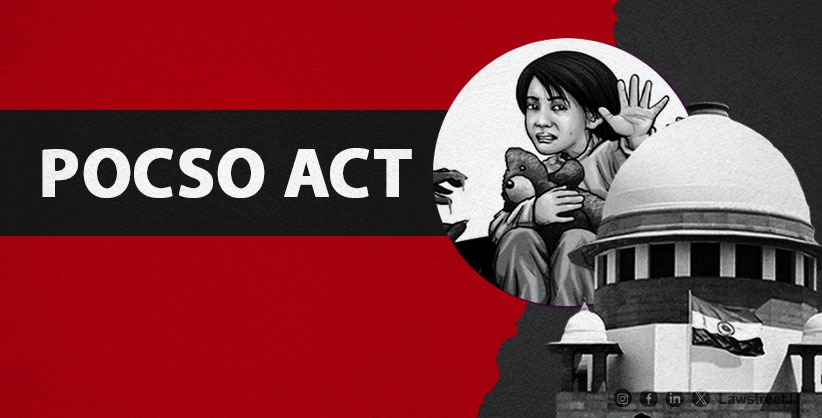
Supreme Court Clarifies Duty to Report Information Shared by Minor Victims Under POCSO Act
A bench of Justices Manoj Misra and KV Viswanathan, which interpreted the question as to when can it be said that a person has knowledge that an offence under the POCSO Act has been committed, noted that the phrase "has knowledge that such an offence has been committed" is not limited to direct knowledge, but would include awareness of its commission based on direct information received from the minor victim.
The bench interpreted the question arising from a Prevention of Children from Sexual Offences Act (POCSO) case related to a school in Arunachal Pradesh, where an eight-year-old girl reported about the sexual assault allegedly by a senior school boy to her teachers, elder sister and classmates.
The bench said there may be instances where a child may report without understanding the nature of the act to which the child has been subjected.
"In such cases, and also where the information provided by the child is either not clear or confusing, a brief questioning of the child may be justified to derive a lucid picture of the nature of the information which the child wishes to convey. However, such questioning should not be with a view to rubbish the complaint made by the child, rather it must be to understand the true and correct nature of the complaint," it said.
The top court set aside the order of the Gauhati High Court and the trial court, which discharged the teachers and the headmistress from the offences under the POCSO Act regarding omission to furnish information regarding commission of the offence, causing disappearance of evidence of the offence, conspiring not to disclose the incident to anyone, and for failing to report the commission of a cognisable offence.
It said that the expression 'knowledge' is not defined in either the POCSO Act or any of the Codes/Acts, and even the General Clauses Act, 1897 does not define it.
Therefore, a contextual meaning of the word 'knowledge', which serves the avowed purpose of the Act, would have to be ascertained, the bench said.
"In light of the discussion above, in our considered view, to serve the avowed purpose of the POCSO Act, the phrase 'has knowledge that such an offence has been committed', as used in sub-section (1) of Section 19, would have to be construed as to include awareness based on the receipt of credible information with regard to commission of an offence punishable under the Act. And where such information is received directly from the victim, who is capable of communicating/reporting/informing, it will be deemed credible," the bench said.
Dealing with the case, the bench added that the high court and the trial court fell in error in holding that as there were no noticeable signs of sexual assault, there was no reason to believe that such an offence had been committed; therefore, the accused were not under a legal obligation to report.
"However, not all teachers or office-bearers of the institution need to be prosecuted for the offence punishable under Section 21 of the Act. Only those who received information directly from the victim, of her being subjected to sexual assault, could be prosecuted for failure to report," it said.
The bench noted that the victim had imparted information about the incident to as many as four persons, namely, her elder sister, her friend, the head girl, and a teacher.
The top court said the victim's sister, the victim's friend and the head girl of the institution are not liable to be prosecuted for an offence punishable under the POCSO Act as they were minors.
While partially allowing the appeal filed by the mother of the victim, challenging the high court order, the top court said qua the teacher, the police report had sufficient material to create grave suspicion against her for the purposes of framing charge of an offence punishable under Section 21 of the POCSO Act and Section 176 of the IPC, and therefore, she was not entitled to be discharged.
0 Response to "Supreme Court Clarifies Duty to Report Information Shared by Minor Victims Under POCSO Act"
Post a Comment
Disclaimer Note:
The views expressed in the articles published here are solely those of the author and do not necessarily reflect the official policy, position, or perspective of Kalimpong News or KalimNews. Kalimpong News and KalimNews disclaim all liability for the published or posted articles, news, and information and assume no responsibility for the accuracy or validity of the content.
Kalimpong News is a non-profit online news platform managed by KalimNews and operated under the Kalimpong Press Club.
Comment Policy:
We encourage respectful and constructive discussions. Please ensure decency while commenting and register with your email ID to participate.
Note: only a member of this blog may post a comment.