
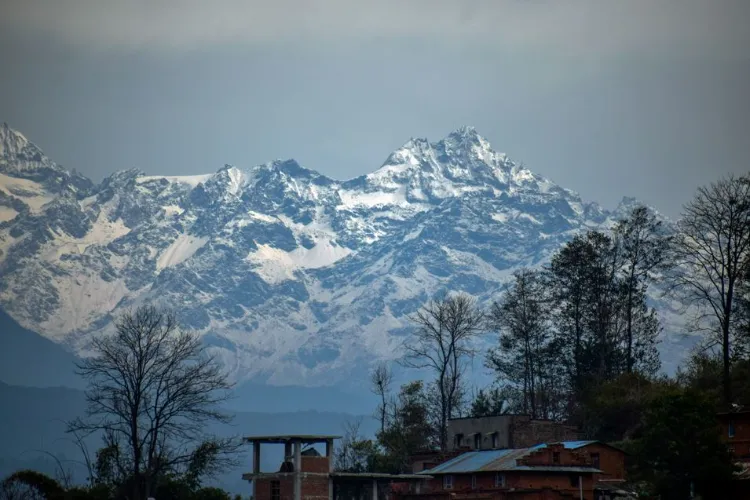
Study suggests Himalayan snowfall may be higher than previous estimates
Researchers, including those from the British Antarctic Survey, the UK Met Office and the Indian Institute of Technology, Kharagpur, said Himalayan snowfall has been miscalculated for years and that the study provides improved estimates of snowfall across the west-central Himalayas.
Snowfall, a vital source of freshwater and a key component of the terrestrial water budget, is difficult to measure in mountains owing to the complexities of the terrain, they said.
The study, published in the journal Monthly Weather Review, tackles the difficulties by using frozen lakes at high altitudes as naturally occurring pressure sensors for monitoring snowfall across sites in the west-central Himalayas, among other mountainous terrains.
The team installed commercially available water-pressure sensors at three lakes—Ghepan and Hampta in the western Himalayas, and Mugu in Nepal.
“Unlike conventional instruments, these sense the whole lake surface—an area of thousands to billions of square metres—to measure the timing and intensity of snowfall,” author Siddharth Gumber, a mountain climate scientist with the British Antarctic Survey, explains in an article for The Conversation.
Based on the Archimedes principle of displacement, the instruments use water pressure in lakes to directly measure the mass of accumulating snow, “providing an accurate and unbiased estimate of snowfall”, Gumber said.
Results from the study show that the model can generally reproduce both when the snow falls and how much accumulates, and is particularly good at representing extreme snowfall events, he said.
“The results show that the model can accurately simulate both the timing and amounts of the snowfall observations and can effectively be used for the generation of long-term snowfall products,” the authors wrote in the study.
Understanding when snow falls could be crucial for predicting melt and how much water will flow into rivers, helping communities and policymakers better prepare for water shortages, Gumber said in the article.
The mountain climate scientist added that while it is time to reassess reliance on mountain water supplies—as the region is starting to see more water shortages—how much water the mountains provide and how it changes remain “remarkably uncertain”.
“Good measurements of snowfall are now more important than ever for predicting the future of water resources, which until now have been lacking,” Gumber said.
0 Response to "Study suggests Himalayan snowfall may be higher than previous estimates"
Post a Comment
Disclaimer Note:
The views expressed in the articles published here are solely those of the author and do not necessarily reflect the official policy, position, or perspective of Kalimpong News or KalimNews. Kalimpong News and KalimNews disclaim all liability for the published or posted articles, news, and information and assume no responsibility for the accuracy or validity of the content.
Kalimpong News is a non-profit online news platform managed by KalimNews and operated under the Kalimpong Press Club.
Comment Policy:
We encourage respectful and constructive discussions. Please ensure decency while commenting and register with your email ID to participate.
Note: only a member of this blog may post a comment.