
Hunger Strikes Remain a Powerful Tradition in India's Democratic Protest History
From a few days to 16 years, the many hunger strikes of varying scale buried under the sands of time have tugged at the heartstrings of a nation that takes pride in its legacy of fasting against injustice as a protest tool.
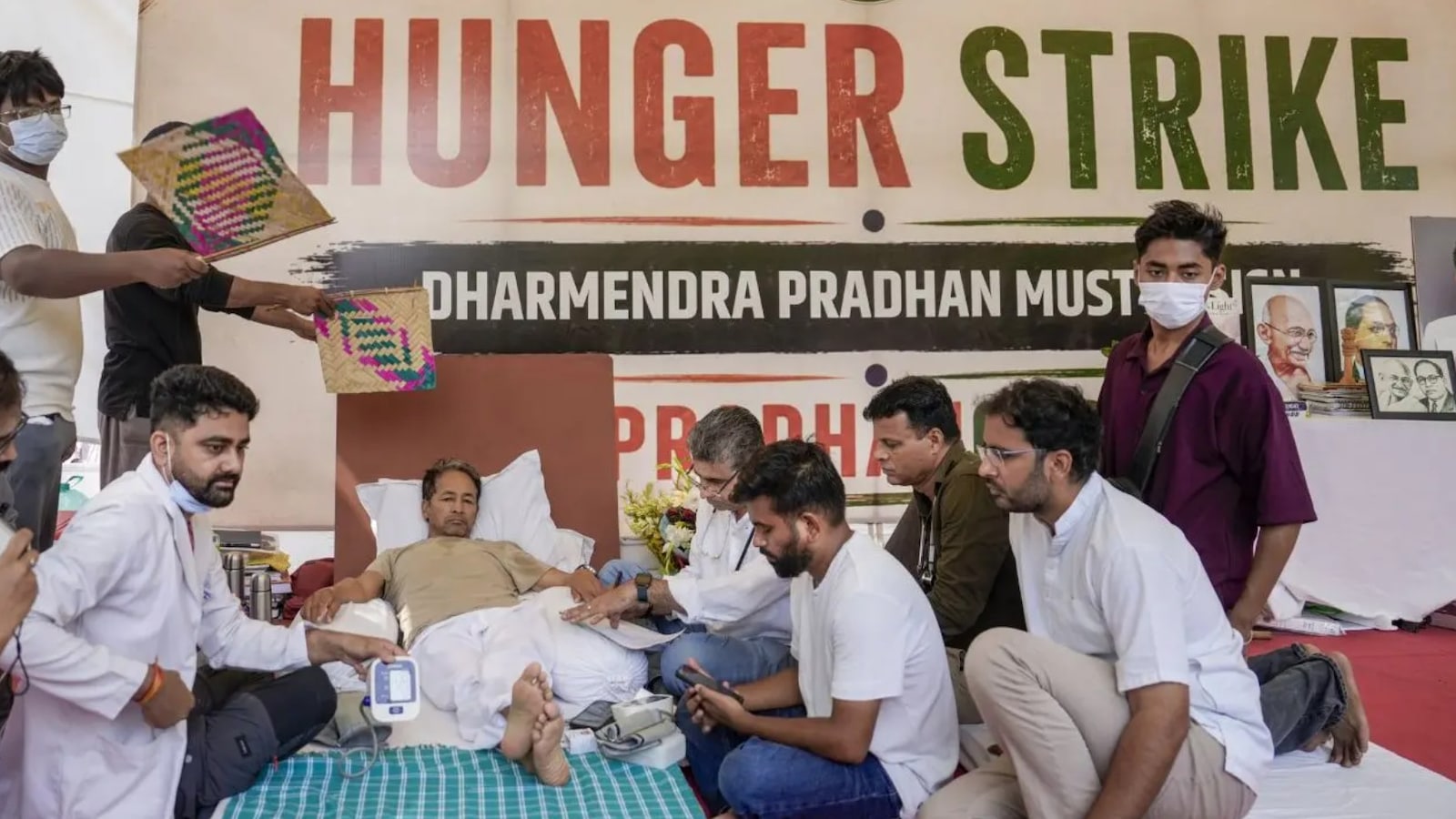
As Wangchuk's strike, in solidarity with the Cockroach Janata Party (CJP) over alleged irregularities in the examination system, entered day 20 on Friday, attention swivelled to Delhi's Jantar Mantar, where hundreds have been gathering to express their support for him and other students fasting with him.
Wangchuk's fast unto death lies on the bedrock of hunger strikes throughout contemporary Indian history, starting with Mahatma Gandhi and including Irom Sharmila, who abstained from food for 16 years in protest against the Armed Forces (Special Powers) Act (AFSPA) and holds the record for the longest hunger strike anywhere in the world.
"...a fast which a votary of non-violence sometimes feels impelled to undertake by way of protest against some wrong done by society, and this he does when he as a votary of Ahimsa has no other remedy left. Such an occasion has come my way."
Gandhi, one of the strongest proponents of fasting as a form of protest, wrote this ahead of the last of his 18 fasts on January 13, 1948, from Birla House for the restoration of communal peace across the nation. Two weeks later, he was assassinated at the same place.
"I never like to feel resourceless, a Satyagrahi never should. Fasting is his last resort in the place of the sword — his or others," he wrote in Harijan.
The Father of the Nation undertook 18 fasts for various reasons, starting with a seven-day fast in Phoenix, South Africa, as penance for the inmates, followed by another day-long fast at the ashram for similar reasons.
The longest of his fasts lasted 21 days, including those for Hindu-Muslim unity, against untouchability and detention by the British without charges.
Gandhi's idea of the hunger strike found resonance among his followers, most prominently with freedom fighter Potti Sreeramulu.
The staunch Gandhian played a pivotal role in the creation of Andhra State. He started fasting in October 1952, demanding a separate state for Telugu speakers, something that Prime Minister Jawaharlal Nehru had resisted.
On the 58th day, he died.
The region erupted in violent protests, forcing the government to carve out the territory that later became Andhra Pradesh.
In death, Sreeramulu managed to change the country's map through the sheer resolve of a hunger strike.
According to Ajay Gudavarthy, Associate Professor of Political Science at Jawaharlal Nehru University (JNU), Gandhi's understanding of fasting went beyond seeing it merely as a means of putting pressure on the government.
"...he also saw it as a sense of self-purification to make one's own intentions clear. And he thought that arguments don't make intentions clear. The preparedness for suffering does. Fasting was that kind of a self-purificatory act to express one's purity of one's own intent," Gudavarthy told PTI.
In pre-Independence India, the names of Bhagat Singh, Batukeshwar Dutt and Jatindra Nath Das are remembered for leading a hunger strike in 1929 to improve prison conditions while they were imprisoned in connection with the killing of John Saunders.
They demanded to be treated as political prisoners and sought equality in food standards, clothing, toiletries, and access to books and newspapers. The protest received support from Jawaharlal Nehru and Mohammed Ali Jinnah.
After 63 days, and despite many attempts by the British government to break their resolve, Das died after prolonged starvation.
Bhagat Singh ended his fast after 116 days, but not before securing significant prison reforms for other Indian prisoners.
"It's very well recorded Bhagat Singh's hunger strike led to prison reforms. He was able to change a lot of things in the prison where he was kept," said Ajay Mehra, former Principal of Shaheed Bhagat Singh Evening College.
In more recent times, Manipuri activist Irom Sharmila began her hunger strike on November 5, 2000. She was repeatedly arrested in different Indian states before ending her fast on August 9, 2016.
Beyond raising political awareness about the issues surrounding AFSPA, Sharmila's protest achieved little in terms of her original demands. The following year, she entered electoral politics by contesting the state elections but suffered a crushing defeat, securing fewer than 100 votes.
While Sharmila was enduring her prolonged fast in Manipur, social activist Anna Hazare sat on a hunger strike in Delhi in August 2011, demanding the enactment of an anti-corruption law.
Even though the fast lasted 11 days, it captured public sentiment in a way that was unprecedented in recent years.
Centred around the protest at Delhi's Ramlila Maidan, where thousands of supporters gathered, similar demonstrations took place across the country demanding a strong anti-corruption law.
The Lokpal Bill was passed by the Lok Sabha in December 2011, by the Rajya Sabha in December 2013, and came into effect on January 16, 2014, after receiving the assent of then President Pranab Mukherjee.
In 2013, Aam Aadmi Party (AAP) leader Arvind Kejriwal went on a 15-day hunger strike to protest against allegedly inflated electricity and water bills in Delhi.
There have been others.
Activist Medha Patkar went on a 20-day hunger strike in 2006 to protest against the raising of the Sardar Sarovar Dam's height and demanded the rehabilitation of tens of thousands of displaced families.
The same year, Trinamool Congress leader Mamata Banerjee undertook a 26-day hunger strike to protest against the Left Front government's acquisition of fertile farmland in Singur for a Tata Motors factory.
One of the most notable hunger strikes in recent times was undertaken by environmentalist G. D. Agrawal in June 2018.
An IIT graduate, Agrawal sat on several hunger strikes demanding an end to environmentally damaging projects and the uninterrupted flow of the Ganga. After 111 days of fasting, Agrawal died of starvation at the age of 86.
Wangchuk should not die.
That is the appeal from people across different walks of life, including politicians, film personalities and academics.
As the educationist and climate activist grows weaker by the hour, he has asserted that he will "stay alive till July 20 at any cost", the day the CJP has planned a protest march to Parliament.
The CJP has been demanding the resignation of Union Education Minister Dharmendra Pradhan and Rs 1 crore in compensation for the families of students who allegedly died by suicide over alleged examination irregularities.
0 Response to "Hunger Strikes Remain a Powerful Tradition in India's Democratic Protest History"
Post a Comment
Disclaimer Note:
The views expressed in the articles published here are solely those of the author and do not necessarily reflect the official policy, position, or perspective of Kalimpong News or KalimNews. Kalimpong News and KalimNews disclaim all liability for the published or posted articles, news, and information and assume no responsibility for the accuracy or validity of the content.
Kalimpong News is a non-profit online news platform managed by KalimNews and operated under the Kalimpong Press Club.
Comment Policy:
We encourage respectful and constructive discussions. Please ensure decency while commenting and register with your email ID to participate.
Note: only a member of this blog may post a comment.