
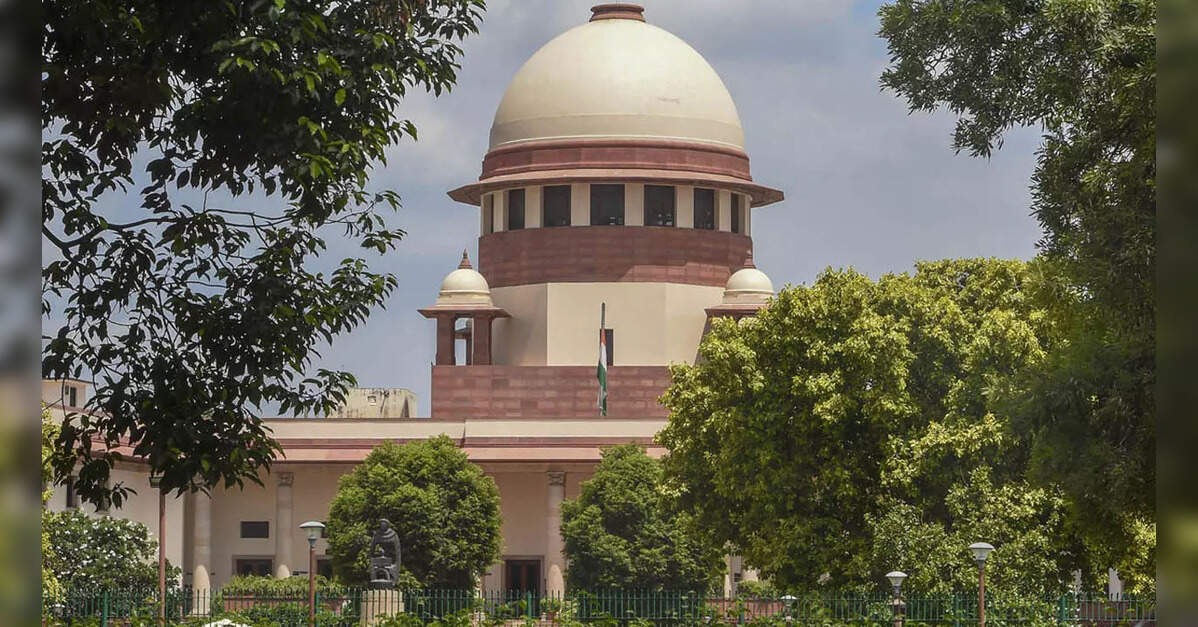
Supreme Court to Examine Whether Suppression of Higher Qualification Can Lead to Termination from Government Service
The Supreme Court on Tuesday agreed to examine a Telangana High Court verdict, which upheld the Centre's decision to terminate the service of a Scheduled Tribe person who had allegedly suppressed the information of being 'intermediate pass' rather than the prescribed 'tenth pass' criteria required for the job of 'work assistant'.
A bench of Justices PS Narasimha, Aravind Kumar and Shree Chandrashekar issued notice to the Centre on a plea of Pawar Subhash, who has challenged the order of the High Court dated November 27, 2025.
“This judgement is prima facie wrong. We will examine the judgment. There is already a Supreme Court judgement which says that higher qualification cannot be a ground for disqualification,” the bench told the counsel appearing for Subhash.
The High Court, in its verdict, had noted that the petitioner had applied for the post of 'work assistant', for which the prescribed qualification was 'tenth pass', and did not disclose that he was already "intermediate pass".
It had said that Subhash passed the 10th class in 2003 and intermediate in 2006 and applied for the post on July 26, 2010.
The High Court said that, based on the declaration made by Subhash, he was shortlisted for the job. It said that on May 25, 2013, he submitted a declaration disclosing that he had actually passed the Intermediate examination in 2006.
It said that, treating this as "wilful suppression" of material information at the stage of application and during the subsequent verification process, the Union government terminated his services on May 27, 2013.
Subhash challenged the termination order before the Central Administrative Tribunal (CAT), which set aside the order dated May 27, 2013, and remanded the matter, directing the Union government to reconsider the aspect of keeping him in public employment, for which he was otherwise qualified, and to pass a speaking order.
The government, upon reconsideration of the matter, passed a detailed speaking order dated April 30, 2022, stating that the petitioner was unsuitable for public employment, reiterating that he had deliberately and repeatedly suppressed his higher qualification in the application form, undertaking and declaration.
The government further concluded that the act of suppression clearly exhibited a lack of integrity on the part of the petitioner, which made him unsuitable for public employment, and rejected his claim.
The order of the government was again challenged before the tribunal, but this time the decision was upheld on the ground that the petitioner's suppression was intentional and deliberate.
Aggrieved by the decision of the tribunal, Subhash then moved the High Court and took the ground that the suppression, if any, was not of a 'material fact'.
He relied on two apex court decisions that the possession of a higher qualification was not a ground for disqualification.
His counsel contended before the High Court that the termination of his services on account of the petitioner possessing the Intermediate qualification was shockingly disproportionate and violative of Articles 14, 16 and 21 of the Constitution.
Subhash's counsel further submitted that he belongs to a Scheduled Tribe and hails from a remote area and did not possess the requisite awareness regarding procedural formalities, and that the subsequent disclosure by him in May 2013 of having passed intermediate was voluntary and demonstrated his bona fides.
The High Court, however, did not agree with the submissions and said that, due to a large volume of applications for the post, the government exercised the right to restrict the number of candidates based on higher qualification and screened out approximately 45 per cent (about 14,000) candidates who possessed qualifications above tenth pass.
It said the petitioner's Intermediate qualification was not irrelevant and was a specific criterion that would have, and in the case of 45 per cent of applications did, lead to the application being screened out at the initial stage itself.
“Further, by declaring that the petitioner only possessed SSC (tenth pass) qualification, the petitioner circumvented the screening process. The petitioner secured a place in the written examination and the subsequent process, which he might not have secured in the event of his having made a truthful declaration of possessing an Intermediate qualification,” it had said.
It said that, in matters of public employment, the process must be fair, transparent and equitable to all candidates, and a candidate who gains access through suppression or misrepresentation taints the entire process.
0 Response to "Supreme Court to Examine Whether Suppression of Higher Qualification Can Lead to Termination from Government Service"
Post a Comment
Disclaimer Note:
The views expressed in the articles published here are solely those of the author and do not necessarily reflect the official policy, position, or perspective of Kalimpong News or KalimNews. Kalimpong News and KalimNews disclaim all liability for the published or posted articles, news, and information and assume no responsibility for the accuracy or validity of the content.
Kalimpong News is a non-profit online news platform managed by KalimNews and operated under the Kalimpong Press Club.
Comment Policy:
We encourage respectful and constructive discussions. Please ensure decency while commenting and register with your email ID to participate.
Note: only a member of this blog may post a comment.