
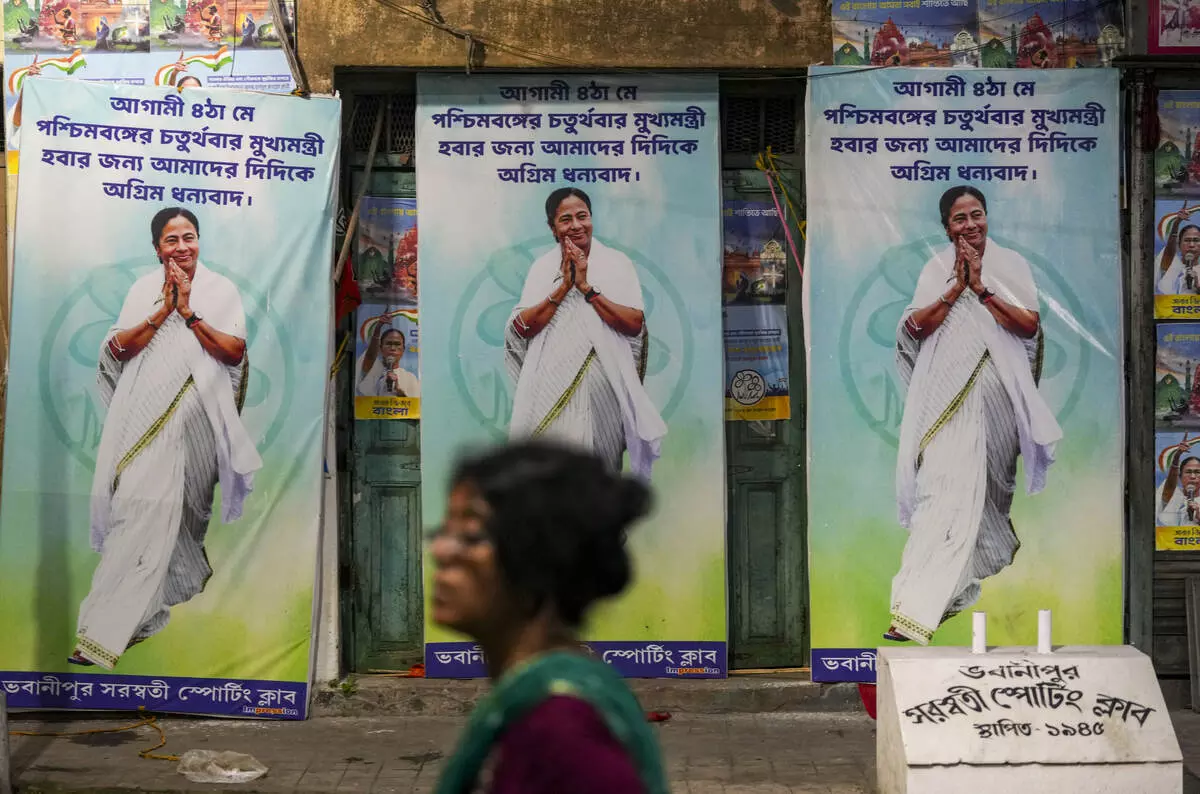
Organisational decay, mid-level leadership drift: Inside TMC’s Bengal collapse
At the centre of the setback lies not merely anti-incumbency or a resurgent BJP, but a steady erosion of the party’s most critical layer — the “middle order” that historically converted Mamata Banerjee’s mass appeal into booth-level control.
“The TMC didn’t just lose an election, it lost its organisational memory. This is not just an electoral defeat; it is an organisational implosion. The Trinamool Congress lost its transmission belt between leadership and cadre,” said political scientist Biswanath Chakraborty, describing the outcome as the culmination of a long structural decline.
The scale of the electoral reversal mirrors this organisational weakening. The BJP’s vote share rose sharply to around 45 per cent from 38 per cent in 2021, while the TMC’s declined to nearly 40.94 per cent from 48 per cent. In seat terms, the shift was even more stark: the TMC’s tally falling from 215 to 80, even as the BJP surged from 77 to 206 seats, effectively translating organisational gains into a decisive mandate.
For a party that emerged from grassroots mobilisation, the strength of its second rung was once its defining feature. Leaders such as Mukul Roy, Suvendu Adhikari and Partha Chatterjee were not just political figures but organisational pillars who built networks, managed local dynamics and ensured electoral delivery. That layer has now thinned considerably. Some leaders exited at key moments, others were weakened by controversies, and several saw their roles diminish within an increasingly centralised structure that revolved around Mamata Banerjee and Abhishek Banerjee.
“The BJP’s rise in Bengal is as much about TMC’s internal contraction as it is about its own expansion. A section of TMC’s organisational strength effectively shifted to the BJP through defections,” observed psephologist Sanjay Kumar.
Across multiple districts, particularly in rural areas, the BJP was able to leverage networks built by former TMC leaders, giving it a ready-made grassroots structure and deep local insight. The electoral data reflects this ground-level shift — what began as incremental organisational seepage culminated in a full-scale political realignment. The result was a reversal of roles, with the TMC struggling to match the organisational efficiency of its rival.
The internal transition led by Abhishek Banerjee was conceived as a structural reset — an effort to move from personality-driven mobilisation to a more systematised, performance-based model. However, the transition created disruptions.
“The effort to professionalise the organisation ended up weakening its informal support systems,” said analyst Udayan Bandyopadhyay.
The large-scale candidate overhaul ahead of the elections removed several experienced leaders but did not always replace their local influence. Many new entrants lacked the grassroots connect required in closely fought contests.
Simultaneously, growing reliance on data-driven strategies and consultancy inputs altered the party’s internal functioning. A senior district leader remarked, “Earlier, politics was driven by personal networks. Now decisions are more centralised and less connected to ground realities.”
The organisational changes also highlighted the limits of excessive centralisation. Decision-making became concentrated, reducing the autonomy of district leaders and weakening the feedback loop from the grassroots.
Electorally, this translated into weaker coordination at booth level and slower responses to shifting local dynamics — gaps that a cadre-driven opponent was able to exploit. Unlike earlier elections, when decentralised structure allowed quick adaptation, the system now appeared rigid and less responsive, amplifying the impact of anti-incumbency and local dissatisfaction.
Even as organisational weaknesses became more visible, the TMC continued to rely on welfare programmes to retain voter support. While these schemes generated goodwill, they were insufficient to offset structural shortcomings. In several constituencies, the absence of strong local leadership meant that welfare gains did not translate into electoral success.
Additionally, corruption allegations and governance fatigue affected the credibility of local leaders, further weakening the party’s position on the ground.
Analysts suggest that the timing of organisational reforms also played a role in the outcome. Changes were introduced at a point when anti-incumbency pressures and internal challenges were already high.
“The reforms were necessary, but their timing made the transition more difficult,” said political analyst Maidul Islam.
For the TMC, the challenge now extends beyond electoral recovery to organisational rebuilding. Reconstruction will require strengthening district-level leadership, rebuilding internal cohesion and restoring a balance between central control and local initiative.
For Mamata Banerjee, the defeat represents a significant political setback. For Abhishek Banerjee, it marks a critical phase where organisational rebuilding will test his leadership.
0 Response to "Organisational decay, mid-level leadership drift: Inside TMC’s Bengal collapse"
Post a Comment
Disclaimer Note:
The views expressed in the articles published here are solely those of the author and do not necessarily reflect the official policy, position, or perspective of Kalimpong News or KalimNews. Kalimpong News and KalimNews disclaim all liability for the published or posted articles, news, and information and assume no responsibility for the accuracy or validity of the content.
Kalimpong News is a non-profit online news platform managed by KalimNews and operated under the Kalimpong Press Club.
Comment Policy:
We encourage respectful and constructive discussions. Please ensure decency while commenting and register with your email ID to participate.
Note: only a member of this blog may post a comment.