
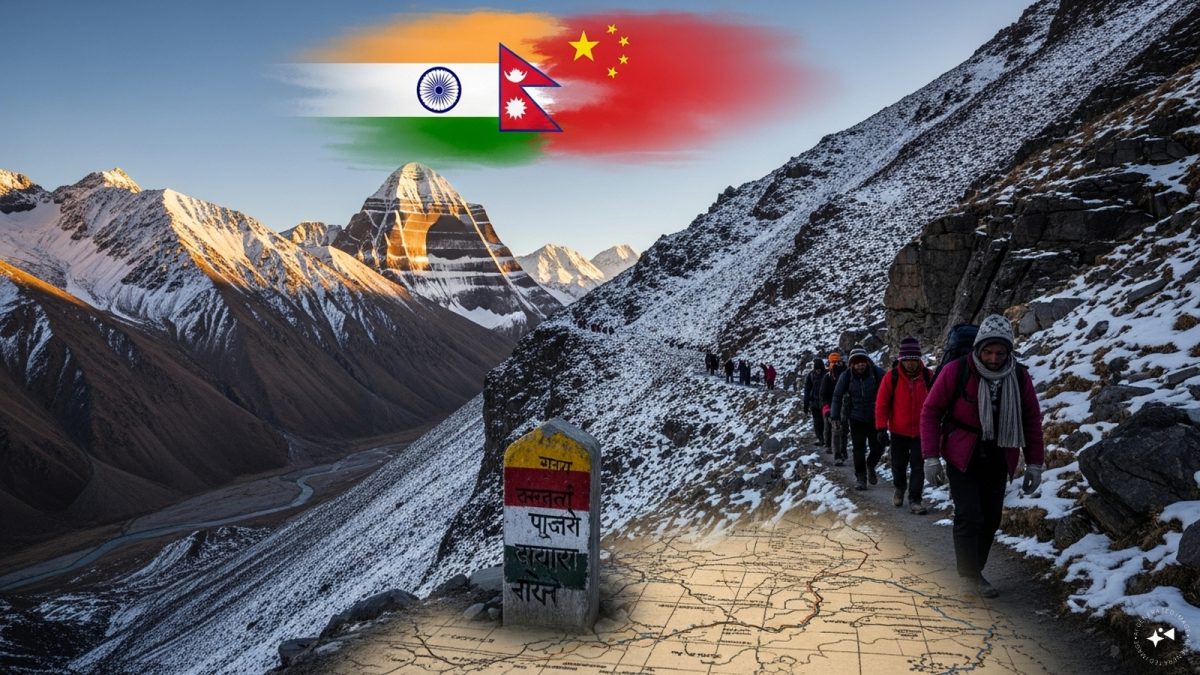
 "Nepal raises objection to Kailash Mansarovar Yatra via Lipulekh, renews territorial claim")
Nepal raises objection to Kailash Mansarovar Yatra via Lipulekh, renews territorial claim
In a statement, the Nepalese Foreign Ministry said that Kathmandu was not consulted before finalising the route for the pilgrimage.
New Delhi has been maintaining that Lipulekh belongs to it.
Nepal’s objection to the Kailash Mansarovar Yatra came days after India announced that it would be held between June and August.
“The Nepal Government is clear and fully committed to its stand that Lipulekh, Limpiyadhura and Kalapani, lying in the east of the Mahakali River, are its inseparable territories based on the Sugauli Treaty of 1816,” the Foreign Ministry said in the statement posted on social media.
“The Nepalese Government has reiterated its clear stand to both India and China regarding the Kailash-Mansarovar tour to be organised via Nepalese territory, Lipulekh,” it said.
Earlier, the Nepalese Government had also requested the Government of India not to conduct activities such as road construction, expansion, border trade and pilgrimage in the area, it said.
The statement added that the Nepalese Government has also informed China about it.
“The Nepal Government is always committed to resolving the border issue through diplomatic channels based on historical agreement, understanding, facts, maps and proofs in view of close and friendly relations existing between Nepal and India,” the ministry said.
Nepal claims that Lipulekh and Kalapani are its territories, whereas India maintains that the territories belong to it.
Nepal’s K.P. Oli-led Government in May 2020 included the territories, including Kalapani and Lipulekh, in its official map.
The move came after India inaugurated an 80-km road linking Dharchula to the Lipulekh Pass—a route to the Kailash Mansarovar pilgrimage site in Tibet. Nepal protested the road’s inauguration as what it called India’s “unilateral act”.
On April 30, the Ministry of External Affairs (MEA) in New Delhi announced that the annual Kailash Mansarovar Yatra is set to take place from June to August this year via two routes—Lipulekh Pass in Uttarakhand and Nathu La in Sikkim.
The pilgrimage to Mount Kailash and Mansarovar Lake in China’s Tibet Autonomous Region holds religious significance to Hindus, Jains and Buddhists.
The yatra resumed last year after a gap of nearly five years as part of efforts to normalise the relations between India and China
0 Response to "Nepal raises objection to Kailash Mansarovar Yatra via Lipulekh, renews territorial claim"
Post a Comment
Disclaimer Note:
The views expressed in the articles published here are solely those of the author and do not necessarily reflect the official policy, position, or perspective of Kalimpong News or KalimNews. Kalimpong News and KalimNews disclaim all liability for the published or posted articles, news, and information and assume no responsibility for the accuracy or validity of the content.
Kalimpong News is a non-profit online news platform managed by KalimNews and operated under the Kalimpong Press Club.
Comment Policy:
We encourage respectful and constructive discussions. Please ensure decency while commenting and register with your email ID to participate.
Note: only a member of this blog may post a comment.