
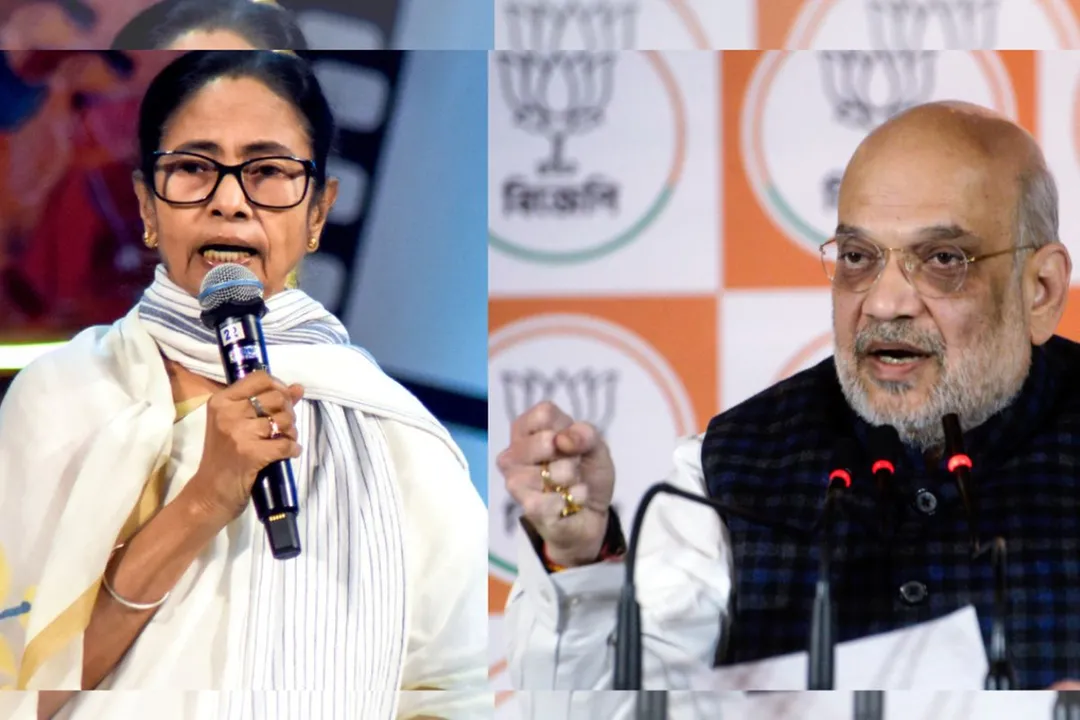
Bengal awaits verdict as Mamata faces toughest electoral test; BJP eyes breakthrough
This election is no longer merely about who reaches Nabanna, the state secretariat.
It is a referendum on whether Chief Minister Mamata Banerjee, after 15 years in power, remains Bengal’s central political figure, and whether a fourth straight victory can firmly establish her as the strongest opposition face against the BJP before the 2029 Lok Sabha polls, or whether the saffron party has finally found a road to power in Bengal after repeated failures.
With 92.47 per cent cumulative polling across the two-phase Assembly elections—93.13 per cent in the first phase and 91.66 per cent in the second phase—West Bengal has recorded its highest-ever voter turnout since Independence, surpassing even the 84 per cent polling in the 2011 election that first brought Banerjee to power and ended 34 years of Left Front rule.
The scale of participation delivered the first unmistakable political message: Bengal voted as if it believed power itself was at stake. In a state where elections are often read as emotional referendums as much as electoral exercises, the turnout transformed this contest from a routine fight for office into a larger verdict on political legitimacy, leadership, and the future direction of the state.
For Banerjee, this election is perhaps the defining battle of her political life. After three successive terms and a decade and a half at the helm of Bengal politics, she is fighting not just to retain power but to defend the political order she built.
Few leaders embody their party as completely as Banerjee does. The distinction between Banerjee and the TMC has long blurred into near-complete overlap.
In 2021, when the BJP mounted its most aggressive assault with Prime Minister Narendra Modi and Union Home Minister Amit Shah leading a full-spectrum campaign, Banerjee fought back almost single-handedly—on a wheelchair, with her leg in plaster—turning personal injury into a political metaphor.
That victory elevated her beyond a regional chief minister and strengthened her stature as perhaps the strongest non-BJP opposition face nationally.
But 2026 is a more difficult battle. In 2021, Banerjee fought as a wounded but defiant incumbent, turning personal injury and the BJP’s all-out assault into political advantage. In 2026, she faces a heavier burden—not just anti-incumbency, but the accumulated fatigue of 15 years in power, corruption allegations, recruitment scams and growing questions over governance.
“This election is about protecting Bengal’s political identity. If Didi wins again, it proves that welfare politics and Bengali pride can defeat communal polarisation,” a senior TMC minister said.
For Banerjee, victory would mean far more than securing a fourth straight term. A defeat, however, would be existential. Unlike cadre-driven national parties, the TMC has no parallel centre of gravity beyond her.
For the BJP, Bengal remains unfinished political business.
The party believes the moment may finally be ripe to breach what many call its “final ideological frontier” by capturing power in West Bengal—the birthplace of ideologue Syama Prasad Mookerjee and a state that remained the Left’s impregnable citadel for decades.
Since its 2019 Lok Sabha breakthrough, the BJP has treated Bengal not merely as another electoral target but as a test of political completion.
From barely four per cent vote share in 2011, it surged to nearly 40 per cent in 2019 and then won 77 seats in 2021, displacing the Left and Congress as the TMC’s principal challenger.
But the harder task has always been converting electoral expansion into governmental power. Its 200-plus claim in 2021 collapsed, and the 2024 Lok Sabha target of crossing 30 seats again fell short.
“For us, Bengal is unfinished political business. From Syama Prasad Mookerjee to today, this is about completing a political journey,” a state BJP leader said.
If Phase 1 tested whether the BJP could retain its northern strongholds, Phase 2 was the real examination: whether it could breach the TMC’s southern fortress. Of the 142 seats that voted on Wednesday, the TMC had won 123 in 2021.
Yet beneath turnout figures lay the election’s deepest undercurrent—the Special Intensive Revision (SIR) of electoral rolls.
With nearly 91 lakh names deleted statewide, almost 12 per cent of the electorate disappeared before polling began. Numerically, it changed the arithmetic. Politically, it changed the chemistry.
The TMC framed SIR as targeted disenfranchisement of minorities, migrants, women and poorer voters. The BJP defended it as a long-overdue cleansing of bogus entries.
In many constituencies, deleted names exceed previous victory margins, ensuring the battle over who was allowed to vote may continue even after polling ends.
Political analyst Biswanath Chakraborty said SIR changed both arithmetic and emotion.
“Elections are not decided only by subtraction. They are decided by the psychology created by that subtraction,” he said.
“The election is no longer just about seat arithmetic; it is about whether Mamata Banerjee remains the central political fact of Bengal. If she wins again, it places her at the centre of national opposition politics,” Chakraborty added.
For the BJP, Bengal is the last major ideological frontier. A victory here would be read nationally as proof that even Bengal’s exceptional political culture can be breached, he said.
The results will be announced on May 4, when Bengal will know whether Banerjee’s long political dominance still holds its electoral grip, or whether the BJP has finally found a way to turn years of ambition, organisation and ideological pursuit into power at Nabanna.
0 Response to "Bengal awaits verdict as Mamata faces toughest electoral test; BJP eyes breakthrough"
Post a Comment
Disclaimer Note:
The views expressed in the articles published here are solely those of the author and do not necessarily reflect the official policy, position, or perspective of Kalimpong News or KalimNews. Kalimpong News and KalimNews disclaim all liability for the published or posted articles, news, and information and assume no responsibility for the accuracy or validity of the content.
Kalimpong News is a non-profit online news platform managed by KalimNews and operated under the Kalimpong Press Club.
Comment Policy:
We encourage respectful and constructive discussions. Please ensure decency while commenting and register with your email ID to participate.
Note: only a member of this blog may post a comment.