
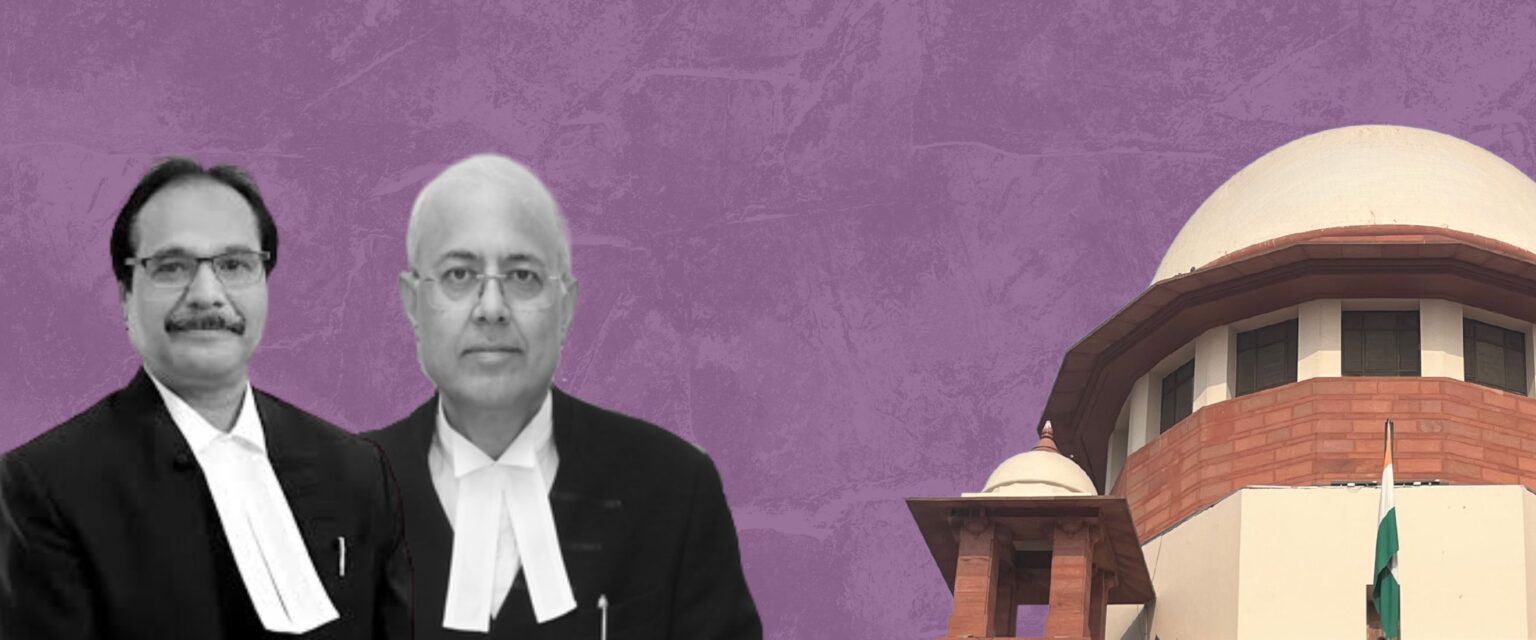
Supreme Court Ruling on Religious Conversion and Scheduled Caste Status
The ruling of the Supreme Court of India makes a clear and important distinction regarding Scheduled Tribe (ST) status, separate from Scheduled Castes (SC). It did not change or grant anything about Scheduled Tribe (ST) status. It mainly dealt with Scheduled Caste (SC) status, not ST.
A Bench comprising Justices Prashant Kumar Mishra and N. V. Anjaria held that a person who converts to a religion outside the three specified faiths ceases to be a member of a Scheduled Caste and cannot claim protection under the Scheduled Castes and Scheduled Tribes (Prevention of Atrocities) Act, 1989. Upholding the High Court’s earlier judgment, the Bench ruled that conversion to Christianity results in the “immediate and complete loss” of Scheduled Caste status.
“No person who professes a religion other than Hindu, Sikh or Buddhist shall be a member of Scheduled caste. Conversion to any other religion results in loss of Scheduled caste status.”
The Court further emphasized: "No statutory benefit, protection or reservation or entitlement under the Constitution or enactment of Parliament or state legislature can be claimed by or extended to any person who, by operation of clause 3, is not deemed to be a member of the Scheduled Caste. This bar is absolute and admits no exception. A person can't simultaneously profess and practice a religion other than the one specified in clause 3 and claim membership of the Scheduled caste."
The judgment arose from an appeal filed by a pastor, Chinthada Anand, who challenged a May 2025 ruling of the Andhra Pradesh High Court. Anand, born into the Madiga community—a recognized Scheduled Caste in Andhra Pradesh—had converted to Christianity and had been serving as a pastor for over a decade, conducting regular Sunday prayer meetings. In January 2021, he alleged that members of a locally dominant community assaulted him, abused him using caste-based slurs, and threatened to kill him and his family. Based on his complaint, an FIR was registered and a chargesheet was filed, supported by 16 witnesses and a medical report confirming injuries.
However, the accused approached the High Court seeking to quash the case, contending that Anand, having converted to Christianity and functioning as a pastor, was no longer entitled to claim Scheduled Caste status or invoke protections under the SC/ST Act. Accepting this argument, the High Court quashed the FIR, holding that caste distinctions are not recognized within Christianity and that conversion disentitles a person from invoking protections available to Scheduled Castes. It also observed that the allegations under the Indian Penal Code, 1860 lacked sufficient corroboration.
Affirming the High Court’s reasoning, the Supreme Court relied on the Constitution (Scheduled Castes) Order, 1950, which restricts SC status to persons professing Hinduism, Sikhism, or Buddhism. The Bench clarified that the restriction under Clause 3 of the Order is absolute. It stated that no statutory benefit or protection can be extended to any individual who is not deemed a member of a Scheduled Caste under this provision, and that this constitutional bar overrides any administrative recognition such as a caste certificate. The Court made it clear that mere non-cancellation of a caste certificate does not entitle a person to claim SC benefits after conversion.
In examining the facts, the Court noted that Anand had neither reconverted to his original religion nor re-entered the fold of his caste community. On the contrary, evidence showed that he had been actively practicing Christianity and working as a pastor for over a decade, including conducting regular prayer meetings.
“These facts leave no room for doubt that he continued to remain a Christian on the date of the occurrence.”
Accordingly, the Court held that Anand could not invoke the SC/ST Act, as he was not a member of a Scheduled Caste at the time of the alleged incident. The appeal was dismissed, and the High Court’s decision was upheld.
The Court also addressed arguments raised by Anand’s counsel, who contended that caste is determined by birth and that conversion does not erase historical disadvantages. Reference was also made to a 1977 government order suggesting that Scheduled Caste converts continue to suffer social disabilities. However, the Bench rejected these arguments, relying on Clause 3 of the 1950 Order and the interpretation of the term “professes” as requiring a public declaration of faith, as established in Punjabrao v D.P. Meshram (1964). It held that Anand’s long-standing role as a pastor constituted clear and unequivocal evidence of professing Christianity.
The Court further observed that Christianity, by its theological foundation, does not recognize caste distinctions, citing the Biblical passage:
“There is neither Jew nor Gentile, neither slave nor free, nor is there male and female, for you are all one in Christ Jesus.”
Relying on earlier precedents such as Principal, Guntur Medical College v Y. Mohan Rao (1976) and C.M. Arumugam v S. Rajagopal (1975), the Court reasoned that the social and economic disabilities associated with caste under Hindu society cease upon conversion to Christianity.
Importantly, the judgment drew a clear distinction between Scheduled Castes and Scheduled Tribes. While SC status is strictly tied to religion under the 1950 Order, Scheduled Tribe (ST) status is not determined by religion but by factors such as cultural identity, customary practices, and community recognition. Therefore, conversion does not automatically extinguish ST status, making the legal frameworks for SCs and STs fundamentally different.
The ruling also highlighted a broader constitutional and social debate. While the legal framework treats conversion as an absolute bar to SC status, several studies and commissions—including the Ranganath Mishra Commission and the Sachar Committee—have documented the persistence of caste-based discrimination among converted communities. Additionally, a commission led by former Chief Justice K. G. Balakrishnan is currently examining whether Scheduled Caste status should be made religion-neutral, though its report is still awaited.
Notably, the Supreme Court’s decision does not engage with earlier rulings such as Soosai v Union of India (1985), which acknowledged the need for socio-economic data to resolve the constitutional validity of such restrictions. Nor does it address pending challenges to Clause 3 of the 1950 Order.
For Anand, the consequences are immediate and concrete: despite a complaint supported by witnesses, a chargesheet, and medical evidence, the law does not recognize his eligibility for protection under the SC/ST Act due to his religious conversion. The ruling thus reinforces a strict constitutional position—that while individuals are free to choose and practice any religion, such a choice carries legal consequences for caste-based entitlements.
The judgment ultimately rests on a clear doctrinal foundation: Scheduled Caste status and the profession of a religion outside Hinduism, Sikhism, or Buddhism are mutually exclusive. Conversion results in the instant and complete loss of SC identity in the eyes of the law. At the same time, the decision brings into sharp focus an ongoing tension between constitutional design and social reality, raising important questions about whether legal definitions adequately reflect lived experiences of discrimination in contemporary India.
In essence, the Court has reaffirmed that under the current constitutional framework, a person cannot simultaneously profess a non-recognized religion and claim Scheduled Caste status, and that this bar remains absolute, leaving no room for exceptions.
0 Response to "Supreme Court Ruling on Religious Conversion and Scheduled Caste Status"
Post a Comment
Disclaimer Note:
The views expressed in the articles published here are solely those of the author and do not necessarily reflect the official policy, position, or perspective of Kalimpong News or KalimNews. Kalimpong News and KalimNews disclaim all liability for the published or posted articles, news, and information and assume no responsibility for the accuracy or validity of the content.
Kalimpong News is a non-profit online news platform managed by KalimNews and operated under the Kalimpong Press Club.
Comment Policy:
We encourage respectful and constructive discussions. Please ensure decency while commenting and register with your email ID to participate.
Note: only a member of this blog may post a comment.