
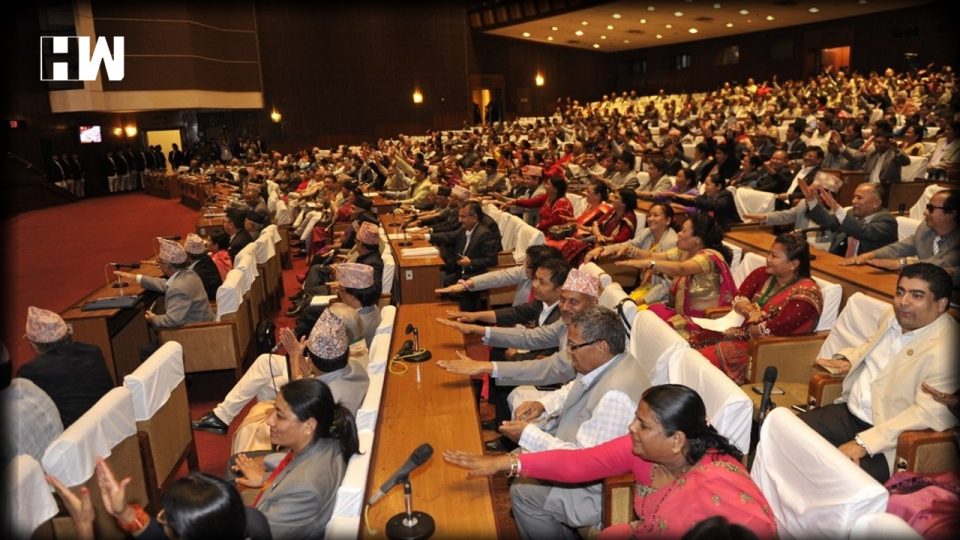
Nepal’s Parliament Prepares for Session Amid All-Party Meeting Call and Debate on Constitutional Amendment
The Federal Parliament Secretariat has invited all parties represented in Parliament to attend an all-party meeting scheduled for Wednesday at 1:00 PM, according to spokesperson Ekaram Giri.
The meeting has been convened to prepare for the upcoming parliamentary session, which was formally called following a recommendation by the Council of Ministers.
President Ramchandra Paudel has summoned a joint session of both houses of the Federal Parliament for April 1, 2026, at 2:00 PM (converted from Chaitra 19, 2082). The first बैठक (meeting) of the session will also take place at the same time.
Due to delays in completing the new Parliament building at Singha Durbar, a multipurpose hall within the same complex has been prepared to host the first session.
The बैठक is expected to initiate the election process for the Speaker and Deputy Speaker. Six major political parties are currently represented in the House of Representatives, including Rastriya Swatantra Party (RSP), Nepali Congress, UML, Nepal Communist Party (NCP), Shram Sanskriti Party, and Rastriya Prajatantra Party (RPP).
The government led by Kathmandu Mayor Balendra (Balen) Shah has formally begun groundwork for constitutional amendments. However, the move has sparked widespread concern among political leaders, legal experts, and stakeholders.
A Cabinet meeting held on March 30, 2026 (Chaitra 16, 2082) decided to form a task force to prepare a “discussion paper” on constitutional amendments. The task force will be led by the Prime Minister’s chief political advisor Asim Shah, and will include representatives from political parties in Parliament.
Government spokesperson and Education Minister Sasmit Pokhrel stated:
“The task force, under the leadership of the Prime Minister’s political advisor, will include representatives from all parties in Parliament. A discussion paper for constitutional amendment will be prepared based on national consensus.”
Despite the announcement, critics argue that the issue of constitutional amendment—a highly sensitive and complex matter—has not been handled with the seriousness it demands.
Concerns have been raised that the task force is not led by constitutional experts or experienced lawmakers, but rather by a close political advisor, which may undermine the credibility of the process.
Key Reactions from Political and Legal Figures
Yogendra Chaudhary (Nepali Congress) stated that the party will decide its position after receiving official details.
He further warned that such an approach could pose long-term risks not only to the Constitution but also to the country’s future.
Former Nepal Bar Association General Secretary Anjita Khanal emphasized the gravity of the issue:
“Constitutional amendment is an extremely serious and sensitive matter. It should not be handled lightly or out of arrogance.”
She added that the task force would have been more effective if led by a legal expert or a qualified individual from within Parliament.
Former Attorney General Raman Kumar Shrestha acknowledged that initiating the amendment process is positive, but warned:
“The main question is how effective the task force will be. If major political parties do not participate, the amendment process cannot move forward.”
Former Law Minister Nilamber Acharya also stated that the task force does not match the seriousness required for such a المهمة (task).
Legal expert and former National Assembly member Radheshyam Adhikari proposed an alternative approach:
“If constitutional amendment is truly the goal, an inclusive ‘Advisory Committee’ should be formed that accommodates all stakeholders.”
He suggested that such a committee could identify necessary changes, present proposals, and ensure that only broadly agreed-upon amendments are adopted.
As Nepal moves toward a new parliamentary session, political tensions are rising on multiple fronts—from leadership elections to constitutional reform. While the government’s initiative to amend the Constitution signals potential change, concerns over transparency, inclusiveness, and expertise continue to dominate public discourse.
The upcoming all-party meeting and parliamentary session are expected to play a crucial role in shaping both the legislative agenda and the broader political direction of the country.
0 Response to "Nepal’s Parliament Prepares for Session Amid All-Party Meeting Call and Debate on Constitutional Amendment"
Post a Comment
Disclaimer Note:
The views expressed in the articles published here are solely those of the author and do not necessarily reflect the official policy, position, or perspective of Kalimpong News or KalimNews. Kalimpong News and KalimNews disclaim all liability for the published or posted articles, news, and information and assume no responsibility for the accuracy or validity of the content.
Kalimpong News is a non-profit online news platform managed by KalimNews and operated under the Kalimpong Press Club.
Comment Policy:
We encourage respectful and constructive discussions. Please ensure decency while commenting and register with your email ID to participate.
Note: only a member of this blog may post a comment.