
Series of Earthquakes Rock Sikkim–Darjeeling Region, Renewing Seismic Safety Concerns
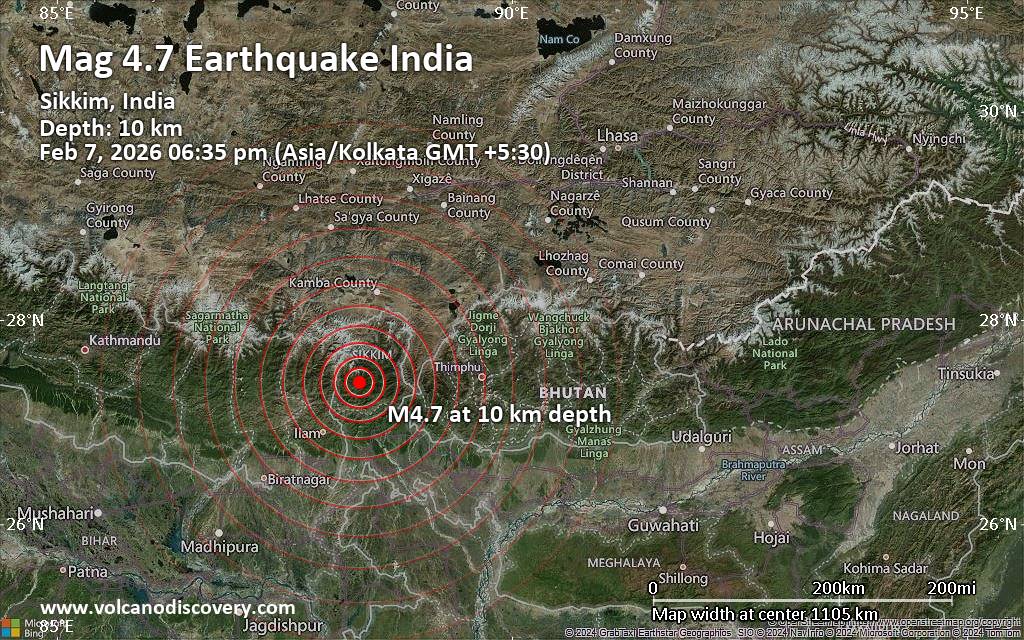
The primary epicentre of the initial and strongest earthquake was located near the Gyalshing region in West Sikkim at a shallow depth of approximately 5 to 10 kilometres, making the tremors more strongly felt across surrounding areas.
Significant jolts were felt across Gangtok, Namchi, Pelling, Ravangla, Mangan and Tadong in Sikkim. Tremors were also clearly experienced in Darjeeling, Kalimpong and Siliguri, as well as parts of Nepal, China and even Bhutan, where weak shaking was reported in Thimphu, nearly 121 km from the epicentre.
Reports stated that, according to the National Centre for Seismology (NCS), Delhi, the aftershocks ranged from magnitudes 2.2 to 4.0 and were recorded mainly to the east of the main epicentre. The first quake occurred at a depth of 10 km and was located around 31 km from Darjeeling, 42 km from Gangtok and 68 km from Siliguri.
“The event occurred on the Teesta fault/lineament and south of the M 6.9, 18th September 2011 event,” the NCS said in a statement. The 2011 earthquake had caused widespread destruction in Sikkim and the Darjeeling hills, killing nearly 100 people.
A report published in The Telegraph quoted Dr. Saibal Ghosh, Deputy Director General of the Geological Survey of India (GSI): “A total of 32 events (aftershocks) were recorded within 13 hours after the first earthquake.”
“This time, only two quakes were of magnitude 4 and 4.5 on the Richter Scale. Even though a series of jolts has released the pressure (in the tectonic plates), the event is a reminder for the public to be cautious. They need to be careful while constructing buildings,” Ghosh said.
Experts have reiterated that the Sikkim–Darjeeling belt lies in a highly sensitive seismic zone. Darjeeling was earlier classified under Seismic Zone IV, but last year the Bureau of Indian Standards (BIS) upgraded the entire Sikkim–Darjeeling Himalayan region to the highest seismic risk category, Zone VI. Earlier, the Himalayas were divided between Zones IV and V, but the revised zonation now places the entire belt under the most vulnerable category.
Concerns have also been raised about building safety, particularly in Darjeeling, where restrictions on building height continue to be flouted. Under Rule 162 of the West Bengal Municipal Building Rules, 2007, hill civic bodies can sanction building plans up to a height of 11.5 metres, roughly equivalent to a four-storey structure. Construction up to 13.5 metres requires prior state government approval.
The recent tremors, though moderate in intensity, have once again underscored the region’s high seismic vulnerability and the urgent need for strict adherence to earthquake-resistant construction norms to minimise risk to life and property.
he Sikkim-Darjeeling region remains highly seismically active, with the recent series of 33 earthquakes and aftershocks highlighting its vulnerability. Experts have warned that while the recent series may have released some tectonic stress, the risk of future moderate to strong earthquakes cannot be ruled out due to the region's location along the Teesta fault/lineament and the broader Himalayan seismic belt.
Some geologists are of the opinion that there have been three earthquakes with magnitudes around 4.5. There will be aftershocks related to these events, and they are expected to be lower in magnitude than 4.5. That is normal and consistent with typical seismic behavior following moderate earthquakes.
According to experts, these earthquakes are located within the Lesser Himalayan Duplex. Because of this geological setting, they are believed to be related to thrust faulting rather than strike-slip faulting, such as the mechanism associated with the 2011 earthquake. Earthquakes linked to duplex structures are common throughout the Himalayan region, so there is nothing unusually alarming about this activity at present.
A question many people are asking is whether these earthquakes could be precursors to a larger event. Probably not would be the best guess from geologists at this stage. However, having said that, scientists also emphasize that we never really know whether an earthquake is a precursor or not until a larger earthquake actually occurs.
While the recent seismic activity has naturally drawn attention, current expert understanding suggests that these earthquakes and their aftershocks fall within normal patterns for the region. Staying informed through reliable sources and maintaining general earthquake preparedness remains the most sensible approach.
Possibility Warnings
-
Aftershocks: Following the recent 4.0–4.5 magnitude events, further aftershocks of moderate intensity (3–5 magnitude) may continue over the coming days.
-
Potential for Larger Earthquakes: The region is classified as Seismic Zone VI (highest risk), meaning there is a possibility of stronger quakes in the future, similar to the 2011 Sikkim earthquake (M 6.9).
-
Structural Vulnerability: Many existing buildings, especially in Darjeeling and Kalimpong, do not comply with BIS seismic norms, increasing the risk of structural damage during larger quakes.
Precautionary Measures for Residents
-
Building Safety Compliance: Ensure all new constructions and retrofits adhere strictly to BIS seismic standards, especially for hill towns prone to landslides.
-
Emergency Preparedness:
-
Keep emergency kits ready, including water, food, first-aid supplies, flashlights, and essential medicines.
-
Identify safe zones in homes and public buildings, such as under sturdy tables, door frames, or open areas away from tall structures.
-
-
Evacuation Plans: Residents should be aware of evacuation routes, especially in hill towns prone to landslides or slope instability during tremors.
-
Stay Informed: Follow updates from the National Centre for Seismology (NCS), local administration, and disaster management authorities.
-
Avoid Unsafe Buildings: Avoid staying in illegal high-rise structures or buildings with cracks or weak foundations.
-
Community Preparedness: Schools, hospitals, and offices should conduct earthquake drills and have contingency plans in place.
-
Hydro Projects and Infrastructure Awareness: Residents living near hydroelectric dams or tunnels should monitor official advisories, as strong tremors can impact these structures.
Dr. Saibal Ghosh, Deputy Director General of GSI, emphasized:“Even though a series of jolts has released the pressure in the tectonic plates, the event is a reminder for the public to be cautious. They need to be careful while constructing buildings.”
0 Response to "Series of Earthquakes Rock Sikkim–Darjeeling Region, Renewing Seismic Safety Concerns"
Post a Comment
Disclaimer Note:
The views expressed in the articles published here are solely those of the author and do not necessarily reflect the official policy, position, or perspective of Kalimpong News or KalimNews. Kalimpong News and KalimNews disclaim all liability for the published or posted articles, news, and information and assume no responsibility for the accuracy or validity of the content.
Kalimpong News is a non-profit online news platform managed by KalimNews and operated under the Kalimpong Press Club.
Comment Policy:
We encourage respectful and constructive discussions. Please ensure decency while commenting and register with your email ID to participate.
Note: only a member of this blog may post a comment.