

What’s cooking in Nepal? Ominous Developments before the March 5 polls!
Ramakrishnan, Countercurrents, January 27, 2026 : ‘Leaders make beeline to Delhi just before March polls,” says a recent report, with the above illustration, in mypeoplesreview.com, decades-old news magazine of Nepal. “The message is clear. When the stakes rise in Kathmandu, leaders look South.” Among the well known, Prachanda’s January 4 meeting with Ajit Doval, India’s National Security Agency’s Chief, former chief of RAW, India’s CIA, raises many questions. Many in Nepal believe Modi-led India is meddling in various ways in their internal affairs, even during elections. Recent developments only confirm their fears.

This Report is part of a series on Nepal, published after the violent events of September last, then called as a revolt by Generation-Z, and may be deemed as part-3.
Nepal Turmoil:The Role of India’s Hindutva, Expansionist, and pro- monarchy forces
Part-1, 31/10/2025 is here:
Part-2, 05/11/2025, is here
A senior journalist, a retired editor of Telugu newspapers, in a letter to the editor, contested the analysis of the role of Hindutva and monarchist forces in Nepal. He asserted, as per a friend, that it is “misleading and a distortion”, but without any specifics, and that undermines the credibility of the journal. He was referring to an article that was published in a Telugu monthly magazine, in its December issue. He said he visited Nepal for 11 days in November second week, met many leaders and people, including those of generation-Z.
The above two parts in countercurrents.org had specific citations, including those from RSS organ Organizer, and pro-Modi magazine Swarajya, that revealed the machinations of Hindutva forces and Indian expansionism. It is strange that he found nothing abnormal. In the absence of any specific criticism, his complaint looks mischievous. And it is a cover-up mission. Indian journalists are sent on such missions, as part of embedded journalism, a method adopted by USA since its Gulf wars of aggression.
We have not invented the role of Hindutva forces and Indian expansionism. There were a few others also who raised the questions. We cite just two items:
The Frontline magazine of the Hindu group published, Dec 18, 2025, a story with this caption: Monarchy is used as a mascot for bringing back Hindu rashtra in Nepal: Sujeev Shakya.
Shakya is a leading senior economist of Nepal, “an insider who saw the palace from within” whose latest book (Nepal 2043: The Road to Prosperity) arrived just a week before the Gen Z uprising of September 2025.
See this caption of a brazen event in thetelegraph.com, Jan 11, 2026:
Nepalese royalists demand monarchy restoration ahead of March elections.
“ Supporters of Nepal’s former royal family participate in a rally demanding the restoration of the monarchy as they mark the birth anniversary of the 18th century king Prithivi Narayan Shah, founder of the Shah dynasty, in Katmandu.”
India’s MSM almost never opposes Indian expansionism, even when it is brazen. Nor they highlight such news as above. The journalist wrote the letter late in December, and by that time many more things came out. But Indian big media ignores or underplays any such news. Countercurrents.org is distinguished in its exposure of India’s expansionism, along with US imperialism. This part-3 and 4 are recording brazen interference by Indian agencies.
mypeoplesreview.com, reported:
“As Nepal moves closer to March 5, a familiar pattern has returned. Nepali leaders are packing their bags for Delhi, one after another, at a time when domestic politics is tense and uncertain. Publicly, these trips look routine. Leaders attend seminars etc… Behind the scenes, these visits carry far greater weight. They signal anxiety, calculation, and a long-standing habit of seeking reassurance across the southern border when politics at home turns uneasy…”
Significantly, the report added: “This is not new. Whenever Nepal enters a sensitive political phase, elections, regime shifts, or street movements, Delhi becomes a key stop for leaders from across the spectrum...”
(mypeoplesreview.com, Nepal’s newspaper, January 08, 2026).
Former Leftist prime ministers Baburam Bhattarai, followed quickly by Pushpa Kamal Dahal aka Prachanda, visited and spent several days in Delhi, at a time they should have been very busy in Nepal. Soon after the two leaders, former Foreign Minister, Arzu Rana Deuba, wife of another prime minister, of Nepali Congress Party, visited Delhi (see illustration above). Many more less known leaders, including those of newer political forces, also visited.
Notably, the Indian media, which sensationalizes selective foreign news, ignores or underplays the reports. It is busy spreading misinformation regarding Bangladesh and its soon-to-be-held polls, with an eye on elections in India, particularly in Bengal.
*** ***
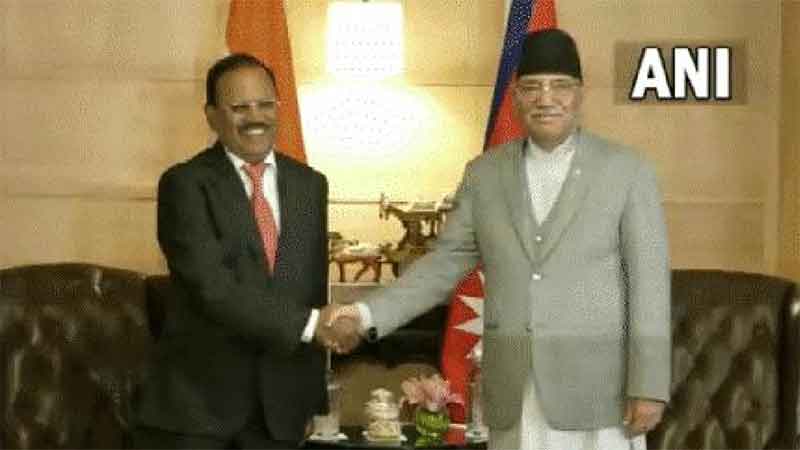
Synopsis of a Report by Economic Times, Jan 7, 2026 reads:
“India has voiced support for Nepal’s upcoming elections. National Security Advisor Ajit Doval met former Prime Minister Pushpa Kamal Dahal Prachanda in New Delhi. Discussions focused on safeguarding Nepal’s democracy through the polls. Elections are seen as the fundamental solution to the country’s political transition. India desires stability for its neighbor.”
himalayadiary.comreported , January 6, 2026:
.. Doval hosted, on Sunday (January 4), the dinner meeting at a hotel for Prachanda, the leader of the Nepal Communist Party. The high-level meeting served as a critical platform to address the current political situation in Nepal and the strategic necessity of the upcoming polls. Notable is the presence of Ganga, his daughter, who not only accompanied him, but joined in the meeting.
The primary focus of the dialogue was the implementation of general elections as the fundamental solution to the country’s political transition. This meeting comes at a sensitive time following the fall of the KP Sharma Oli government following the ‘Gen Z’ protests last year.
https://himalayadiary.com/nsa-ajit-doval-meets-former-nepal-pm-prachanda-ahead-of-polls/
A hotel dinner, a one on one conversation, and no public readout spoke louder than any formal event. Such meetings are not about speeches. They are about signals, reassurance, and red lines. (Nepali media comment).
Sources privy to the meeting told News18 that India’s position, as articulated by Doval, is that holding these elections is not merely a procedural requirement but a vital necessity for national stability. India expressed a firm commitment to the protection of Nepal’s democratic framework, they said.
They said Doval reportedly told Prachanda that elections are the only way to protect the political system and that India also wants the same stability for its neighbour. He stressed that a democratic mandate through the ballot box remains the best option to safeguard democracy, they added.
Many in Nepal however believe India is behind destabilization. Nepal witnessed 13 prime ministers in the last 19 years, and it is a sign of instability, which, it is claimed, was one factor behind the Generation-Z Revolt of last September.
A senior journalist of Nepal, with 50 years of experience, NP Upadhyaya (Aryal), Editor of Telegraph Nepal, published articles which exposed the India and its RAW hand (the CIA of India) behind every regime change in Nepal.
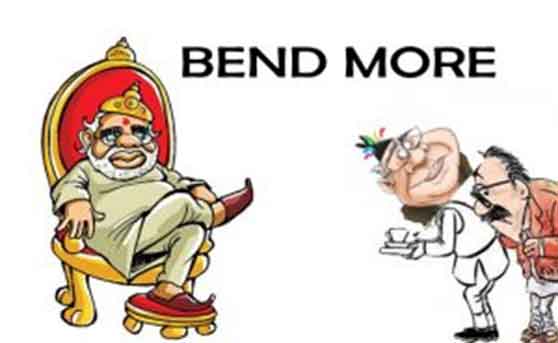
We see only one example here:
Under the caption Nepal: Politics under firm grip of New Delhi again, he wrote on January 5, 2023, in telegraphnepal:
“ The dis (information) lab is situated across the border, Delhi, and in some “dark corners” in Kathmandu led by a recognized known alien force and its paid and posted hangers on spreading fake and false accounts..”
“ The November 16, 2022, article penned by three Indian nationals, Vedanta Choudhary, Abhinav Singh Khatri and Samkalp Chakravorty leaves no doubt that the present government in Nepal, under “India comfortable” Prachanda, is the tacit maneuvering of the Indian regime as usual and that India played its tricks to uplift its bosom friend Prachanda to lead the new government in Nepal..”
“ The three South Block close intellectuals, mentioned above, had clearly stated in their joint article published in the “National Interest” that “Delhi will entertain the increasing US influence in Nepal if it helps the New Delhi regime..”.
“ Senior political analyst Bharat Dahal who himself served the Nepal Maoists party as its loyal cadre says that “when I saw for myself as to how the Maoist leaders in Delhi were provided with the Indian government’s top-class security, I came to my senses and concluded that the Maoist people’s war was nothing but an India designed war against the Nepal government or say the Nepali State”.
India has several nefarious designs in Nepal which remains yet to come to our notice.
The fact is that the Indian media is shielding Prachanda from his “Delhi’s past” and in doing so, the Indian government under Islamophobic Modi prefers to portray Prachanda (the Delhi confidante in essence) as China hand.. Delhi can’t fool Nepali population ad infinitum.
Prachanda’s antics are not new. He dons Hindutva costumes too (see the next section).
So India plays a role in safeguarding Nepal’s democracy! And that is discussed with Ajit Doval, former chief of RAW. Doval had a role in Sikkim that was annexed by India, 50 years ago. That was after stirring up a revolt, then against monarchy, and for electoral democracy. Now 50 years later, there was a revolt against such democracy, and demanding restoration of constitutional monarchy! What remains constant is the expansionist interests.
See Annexation of Sikkim, remembered 50 years later (31/05/2025)
https://countercurrents.org/2025/05/annexation-of-sikkim-remembered-50-years-later/
Says a report:
For those who played a role in the 2006–07 change, Delhi still represents a place where past alliances were shaped and political survival once secured. India, too, has long framed that period as part of its own regional success story. .
India’s own concerns explain part of this rush. Its traditional political partners in Nepal have weakened. The monarchy is gone. The Nepali Congress struggles to regain momentum. The Maoists no longer command the influence they once did.
In this setting, India appears eager to stay engaged before voters speak… For Nepali leaders, this attention cuts both ways. Some seek India’s comfort to steady their footing at home. Others hope to show they remain relevant regional players. Even emerging leaders seem keen to be seen, heard, and noted in Delhi’s policy circles.
At a time when leaders should be busy in Nepal, preparing for and campaigning in elections, they visit Delhi and spend days! India is busy making arrangements, it is reported, for peaceful conduct of elections, in Nepal, yes Nepal too. If it were so, some officials may meet. But why political leaders? And why they come all the way to Delhi? And seek to please Hindutva forces?
Why ‘revolutionary’ communist PM Prachanda went to temples in India
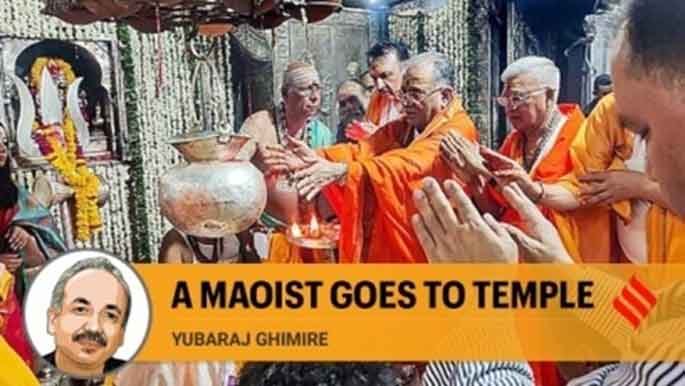
On the third day of his trip, June 5, 2023, Nepal’s Prime Minister Pushpa Kamal Dahal not only visited Indore but he did an elaborate puja at the Mahakaleshwar temple in Ujjain, India. (PTI). It was an attempt to showcase his ‘Hindu’ credentials for the BJP government – and to convince them his being in office was in India’s best interest vis a vis China, commented a leading media person of Nepal. (Yubaraj Ghimire,Nepali journalist, June 5, 2023)
He performed an elaborate puja and offered a 108 kg rudraksha bead thread to the Ujjain deity, besides a huge amount (Rs 51,000) as dakshina (offering) to the priest. . Political observers reckon Prachanda’s recent visit to temples was a move to shed his radical image. (Times of India 2023, June 3)
Back home, Prachanda, accompanied by several cabinet ministers, including Finance Minister Prakash Sharan Mahat and Foreign Minister NP Saud, visited the Pashupatinath Temple. It was his first visit to the temple.
Former Prime Minister Baburam Bhattarai said a visit of this nature could be perceived as politically motivated.
“When the Prime Minister and the entire cabinet visits a religious place together, it takes a political dimension, and naturally, questions and concerns arise,” Bhattarai said in a Facebook post.
“If the Prime Minister visited the temple on his own, it would have been praiseworthy, but if he visited the premises to please someone, it will be disastrous for Nepal,” President of Rastriya Prajatantra Party Rajendra Lingden said, without mentioning India.
But his detractors and political rivals believe this was just an attempt to convince New Delhi that him being in office was in the Indian government’s best interests.
Prachanda, was sworn in as the Prime Minister for the third time on December 26 last year after he dramatically walked out of the pre-poll alliance led by the Nepali Congress and joined hands with opposition leader KP Sharma Oli.
Alliances are made and broken at Delhi’s behests, it is widely acknowledged in Nepal. It is a game of musical chairs for prime ministers in Nepal.
Prachanda’s Delhi links are too well known.
On the evening of May 31, 2023 Nepal’s Prime Minister Pushpa Kamal Dahal (“Prachanda”) raised his hands in welcome and signalled Manjeev Singh Puri, asking the former Indian Ambassador to Nepal to approach him at a reception held in his honour at the country’s embassy in New Delhi. “I have not forgotten… you asked me several times when will I wear Daura-Suruwal. Look, I have done it.”
Nepalese royalists demand monarchy restoration ……ahead of March elections!
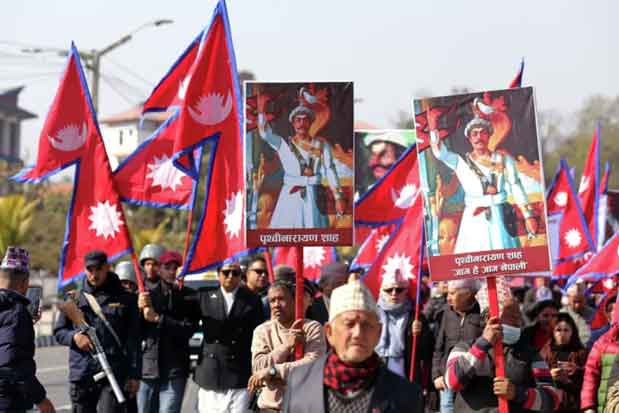
Supporters of Nepal’s former royal family participate in a rally demanding the restoration of the monarchy as they mark the birth anniversary of the 18th century king Prithivi Narayan Shah, founder of the Shah dynasty, in Katmandu, Nepal, Sunday, Jan. 11, 2026.
“We love our king. Bring back the king,” the rally participants chanted around the statue of King Prithvi Narayan Shah, who started the Shah dynasty in the 18th century. The last Shah king — Gyanendra — was forced to step down and the monarchy was abolished in 2008, making Nepal a republic.
“The last and only alternative for this country is king and monarchy only” said protester Samrat Thapa. “In the present context and the path country has taken after the Gen Z movement, there needs to be monarchy restored to manage the situation.”
Thus mass agitation is combined with representations to the interim govt, which allowed and entertained both.
Communal tension surfacing in Madhesh, Tarai
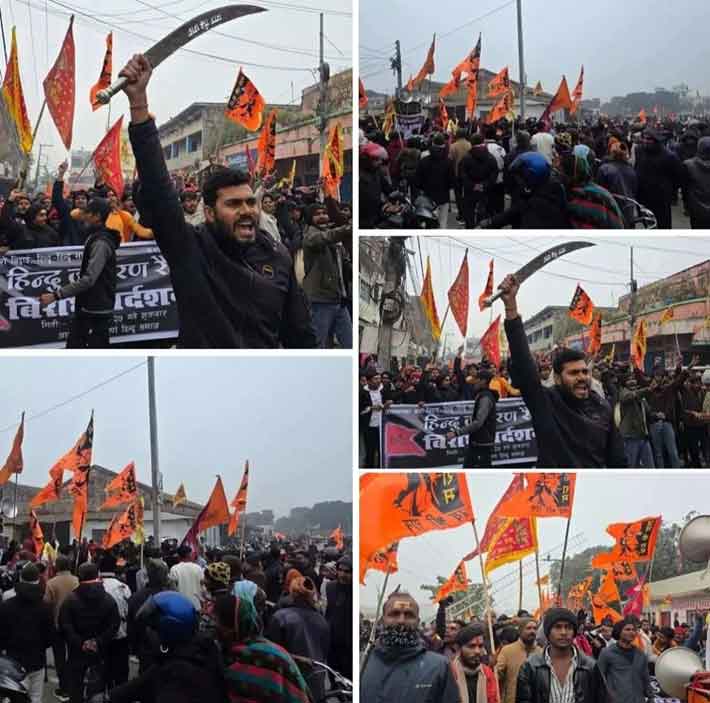
“The vandalism in Dhanusha quickly reverberated across Birgunj, a city that has repeatedly witnessed communal tensions over the past four years.” Hindutva forces in Nepal are increasingly active, as so many reports indicate.
Armed soldiers and police officers were patrolling the streets of Birgunj, located 130 kilometers (80 miles) south of the capital Kathmandu, which is the key border point for importing much of the oil, goods and supplies from neighboring India to Nepal.
The report narrated how it began:
“ Reports indicate that documents were thrown around and religious texts (Quran) were burned during the incident…
“Three people who spread religious rumours via TikTok and on January 3, in Sakhuwa Madan of the same municipality, vandalised a mosque are under the custody of Dhanusha Police,” the district police said..” citing relevant sections of the laws.
AP report January 6, 2026 on the incidents said: “How online provocation, demographic sensitivities, and delayed accountability turned a local social media controversy into a wider communal flashpoint in the Terai-Madhes.”
“From the morning of January 4, members of the Muslim community staged protests in Birgunj, blocking roads, burning tyres, and demanding accountability for the Dhanusha mosque vandalism. During the unrest, a police station in Chhapkaiya was vandalised. Counter-protests by Hindu groups soon followed, raising fears of a wider confrontation.”
Security forces were placed on alert across all eight districts of Madhesh Province, amid concerns that unrest could spread across the 21 districts of the Terai-Madhes plains.
Now we shall see the background:
Tarai is along India’s borders. It is adjoining Bihar’s Madhubani district, where Hindu-Muslim clashes were organized, for instance in 2021, when Hindu mobs played DJ at peak volume near a mosque, and attacked a Muslim youth who questioned it. A communal polarization was sustained, and the recent polls saw NDA sweep 9 out of 10 seats (BJP 4, JDU 4) in the district. The borders with Nepal are open, no visa required, and the population is very much like in the border districts of India. BJP’s politics are seamless.
Districts and towns in Madhesh, adjoining India, with a higher Muslim population increasingly see such eruptions, mostly around religious festivals or after provocative incidents. Several factors feed this vicious cycle. Social media plays a big role, spreading unverified claims at speed and framing incidents through a communal lens. Local disputes then get recast as attacks on faith… emotion travels faster than reason.
Bangladesh now sees orchestrated communal clashes, including murders, as elections approach. Weak and delayed law enforcement adds to frustration, allowing anger to grow before facts are established. Ditto in Nepal too.
Regional influence also matters. Events in India and Bangladesh do not stop at the border. Bengal elections are ahead. And the saffron brigade works overtime. Congress and TMC vie with BJP. It is Hindutva, both sides, hard vs soft.
(For more see https://farsightnepal.com/news/nepal-sits-on-ticking-hindu-muslim-tensions-in-terai-madhes/)
Nepal is often praised for religious harmony, and daily life across communities largely supports that image. Muslims form a small minority in a Hindu- dominated country. Muslims constitute 4.4 percent, as against Hindus 80 and Buddhists 10 percent. Still, harmony at the social level does not always protect against sparks lit by rumor, provocation, or political interest.
The farsight Nepal report made a detailed regional analysis of the “ vulnerable demographic landscape” :
Madhesh Province is home to a significant Muslim population, comprising around 811,878 people, or 13.27% of the province’s population. Muslims account for approximately 7% of the wider Terai-Madhes plains, numbering about 1.41 million. These figures underscore an overlooked reality: Muslim communities in the plains are neither marginal nor invisible, but an integral part of the region’s social and political fabric.
At the district level, Muslims constitute 22.55% of the population in Rautahat, around 19% in Banke, 18% each in Kapilvastu and Parsa, 15.5% in Mahottari, nearly 15% in Bara, 12% in Sunsari, and close to 10% in Dhanusha, among others.
The Indian pattern of orchestrated communal politics, more so in poll season, is now extended to areas across the border. It is evident in Bangladesh, and now in Nepal.
What complicates this landscape further is the persistence of high youth unemployment and educational deprivation across Madhesh and the wider Terai plains.
A review by the farsight of multiple video reels circulating across social media platforms shows how this provocation is unfolding in real time. A large number of accounts appearing to belong to users from the plains communities posted hate-filled and hostile comments targeting Muslims, while many accounts appearing to belong to users from hill communities directed hostility not only at Muslims but also at another minority group, Christians.
Community leaders and security analysts warn that unless the state ensures an unbiased and even-handed approach, bringing extremists from both sides to court and ensuring visible accountability, a culture of impunity will deepen. So far, observers argue, the government response has largely been only reactive..
Acknowledging the wider risk, the Ministry of Home Affairs (MoHA) issued a ten-point circular on January 6 to all 77 district administrations, emphasising religious and social harmony, particularly in the Terai-Madhes region. It reveals the potential and extent of communalism.
The timing is especially sensitive. As national politics gradually shift toward the upcoming elections, political parties are stepping up mobilisation and messaging across the country. In such a climate, unresolved communal tensions, especially in districts with a long history of religious flashpoints, can be easily amplified, exploited, or quietly left to simmer.
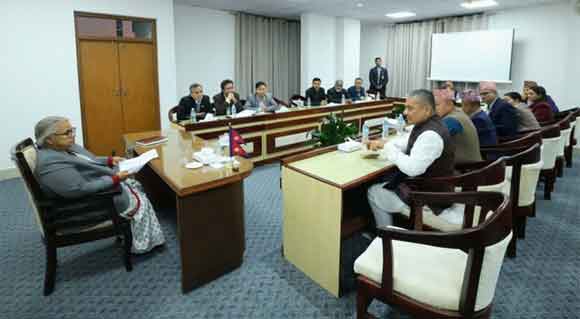
The demands included basic questions like restoration of constitutional monarchy, abrogation of the present Constitution, Hinduism as State religion. The interim govt has no mandate, but discussed the demands. And it announced the formation of a Commission to examine the demands!
Following the meeting, Durga Prasai informed the media that he had put forth a demand to pursue a referendum on the present forms of governance through all-party engagement. He placed demands, with ultimatums, insisting they be fulfilled by the interim govt and before elections!
This development alarmed the parties and leaders, who rushed to Delhi, as seen in this part-3 above. They feel Delhi has a hand behind such things.
Part-4 will cover more of these ominous developments.
Countercurrents had earlier, in 2020, published a series of articles on the unequal relations India imposed on Nepal, including on the border dispute, and the new maps issued. They include:
Part 2 on May26, 2020: India-Nepal Embittered Relations : Much beyond a Border Dispute.
“Nepal map runs into Parliament wall” : Who built this wall? India! (29/05/2020)
https://countercurrents.org/2020/05/nepal-map-runs-into-parliament-wall-who-built-this-wall-india/
India-Nepal Border Dispute : The International Ramifications (31/05/2020)
https://countercurrents.org/2020/05/india-nepal-border-dispute-the-international-ramifications/
0 Response to "What’s cooking in Nepal? Ominous Developments before the March 5 polls!"
Post a Comment
Disclaimer Note:
The views expressed in the articles published here are solely those of the author and do not necessarily reflect the official policy, position, or perspective of Kalimpong News or KalimNews. Kalimpong News and KalimNews disclaim all liability for the published or posted articles, news, and information and assume no responsibility for the accuracy or validity of the content.
Kalimpong News is a non-profit online news platform managed by KalimNews and operated under the Kalimpong Press Club.
Comment Policy:
We encourage respectful and constructive discussions. Please ensure decency while commenting and register with your email ID to participate.
Note: only a member of this blog may post a comment.