
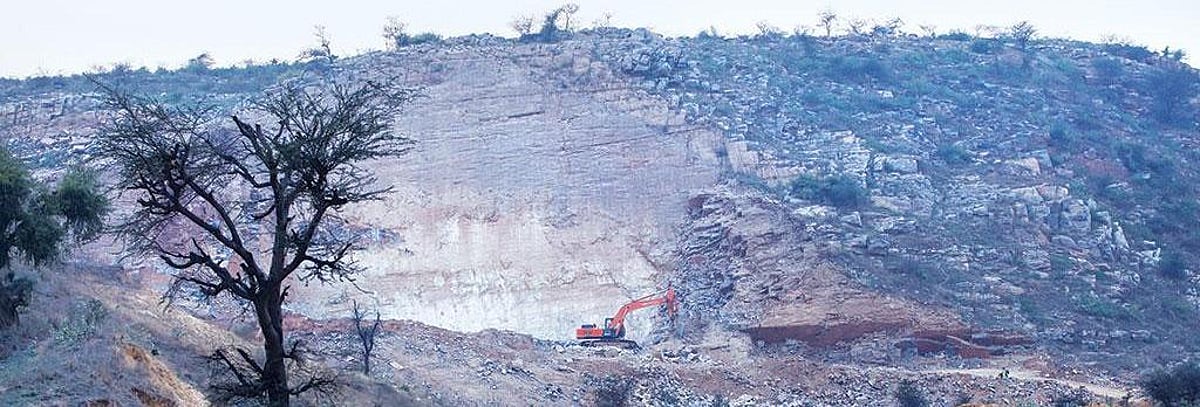
Report Highlights Impact of Encroachments and Illegal Mining on the Aravalli Ecosystem
Extensive diversion of forestlands, particularly around Sariska and Bardod Wildlife Sanctuaries prior to the 1980s, led to a substantial decline in native forest cover, fragmenting critical wildlife habitats and water catchments, it noted.
The research, Eco-restoration of the Aravalli Landscape, was undertaken by Sankala Foundation with support from the Embassy of Denmark in India and the Haryana State Forest Department.
The study adopted an integrated approach to addressing ecological degradation in the Aravalli region, linking environmental sustainability with biodiversity conservation, climate resilience, livelihood security and human rights.
The Aravalli Range, one of the oldest mountain systems globally, is a critical natural barrier and life-sustaining ecosystem for the National Capital Region (NCR) and the Indo-Gangetic Plains of India.
“However, this fragile ecosystem, spanning over four states and 29 districts, home to over 50 million people, is under severe threat due to deforestation, unsustainable land use, including rapid urbanisation, and widespread land degradation and desertification,” said the report launched on Wednesday by Union Environment Minister Bhupender Yadav.
“Encroachments, deforestation, illegal mining, and urban infrastructure expansion have severely impacted groundwater recharge, biodiversity, air quality, and climate regulation in this fragile ecosystem and have weakened the Aravalli’s capacity to act as a green barrier, accelerating desertification and threatening the ecological stability of the northern plains,” the study read.
The Sankala Foundation’s initiative addresses these challenges through a site-specific, evidence-based, and community-inclusive ecological restoration model of a pilot area of four villages in the Aravalli belt of Gurugram, focusing on the southern part of the district.
The study aims to create a replicable eco-restoration framework that integrates scientific analysis, community participation, and adaptive governance.
The study found that forest patches in the project area are highly degraded, fragmented, and invaded by species such as Prosopis juliflora, Lantana camara, and Parthenium hysterophorus. These invasive species have significantly suppressed native biodiversity and altered ecological functions.
“All villages report complete reliance on groundwater for irrigation. This overdependence has contributed to the depletion of natural aquifers and adversely affected forest health. A substantial proportion of households (over 43 pc) rely on forests for firewood, medicinal plants, and fodder. Women play a key role in NTFP collection and resource management. However, alternative livelihoods remain limited,” it added.
0 Response to "Report Highlights Impact of Encroachments and Illegal Mining on the Aravalli Ecosystem"
Post a Comment
Disclaimer Note:
The views expressed in the articles published here are solely those of the author and do not necessarily reflect the official policy, position, or perspective of Kalimpong News or KalimNews. Kalimpong News and KalimNews disclaim all liability for the published or posted articles, news, and information and assume no responsibility for the accuracy or validity of the content.
Kalimpong News is a non-profit online news platform managed by KalimNews and operated under the Kalimpong Press Club.
Comment Policy:
We encourage respectful and constructive discussions. Please ensure decency while commenting and register with your email ID to participate.
Note: only a member of this blog may post a comment.