
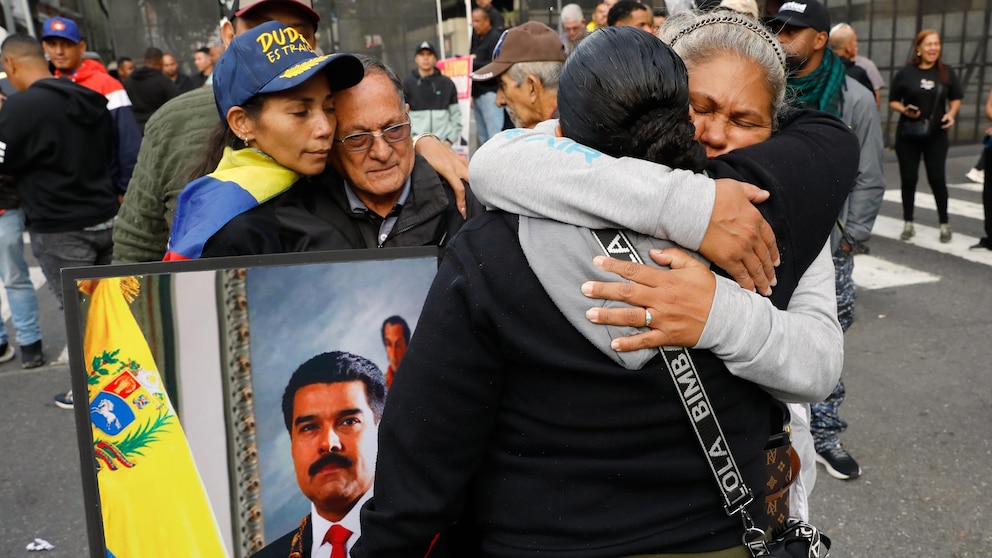
Maduro Arrives in US After Stunning Capture in Operation That Trump Says Will Let the US 'Run' Venezuela
Maduro landed late Saturday afternoon at a small airport in New York following the middle-of-the-night operation that extracted him and his wife, Cilia Flores, from their home in a military base in the capital, Caracas — an act that Maduro's government called "imperialist." The couple faces US charges of participating in a narco-terrorism conspiracy.
The dramatic action capped an intensive Trump administration pressure campaign on Venezuela's autocratic leader and months of secret planning, resulting in the most assertive American action to achieve regime change since the 2003 invasion of Iraq. Legal experts raised questions about the lawfulness of the operation, which was done without congressional approval.
Venezuela's vice president, Delcy Rodriguez, meanwhile, demanded that the United States free Maduro and called him the country's rightful leader as her nation's high court named her interim president. Some Venezuelan civilians and members of the military were killed, said Rodriguez, who didn't give a number. Trump said some US forces were injured, but none were killed.
Speaking to reporters hours after Maduro's capture, Trump revealed his plans to exploit the leadership void to "fix" the country's oil infrastructure and sell "large amounts" of oil to other countries.
After arriving at a small airport in New York City's northern suburbs, Maduro was flown by helicopter to Manhattan, where a convoy of law enforcement vehicles, including an armored car, was waiting to whisk him to a nearby US Drug Enforcement Administration office. A video posted on social media by a White House account showed Maduro, smiling, as he was escorted through that office by two DEA agents grasping his arms.
Trump Claims US Will Run the Country
Trump claimed the US government would help lead the country and was already doing so, though there were no immediate visible signs of that. Venezuelan state TV aired pro-Maduro propaganda and broadcast live images of supporters taking to the streets in Caracas in protest.
“We’re going to run the country until such time as we can do a safe, proper, and judicious transition,” Trump said at a Mar-a-Lago news conference. He boasted that this “extremely successful operation should serve as a warning to anyone who would threaten American sovereignty or endanger American lives.”
Maduro and other Venezuelan officials were indicted in 2020 on narco-terrorism conspiracy charges, and the Justice Department released a new indictment Saturday of Maduro and his wife that painted his administration as a “corrupt, illegitimate government” fueled by a drug-trafficking operation that flooded the US with cocaine. The US government does not recognize Maduro as the country’s leader.
The Trump administration spent months building up American forces in the region and carrying out attacks on boats in the Caribbean Sea and eastern Pacific Ocean for allegedly ferrying drugs. Last week, the CIA was behind a drone strike at a docking area believed to have been used by Venezuelan drug cartels — the first known direct operation on Venezuelan soil since the US campaign began in September.
Taking place 36 years to the day after the 1990 surrender and seizure of Panama leader Manuel Antonio Noriega following a US invasion, the Venezuela operation unfolded under the cover of darkness early Saturday. Trump said the US turned off “almost all of the lights" in Caracas while forces moved in to extract Maduro and his wife.
Gen. Dan Caine, chairman of the Joint Chiefs of Staff, said US forces had rehearsed their maneuvers for months, learning everything about Maduro — where he was and what he ate, as well as details of his pets and his clothes.
Multiple explosions rang out that morning, and low-flying aircraft swept through Caracas. Maduro's government accused the United States of hitting civilian and military installations, calling it an “imperialist attack” and urging citizens to take to the streets. The explosions — at least seven blasts — sent people rushing into the streets, while others took to social media to report what they saw and heard.
Restrictions imposed by the US government on airspace around Venezuela and the Caribbean expired early Sunday, Transportation Secretary Sean Duffy said on X, an announcement that suggested any further immediate major US military action was unlikely. “Airlines are informed, and will update their schedules quickly,” he posted.
Under Venezuelan law, Rodriguez would take over from Maduro. Rodriguez, however, stressed during a Saturday appearance on state television that she did not plan to assume power, before Venezuela's high court ordered that she become interim president.
“There is only one president in Venezuela," Rodriguez said, "and his name is Nicolas Maduro Moros.” The presidential palace was guarded by armed civilians and members of the military. At a nearby plaza, only a street sweeper and a soldier stood, and across the street, a church remained closed for a second day in a row.
In New York, the UN Security Council, acting on an emergency request from Colombia, planned to hold a meeting on US operations in Venezuela on Monday morning.
0 Response to "Maduro Arrives in US After Stunning Capture in Operation That Trump Says Will Let the US 'Run' Venezuela"
Post a Comment
Disclaimer Note:
The views expressed in the articles published here are solely those of the author and do not necessarily reflect the official policy, position, or perspective of Kalimpong News or KalimNews. Kalimpong News and KalimNews disclaim all liability for the published or posted articles, news, and information and assume no responsibility for the accuracy or validity of the content.
Kalimpong News is a non-profit online news platform managed by KalimNews and operated under the Kalimpong Press Club.
Comment Policy:
We encourage respectful and constructive discussions. Please ensure decency while commenting and register with your email ID to participate.
Note: only a member of this blog may post a comment.