
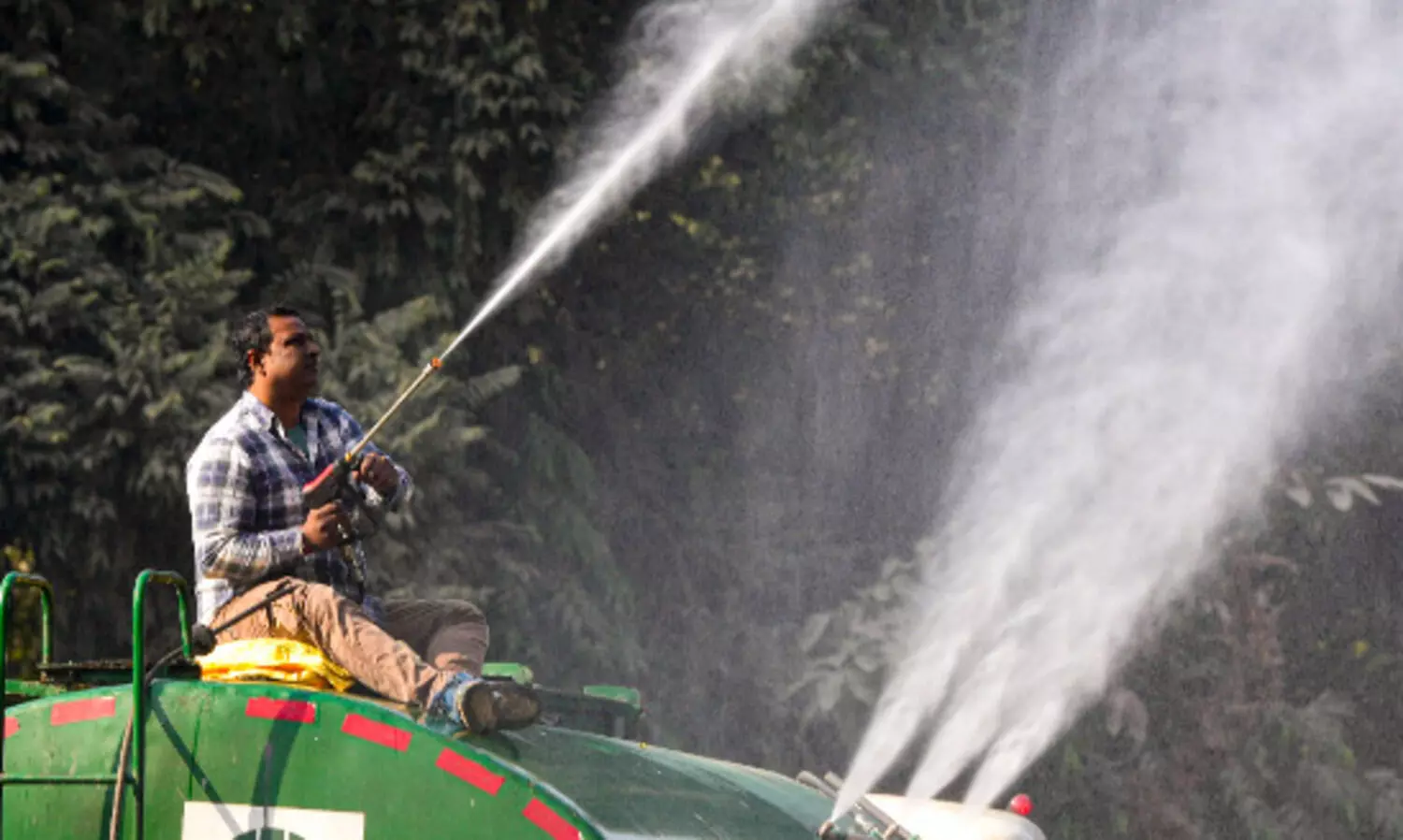
Air Quality 'Very Poor' in Delhi for 13th Consecutive Day, Forecasts Indicate No Relief
The 24-hour average Air Quality Index (AQI) settled at 327 on Wednesday, compared to 352 on Tuesday and 382 on Monday, remaining in the "very poor" category for the 13th consecutive day.
The air quality is likely to remain "very poor" over the coming week, according to a forecast issued by the Air Quality Early Warning System for Delhi.
Meanwhile, the Central Pollution Control Board's (CPCB) Sameer app, which displays real-time readings from monitoring stations across Delhi, had not updated data till 5 pm on Wednesday. On Tuesday, only one station -- Rohini -- recorded the air quality in the "severe" category with an AQI of 401. On Monday, 15 stations were in the "severe" range.
According to the CPCB's standards, an AQI between 0 and 50 is considered "good", 51 and 100 "satisfactory", 101 and 200 "moderate", 201 and 300 "poor", 301 and 400 "very poor", and 401 and 500 "severe".
The Decision Support System (DSS) of the Indian Institute of Tropical Meteorology in Pune estimated that vehicular emissions contributed 21.6 per cent to Delhi's pollution on Wednesday – the highest among all sources – while stubble burning accounted for 0.8 per cent.
For Thursday, these contributions are projected at 19.5 per cent and 0.7 per cent, respectively.
With Delhi's air quality slipping deep into the "very poor" and "severe" categories this winter, doctors have stressed the need for regular diagnostic screening to detect early signs of pollution-linked health deterioration, especially among smokers, asthma patients, children, and people with pre-existing cardiac or respiratory conditions.
Experts have said that preventive health checks are becoming increasingly important as toxic air triggers airway inflammation, reduces lung function, and aggravates underlying diseases.
For patients with persistent breathing difficulties, chest X-rays may be advised to detect chronic inflammation or structural lung changes. Advanced tests such as FeNO (fractional exhaled nitric oxide) are gaining relevance because they can identify airway inflammation even before major symptoms appear.
Health specialists have said that individuals frequently exposed to poor air quality – including outdoor workers, traffic personnel, and daily commuters – should consider establishing a baseline spirometry profile and repeating the test every six months to monitor any decline.
Pulse oximetry can help people experiencing fatigue or breathlessness track oxygen saturation levels. An annual chest evaluation is also recommended for those with chronic exposure to pollutants.
0 Response to "Air Quality 'Very Poor' in Delhi for 13th Consecutive Day, Forecasts Indicate No Relief"
Post a Comment
Disclaimer Note:
The views expressed in the articles published here are solely those of the author and do not necessarily reflect the official policy, position, or perspective of Kalimpong News or KalimNews. Kalimpong News and KalimNews disclaim all liability for the published or posted articles, news, and information and assume no responsibility for the accuracy or validity of the content.
Kalimpong News is a non-profit online news platform managed by KalimNews and operated under the Kalimpong Press Club.
Comment Policy:
We encourage respectful and constructive discussions. Please ensure decency while commenting and register with your email ID to participate.
Note: only a member of this blog may post a comment.