
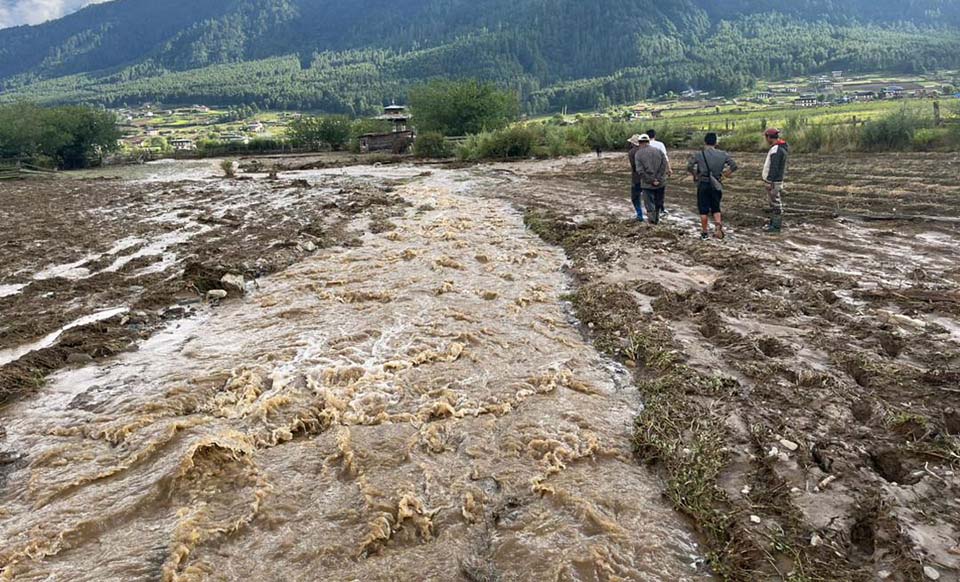
Floods in Bhutan and North Bengal Spark Questions Over Compensation Demand: Tensions Rise Amid Shared River Crisis
The floods, which occurred on October 4 and 5, were triggered by heavy rainfall in the region, causing rivers such as the Amochu, which originates in Bhutan and flows into West Bengal as the Torsa River, to swell beyond capacity. Both countries share these transboundary rivers, which are vital to their livelihoods but also pose significant flood risks during the monsoon season.
Bhutan Faces Economic Losses Amid Flooding
In Bhutan, the aftermath of the floods has been no less devastating. Phuentsholing, the border town neighboring Jaigaon, witnessed severe damage as business establishments engaged in boulder extraction and sand mining along the Amochu River suffered massive losses. According to Kuensel, Bhutan’s national newspaper, stocks of timber, gravel, and boulders, critical for export – particularly to Bangladesh – were completely submerged, resulting in heavy financial losses. Expensive machinery used in mining operations was also partially submerged or damaged. The boulders washed away by the flooding will likely impact the supply chain, while submerged timber stocks have become unsellable for export and must now be sold domestically as driftwood.
Locals in Phuentsholing have voiced their concerns over the lack of flood protection measures, urging the Bhutanese government to build flood barriers to safeguard vulnerable areas. This situation is compounded by the fact that Bhutan’s lower foothills remain vulnerable to recurring floods, with little to no infrastructure to manage the swelling rivers during the monsoon.
Political Tensions and the Question of Accountability
The heavy toll on both Bhutan and West Bengal has given rise to political tensions, especially following statements made by Chief Minister Mamata Banerjee. Banerjee has criticized Bhutan for the unregulated release of water from its dams into shared rivers, accusing the neighboring country of exacerbating flooding in northern Bengal. While her remarks have resonated with some in West Bengal, they have also provoked anger in Bhutanese border towns.
An incident in Jaigaon a week ago highlighted the growing animosity, as members of a prominent Bhutanese family visiting the town were allegedly heckled and one individual assaulted by locals. This altercation further strained relations, raising questions about how the ongoing flooding issue is being perceived by ordinary people on both sides of the border.
Interestingly, the question of who should be held accountable for the floods has also stirred controversy. Some have suggested that China, which controls Tibet and the Chumbi Valley – the source of several rivers flowing into Bhutan, including Amochu – should bear responsibility. Since these rivers originate from territories under China’s control, local residents are questioning whether China should be held liable for the environmental and economic losses suffered by both Bhutan and India.
Diplomatic Efforts to Address Tensions
In an effort to address the growing tensions, a high-level delegation from India’s Ministry of Home Affairs visited Bhutan on Friday. Led by Secretary for Border Management, Rajendra Kumar, the delegation met with Bhutan's Prime Minister in Thimphu. While the official agenda focused on enhancing bilateral cooperation in various fields, including digital governance, trade facilitation, and border management, sources close to the Bhutanese Prime Minister’s Office indicated that the issue of cross-border tensions and flood-related grievances was also discussed.
The Bhutanese Prime Minister expressed appreciation for India’s continued support towards Bhutan’s socio-economic development, acknowledging that India has been one of Bhutan’s most trusted partners. “The relationship between Bhutan and India goes beyond diplomacy. It is built on trust, friendship, and a shared vision for sustainable progress,” the Prime Minister said during the meeting.
On India’s part, the Secretary of Home Affairs reiterated India’s commitment to further strengthening historical ties, emphasizing that cooperation between the two countries extends beyond just strategic issues. "Our cooperation is both strategic and people-centric. It is based on a shared vision of mutual benefit and progress,” he affirmed.
Path Forward: Joint Solutions for Shared River Systems
The meeting between the Indian delegation and Bhutanese leadership underscored the importance of addressing cross-border cooperation, especially when it comes to shared river systems. The floods have highlighted the vulnerability of both regions, with unregulated water releases and inadequate flood management systems causing extensive damage on both sides of the border.
Experts have long warned about the need for stronger cross-border cooperation on water management, flood forecasting, and emergency response. As the region faces increasing environmental challenges due to climate change, both governments will need to prioritize the development of joint flood management strategies to mitigate the risk of future disasters.
Local communities in both Bhutan and West Bengal are calling for more proactive measures, such as the construction of flood protection walls, better monitoring systems for water releases, and joint initiatives to address the root causes of flooding in these shared river systems.
Conclusion: The issue of compensation remains contentious, with both Bhutanese and West Bengali citizens suffering the same fate from the swollen rivers. As the political narrative surrounding flood relief and accountability intensifies, the need for deeper bilateral dialogue and cooperation is becoming increasingly evident. In the face of natural calamities that know no borders, it is clear that both nations must work together to prevent further loss and build a resilient future for their people.
0 Response to "Floods in Bhutan and North Bengal Spark Questions Over Compensation Demand: Tensions Rise Amid Shared River Crisis"
Post a Comment
Disclaimer Note:
The views expressed in the articles published here are solely those of the author and do not necessarily reflect the official policy, position, or perspective of Kalimpong News or KalimNews. Kalimpong News and KalimNews disclaim all liability for the published or posted articles, news, and information and assume no responsibility for the accuracy or validity of the content.
Kalimpong News is a non-profit online news platform managed by KalimNews and operated under the Kalimpong Press Club.
Comment Policy:
We encourage respectful and constructive discussions. Please ensure decency while commenting and register with your email ID to participate.
Note: only a member of this blog may post a comment.