
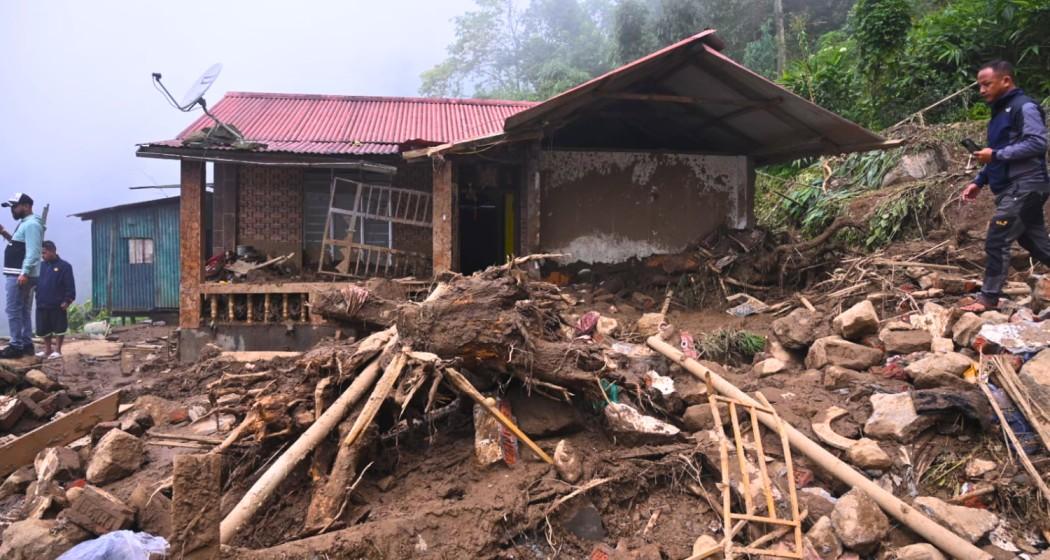
Environmentalists blame unplanned urbanisation for Darjeeling landslides
Environmentalists and experts who have long warned of such a catastrophe said this was not an unpredictable calamity, but the result of years of ecological exploitation and administrative apathy.
"The hills are paying for decades of neglect -- deforestation, unplanned roads, and reckless construction have made the terrain unstable. The rain is only the trigger; the real cause is how we have treated the mountains," said environmentalist Sujit Raha, a member of the North Bengal Science Centre. "There is no proper disaster management plan in place to tackle such crises. The administration and authorities must take this problem seriously and not treat it as an annual tragedy," he said. Unchecked urban growth, poor drainage systems and hill-cutting for construction altered Darjeeling's ecosystem beyond recognition, he added.
Disaster management expert Shailendra Mani Pradhan, a professor at Sarojini Naidu College for Women in Kolkata, said the landslides were a direct fallout of unregulated development in one of the country's most ecologically sensitive zones. "Darjeeling lies in a high seismic area and is naturally prone to landslides. Yet, infrastructure development for tourism and housing continues without any adherence to building bylaws or drainage norms. The terrain is being pushed to its limits," he said.
He pointed out that the rampant construction of multi-storey buildings on unstable slopes, particularly in Mirik, Kurseong, Kalimpong and Darjeeling towns, has increased the risk manifold. He called for decentralisation of disaster management, saying that while national and state-level frameworks exist, "district-level disaster management committees remain largely non-functional."
"People must be sensitised to the ecological risks of violating construction norms. Around 70–80 per cent of land in Darjeeling Municipality has been allotted for residential purposes, which is unsustainable," he said.
Environmental scholar Vimal Khawas said the tragedy fits a recurring pattern of extreme climatic events that have haunted the region for decades. "What we are seeing now is not new, but the scale of devastation this time reflects both natural vulnerability and growing human pressure on a fragile Himalayan ecosystem," he said.
"Habitation has spread into marginal areas where construction should never have been allowed. Weak enforcement of land use regulations, especially after the Gorkhaland agitation, has led to rampant building and road expansion without adherence to safety norms," said Khawas, a professor at JNU's Special Centre for the Study of Northeast India. He said the pattern of disasters seen in Sikkim, Uttarakhand and Himachal Pradesh reflects a larger Himalayan crisis driven by global climate change, compounded by local governance failures.
He said the Gorkhaland Territorial Administration which administers the Darjeeling hills lacks both expertise and infrastructure for disaster management. "The plans are mostly drawn up in Kolkata without factoring in the local topography. What Darjeeling needs is a locally driven disaster preparedness plan linked with climate action and inter-departmental coordination, especially in managing water resources," he said.
Environmental activist Subhas Dutta said the recurring landslides underline the need for a long-term environmental management plan for the entire north Bengal-Sikkim belt. "The continuous soil erosion in the hills is causing stones and sand to flow down into the plains, raising the riverbeds and disturbing their natural course. As a result, many riverbeds now lie higher than the surrounding inhabited areas, increasing the risk of floods," he explained.
Environmental expert Satyadeep Chhetri warned that the eastern Himalayas have moved "from climate change to the climate crisis" phase, urging relocation of habitations from high-risk zones and rehabilitation of affected families. "The refilled South Lhonak glacial lake poses a renewed threat, and the shift of extreme rainfall to September-October signals a dangerous new climatic pattern for the region," he said. Chhetri claimed that large-scale hill-cutting for highways and the ongoing construction of the railway line to Rangpo have destabilised the terrain.
0 Response to " Environmentalists blame unplanned urbanisation for Darjeeling landslides"
Post a Comment
Disclaimer Note:
The views expressed in the articles published here are solely those of the author and do not necessarily reflect the official policy, position, or perspective of Kalimpong News or KalimNews. Kalimpong News and KalimNews disclaim all liability for the published or posted articles, news, and information and assume no responsibility for the accuracy or validity of the content.
Kalimpong News is a non-profit online news platform managed by KalimNews and operated under the Kalimpong Press Club.
Comment Policy:
We encourage respectful and constructive discussions. Please ensure decency while commenting and register with your email ID to participate.
Note: only a member of this blog may post a comment.