
"We Were Shot for Change”: Gen-Z Protest Survivors Speak as Nepal Grapples With Fallout, Looting, and a Cry for Reform
KalimNews, Kathmandu, September 15, 2025 : As survivors of Nepal’s Gen-Z protests share stories of pain, anger, and determination, authorities scramble to recover stolen property, assess damages, and respond to a national outcry for accountability and justice.
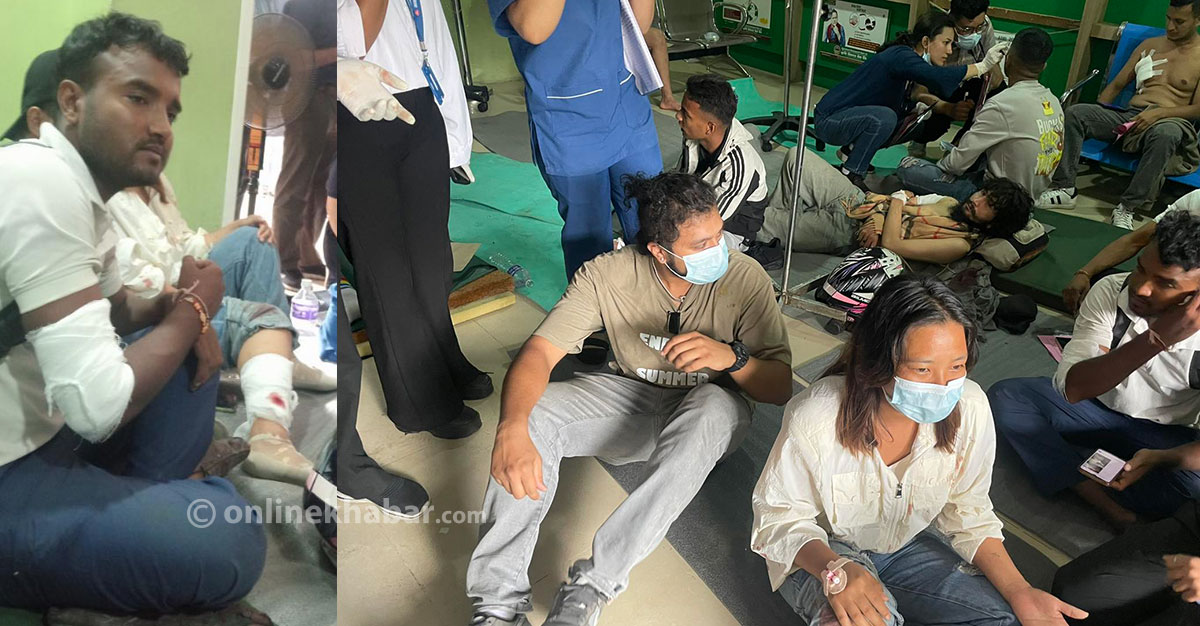
“We barely survived—just by an inch,” says 22-year-old Sudeep Sunar, lying on hospital bed number 125 at Civil Hospital, Kathmandu. Speaking in a faint voice after surviving a gunshot wound to the neck during the Gen-Z protests, he reflects on how close he came to death: “Had that bullet pierced the main artery, I wouldn’t be alive today.” A college student by morning and food delivery worker by evening, Sudeep joined his protesting friends near the Parliament building on Bhadra 23. Amid tear gas and chaos, he was shot and fell unconscious. Bystanders rushed him to the hospital. For days, he feared he’d never speak again. No leaders, he notes bitterly, have come to check on the injured.
Sudeep’s story is just one among many. Rupin Khadka, 26, was shot eight times in the right arm. He had joined the movement because he believed young, educated voices must challenge corruption. “Who else will speak if not us?” he asks. Three bullets were surgically removed on the first day, five more the next. Rupin, a final-year student at Baneshwor Bahumukhi Campus, remains hopeful that the government will take real action beyond rhetoric.
In Bhaktapur, 25-year-old Keshav Limbu, a law student, was shot in the leg. “The law guarantees services, but we don’t receive them,” he says. He joined the protest with friends, driven by frustration and a vision for a better Nepal. “We took bullets for change. Let’s not waste this moment.”
Vikram Deula, 22, was inspired by social media posts highlighting corruption. He joined fellow demonstrators on the streets. A loud bang, a shot to the leg, and he collapsed—his right shin shattered. “I saw people resisting injustice online,” he says. “So I came out. Now I’m in a hospital bed.”
The above stories of Sudeep, Rupin, Keshav, and Vikram were originally reported by Setopati, and are reproduced here with credit.
Their wounds, physical and symbolic, embody a generation’s outcry.
The Gen-Z protests, which erupted on Bhadra 23 and 24, have left deep scars—both personal and institutional. The confirmed death toll stands at 72. Over 450 were injured, according to Civil Hospital records. Violence spread across government institutions, sparking unprecedented levels of looting and destruction. Parliament buildings were set ablaze; the main server system and critical infrastructure were destroyed, reducing decades of records and equipment to ash. The House of Representatives has been dissolved. At least 30 pending bills are now defunct.
In Siraha’s Lahan Municipality–1, the Food Management and Trading Company’s warehouse was looted extensively. According to official records, the looters made away with huge quantity of rice, sugar paddy, including jute sacks, fumigation sheets, cooking gas cylinders, laptops, mobile phones and vehicles including cars and motorcycles (some of which were set on fire)
The estimated loss from the Lahan site alone exceeds NPR 109 million. Officials report that the fumigation sheets—rare and extremely heavy—could only be moved by teams of at least 10 people, indicating organized looting.
However, following strong administrative orders, partial recovery efforts have begun. As of Sunday night, 71 quintals of rice and 18 quintals of sugar have been returned—either voluntarily or via local youth-led mediation. Anil Kumar Mahato, spokesperson for the Lahan branch of the Food Company, confirmed that the names of those returning items are being kept confidential to protect their dignity. “Some came forward themselves; others worked through community networks,” he noted.
Law enforcement has warned that those who fail to return stolen goods may face legal consequences, with identities traceable through CCTV footage and social media content.
Meanwhile, the Federal Parliament Secretariat has also issued a public appeal for the return of stolen government property taken during the arson and looting at the Parliament complex in New Baneshwor on September 9. Items stolen include: office furniture (tables, chairs), electronic devices (computers, TVs, monitors), audio-visual equipment (microphones, speakers, audio mixers), office machines (printers, scanners, photocopiers), cameras and surveillance systems.
“If any of the items are with you, please return them,” the Secretariat said. “If you know where they are or who has them, please inform us.” Citizens have also been encouraged to submit videos or other evidence of individuals removing property. Whistleblowers have been promised complete confidentiality.
The Parliament Secretariat expressed particular concern over the destruction of its main servers, which contained crucial legislative data. All the infrastructure at the New Baneshwor Parliament complex has been declared completely gutted.
The protests, sparked by a youth-led demand for accountability and justice, have now triggered both a crisis of governance and a wave of recovery efforts. With political uncertainty looming, the newly appointed Prime Minister Sushila Karki—a former Supreme Court Chief Justice and the country’s first woman to hold the premiership—faces a daunting challenge. Her government must navigate a fractured society, pacify rising tensions, and chart a course toward institutional reform.
0 Response to ""We Were Shot for Change”: Gen-Z Protest Survivors Speak as Nepal Grapples With Fallout, Looting, and a Cry for Reform"
Post a Comment
Disclaimer Note:
The views expressed in the articles published here are solely those of the author and do not necessarily reflect the official policy, position, or perspective of Kalimpong News or KalimNews. Kalimpong News and KalimNews disclaim all liability for the published or posted articles, news, and information and assume no responsibility for the accuracy or validity of the content.
Kalimpong News is a non-profit online news platform managed by KalimNews and operated under the Kalimpong Press Club.
Comment Policy:
We encourage respectful and constructive discussions. Please ensure decency while commenting and register with your email ID to participate.
Note: only a member of this blog may post a comment.