

Nepal Struggles to Restore Stability Amid Political Unrest and Economic Crisis: 72 Dead
Upon assuming office on Sunday, Prime Minister Karki expressed her profound concern over the damage inflicted on the nation’s key institutions during the Gen-Z protests. In her speech at Singha Durbar, she described the destruction of critical government buildings as “shameful” and “unprecedented.” She stated, “The country’s most essential institutions have been targeted. The police, responsible for public security, were attacked. Police posts and stations were burned down. Court files were destroyed. The nation has lost invaluable documents.” Prime Minister Karki raised pertinent questions regarding the intentions behind such actions, adding, “Why were the very institutions that have upheld governance in Nepal deliberately targeted?”
In a somber tone, Karki expressed her disappointment, stating, “I feel ashamed to witness this. If this was done by a Nepali, can we even call them Nepali?” Her remarks underscored the scale of the devastation, pointing out the extent of damage to government facilities, including the burning of key records that are now lost to history. She decried the unprecedented violence as a shameful chapter for the country.
The political unrest was sparked in part by the Supreme Court’s ruling in August 2025, which mandated the registration of social media platforms operating within Nepal. This directive led the Ministry of Communications and Information Technology to demand compliance from 26 platforms, and when they failed to do so, the government imposed a ban on September 4. For many young Nepalis, particularly Gen-Z, the ban represented more than just an inconvenience—it was a direct attack on their identity, livelihoods, and self-expression. Content creators, influencers, and businesses relying on these platforms faced sudden losses, with their incomes and opportunities severed overnight. The country’s youth, already facing high unemployment rates, viewed the ban as an unjust move in the face of rising economic frustration and limited opportunities.
While elite families and their children enjoyed lives of privilege, exposed by social media, ordinary Nepali youth struggled to secure decent jobs, with many forced to migrate abroad in search of work. Youth unemployment had already reached over 20 percent by 2024, and the imposition of the social media ban only added fuel to the fire of discontent.
Adding to the political turmoil, Rastriya Swatantra Party (RSP) lawmaker Sumana Shrestha resigned from her party, citing internal issues and criticizing the leadership for refusing to acknowledge its mistakes. Shrestha also urged leaders from other major parties, such as Nepali Congress and CPN-UML, to reconsider their roles and step down. She emphasized the need for change and reflection within the political establishment.
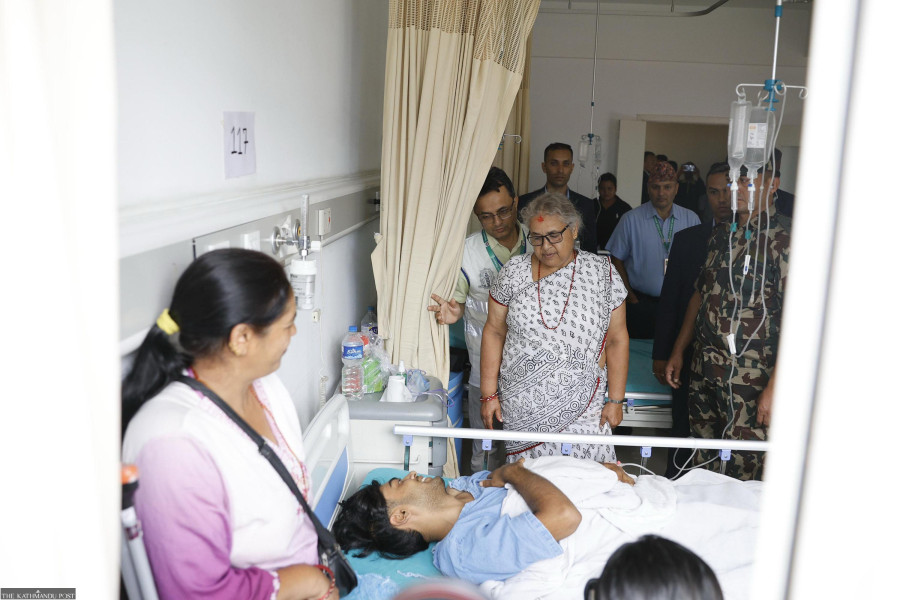
Amid the unrest, Prime Minister Karki visited the National Trauma Centre and Civil Hospital to meet with the injured youths from the Gen-Z protests. Dr. Badri Rijal, Chief of the Centre, reported that 36 individuals were still under treatment, with six in critical condition and two requiring urgent surgery in NTC. In response to the tragic events, the government has declared the deceased as martyrs and pledged Rs 1 million in compensation to their families.
The toll from the protests has been severe, with 72 (59 demonstrators, 10 jail inmates, 3 police personnel) reported deaths, according to Chief Secretary Eknarayan Aryal. Violent acts of arson, looting, and destruction have left Nepal reeling. Investigations are ongoing, and the authorities have vowed to take strict action against those responsible for the damage. Prime Minister Karki has urged the law enforcement agencies to hold the perpetrators accountable, emphasizing that the attack on government institutions was an attack on the very fabric of the nation.
In a separate development, prisoners who escaped from several prisons during the unrest are slowly returning to custody. As of now, 126 inmates from Bharatpur Prison have voluntarily returned, following outreach efforts by prison authorities. Meanwhile, authorities are continuing their search for inmates who fled from other facilities, including Bhimphedi and Tulshipur prisons, where a total of over 1,400 prisoners escaped. A joint operation by the Nepal Army, Nepal Police, and Armed Police Force is underway to track down the remaining fugitives.
The economic fallout from the unrest is substantial. Economists estimate that the damage could amount to approximately Rs 3 trillion, which is roughly half of Nepal’s GDP. Key businesses, including Bhat-Bhateni Supermarket, Chaudhary Group, and Ncell, have suffered severe losses. The Hotel Association of Nepal has reported damages of Rs 25 billion, while automobile dealers estimate losses of Rs 15 billion. Bhat-Bhateni, a prominent retail chain, lost several of its outlets to the protests, with damages exceeding Rs 2.5 billion in insurance claims.
The unrest has left nearly 10,000 Nepalis unemployed, further exacerbating the country’s ongoing economic crisis. As the interim government grapples with restoring order, Nepal faces the urgent task of stabilizing its economy and ensuring a peaceful and fair election process in the coming months. The path to recovery is uncertain, but Prime Minister Karki remains focused on steering the country through these challenging times.
0 Response to " Nepal Struggles to Restore Stability Amid Political Unrest and Economic Crisis: 72 Dead "
Post a Comment
Disclaimer Note:
The views expressed in the articles published here are solely those of the author and do not necessarily reflect the official policy, position, or perspective of Kalimpong News or KalimNews. Kalimpong News and KalimNews disclaim all liability for the published or posted articles, news, and information and assume no responsibility for the accuracy or validity of the content.
Kalimpong News is a non-profit online news platform managed by KalimNews and operated under the Kalimpong Press Club.
Comment Policy:
We encourage respectful and constructive discussions. Please ensure decency while commenting and register with your email ID to participate.
Note: only a member of this blog may post a comment.