
Nepal Government Forms High-Level Probe Panel, Announces Sweeping Relief and Cost-Cutting Measures in Aftermath of Gen Z Movement
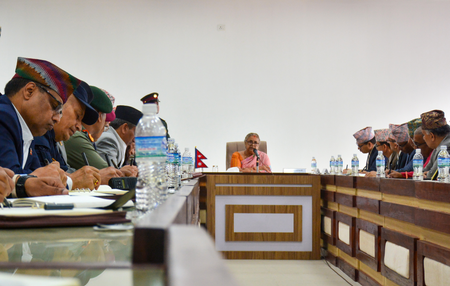
At its Cabinet meeting held on Sunday evening, the government decided to form a three-member high-level probe commission under the leadership of former Special Court chairperson Gauri Bahadur Karki. Former Additional Inspector General of Police Bigyan Raj Sharma and legal expert Bishweshwar Bhandari have been appointed as members. Home and Law Minister Om Prakash Aryal said the commission has been mandated to investigate events surrounding the protests and submit its report within three months.
The decision came on the same day industrialists and business leaders briefed Prime Minister Pushpa Kamal Dahal about the staggering financial losses—estimated at around Rs 800 billion in private property alone—caused during the agitation. Officials confirmed that Singh Durbar, the country’s key administrative hub, and the Supreme Court complex had suffered over 60 percent structural damage, while hotels, shopping centers, and private businesses nationwide were also attacked, vandalized, and set ablaze.
Finance Minister Rameshwor Khanal announced that in view of the extraordinary situation, the government has introduced several relief and austerity measures. He said all small-scale projects with allocations of less than Rs 30 million have been suspended to save resources, a step expected to reduce expenditure by Rs 120 billion. A dedicated Reconstruction Fund will be set up to support rebuilding damaged infrastructure, with contributions allowed from Nepalis at home and abroad, banks and financial institutions, as well as corporate social responsibility (CSR) allocations from industries. To oversee its operation, a Physical Infrastructure Reconstruction Committee will be established.
As part of fiscal discipline, the Cabinet has also restricted the purchase of luxury items, high-end electronics, and non-essential goods by all government offices. Distribution-oriented schemes involving gas cylinders, bicycles, sarees, health insurance premiums, hand pumps, and electricity charges have been banned. The Ministry of Finance has issued directives to all ministries, government agencies, provinces, and local bodies to ensure full implementation of these cost-cutting measures.
To facilitate recovery for the private sector, the government announced a 50 percent customs duty waiver on imports of construction materials required for rebuilding industries and businesses damaged during the agitation. Additionally, the Nepal Rastra Bank and the Insurance Board will roll out special relief facilities, including provisions for advance claims of up to 50 percent of insured damages.
According to the Nepal Insurance Authority, claims related to damages during the Gen Z movement have already reached Rs 22.25 billion. Bagmati Province alone accounts for Rs 17.97 billion worth of claims. A total of 2,478 claims have been filed across 18 insurance companies, led by Oriental Insurance (Rs 5.22 billion) and Siddhartha Insurance (Rs 5.08 billion). Out of these, 1,778 are vehicle-related, 538 pertain to property, 132 to engineering and contractor risks, 11 to transport, and 19 fall under other categories. Officials said all claims have been lodged by private entities, as government-owned structures were not insured.
The Cabinet also made key appointments: Additional Inspector General of Police Manoj KC has been appointed as chief of the Central Investigation Bureau (CIB). KC previously led the investigation into the fake Bhutanese refugee scam. Likewise, Manoj Silwal, former deputy executive director of the Nepal Electricity Authority (NEA), has been promoted as its Executive Director, while outgoing director Hitendra Dev Shakya has been transferred to the Water and Energy Commission.
Meanwhile, Finance Minister Khanal, who also oversees the Ministry of Federal Affairs and General Administration, dismissed speculation about dismantling Nepal’s provincial structure. Speaking to journalists at Biratnagar Airport, he clarified that the government remains committed to the federal framework as mandated by the constitution and has no plans to abolish provinces. He also ruled out any move to demonetize Rs 1,000 and Rs 500 notes, saying the issue has never been discussed at the policy level.
On India’s recent reduction in Goods and Services Tax (GST), Khanal said the government is studying potential impacts on Nepal’s economy and assured that corrective measures would be taken to protect domestic industries if required.
The government maintains that while reconstruction efforts will require vast resources, the combined measures of expenditure cuts, relief provisions, insurance support, and external contributions are aimed at stabilizing the economy and assisting recovery after one of the most destructive protest movements in recent history.
0 Response to "Nepal Government Forms High-Level Probe Panel, Announces Sweeping Relief and Cost-Cutting Measures in Aftermath of Gen Z Movement"
Post a Comment
Disclaimer Note:
The views expressed in the articles published here are solely those of the author and do not necessarily reflect the official policy, position, or perspective of Kalimpong News or KalimNews. Kalimpong News and KalimNews disclaim all liability for the published or posted articles, news, and information and assume no responsibility for the accuracy or validity of the content.
Kalimpong News is a non-profit online news platform managed by KalimNews and operated under the Kalimpong Press Club.
Comment Policy:
We encourage respectful and constructive discussions. Please ensure decency while commenting and register with your email ID to participate.
Note: only a member of this blog may post a comment.