
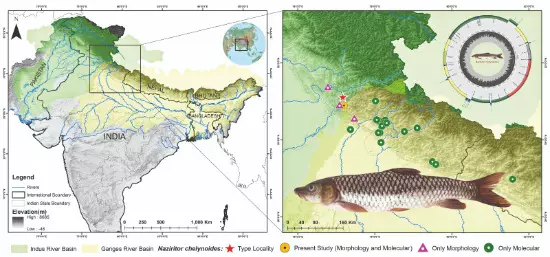
Global Team Decodes Mitochondrial Genome of Himalayan Dark Mahseer
Among them, the Dark Mahseer, endemic to the fast-flowing streams of the Central and Western Himalayan foothills in India, has remained taxonomically ambiguous for decades despite its cultural and ecological importance. “Our morphometric analysis identified clear diagnostic traits, including lateral line scales, body shape, and fin structure, that distinguish N. chelynoides from closely related mahseer species. Genomic insights reinforced this, with the complete mitochondrial genome and phylogenetic analyses confirming Naziritor as a distinct lineage within the subfamily Torinae,” said Boni Amin Laskar, lead author from the High-Altitude Regional Centre, Zoological Survey of India (ZSI) located at Solan, Himachal Pradesh.
Population-level genomic analysis revealed three Evolutionarily Significant Units (ESUs) and seven haplotypes within the Ganges River basin, with high levels of genetic divergence pointing to cryptic diversity. Critical microhabitats in the Tons River, Alakananda River, and regions of Nepal emerged as biodiversity hotspots requiring urgent conservation attention, noted collaborating researchers from Birsa Agricultural University Jharkhand, City College Kolkata, Haldia Institute of Technology in East Midnapore (Bengal), and the University of Tabuk (Saudi Arabia).
In the backdrop of mahseer populations facing severe threats from habitat degradation, river fragmentation, overfishing, and climate change, safeguarding mahseer is not just about protecting a fish species. “It is about ensuring the ecological resilience of rivers and the livelihoods of the millions who depend on them,” emphasised Prof. Sankar Kumar Ghosh of Assam University, India.
The study, which uniquely integrates classical taxonomy with cutting-edge next-generation genomics, underscores the importance of protecting N. chelynoides as a distinct evolutionary lineage, while also highlighting the need for additional genomic research on its congener N. zhobensis to refine evolutionary understanding. “The remarkable genetic diversity we uncovered underlines the urgent need for targeted conservation policies across the Indian subcontinent,” said Shantanu Kundu, corresponding author from Pukyong National University, Republic of Korea.
This pioneering work, published in the Biologia journal by Springer Nature, not only resolves a long-standing taxonomic ambiguity but also charts a roadmap for integrating genomics into freshwater fish conservation, providing a model for safeguarding vulnerable aquatic species across Asia and beyond.
0 Response to " Global Team Decodes Mitochondrial Genome of Himalayan Dark Mahseer"
Post a Comment
Disclaimer Note:
The views expressed in the articles published here are solely those of the author and do not necessarily reflect the official policy, position, or perspective of Kalimpong News or KalimNews. Kalimpong News and KalimNews disclaim all liability for the published or posted articles, news, and information and assume no responsibility for the accuracy or validity of the content.
Kalimpong News is a non-profit online news platform managed by KalimNews and operated under the Kalimpong Press Club.
Comment Policy:
We encourage respectful and constructive discussions. Please ensure decency while commenting and register with your email ID to participate.
Note: only a member of this blog may post a comment.