
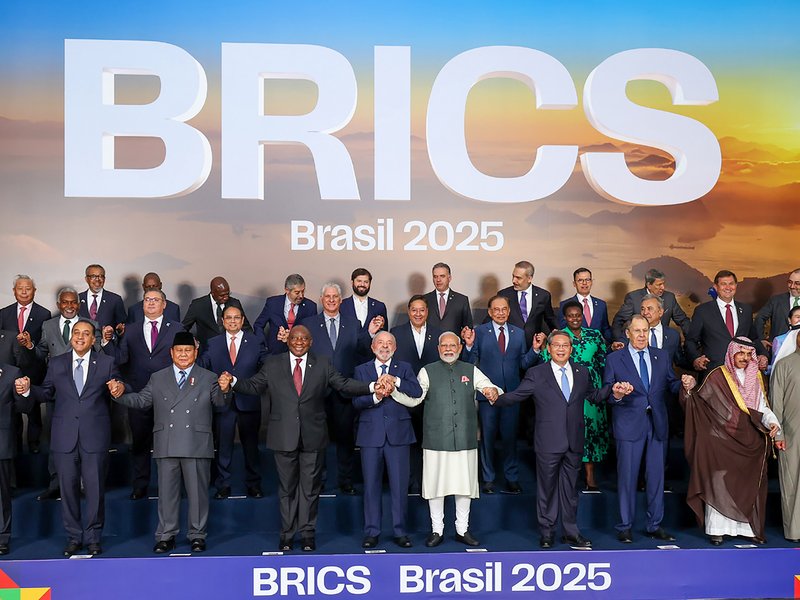
BRICS Pushing for Reforms Without Breaking with the Current System
White House Eyes BRICS Nations as a Challenge to US Hegemony. The group today represents close to half the global population and around 40 percent of the global GDP, with about 26 percent of global trade. Its first meeting took place at the Foreign Ministers' level in 2006, much like Saturday's gathering, at the margins of the United Nations General Assembly in New York. Three years later, the heads of member states met at their first Summit in 2009 at Ekaterinburg, Russia.
The acronym BRIC was first used in 2001 by Goldman Sachs in their Global Economics Paper, "The World Needs Better Economic BRICs." This was based on econometric analyses projecting that the four economies would individually and collectively occupy far greater economic space and would be among the world's largest economies in the next 50 years or so. BRIC expanded into BRICS with the inclusion of South Africa at the then-member Foreign Ministers' meeting in New York in 2010. It further grew in 2024 with Egypt, Ethiopia, Iran, and the UAE becoming full members from January 1, 2024. Indonesia joined the BRICS as a full member in 2025, while Belarus, Bolivia, Kazakhstan, Cuba, Malaysia, Nigeria, Thailand, Uganda, and Uzbekistan were inducted as partner countries.
In recent times, President Trump has warned the bloc against planning a "de-dollarisation move." An article published by the policy institute Chatham House observed last month, "Washington is using Brazil to send a warning to other countries—particularly other BRICS countries like South Africa and India—on issues such as controlling digital communications, using alternative currencies to the US dollar in trade transactions, and relations with China." Due to Western sanctions, Russian oil products exported eastward and southward are being sold in the local currencies of buyers or in the currencies of countries Russia perceives as friendly, it cited as an example. "Among buyers, India, China, and Turkey are all either using or seeking alternatives to the dollar," the report added.
"However, though the US dollar continues to cede ground to nontraditional currencies in global foreign exchange reserves, it remains the preeminent reserve currency," observed three eminent economists associated with the IMF.
Washington may also not take kindly to the BRICS Foreign Ministers' Saturday meeting reiterating their "strong support" for Ethiopia and the Islamic Republic of Iran's bid for accession to the WTO. Neither would it like them condemning "the military strikes against the Islamic Republic of Iran since 13 June 2025."
0 Response to "BRICS Pushing for Reforms Without Breaking with the Current System"
Post a Comment
Disclaimer Note:
The views expressed in the articles published here are solely those of the author and do not necessarily reflect the official policy, position, or perspective of Kalimpong News or KalimNews. Kalimpong News and KalimNews disclaim all liability for the published or posted articles, news, and information and assume no responsibility for the accuracy or validity of the content.
Kalimpong News is a non-profit online news platform managed by KalimNews and operated under the Kalimpong Press Club.
Comment Policy:
We encourage respectful and constructive discussions. Please ensure decency while commenting and register with your email ID to participate.
Note: only a member of this blog may post a comment.