

A Deepening Crisis: Missing Arms, Looted Weapons, and Lethal Force Use During Gen Z Protests Spark Urgent Calls for Accountability

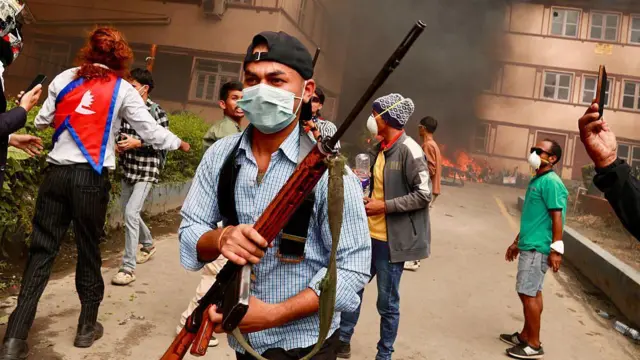
Police reports from the incident state that there were 2,220 instances of aerial firing and 3,323 uses of tear gas during the protests. The mounting number of lost and looted weapons, combined with the extensive use of tear gas and live rounds, has prompted calls from human rights organizations and legal experts for an impartial, high-level inquiry to determine how many rounds were discharged by security forces and to clarify the fate of the missing weapons.
Former Prime Minister KP Sharma Oli stirred further controversy by claiming that automatic weapons not belonging to the police were used during the protests, hinting at possible “infiltration” by external actors at the demonstrations. His comments, made on Constitution Day, have sparked heated debates, especially as evidence of lethal weapons and ammunition shells has been found at protest sites. Critics argue that the focus should be on a transparent investigation, not on politically charged assertions.
Adding to the complexity of the situation, senior police officers and former officials have pointed to a chronic shortage of non-lethal crowd-control equipment as a primary cause of the violent escalation. Despite repeated requests over the past decade, the Nepal Police have stated that the state failed to provide essential equipment such as water cannons, riot gear, rubber bullets, and blank rounds. Procurement proposals submitted to the Home Ministry have not been acted upon, leaving security forces ill-equipped for crowd control.
Compounding the crisis, a mass jailbreak occurred during the peak of the unrest. On Bhadra 24, amid the chaos, 14,043 inmates escaped from 28 jails and detention facilities across the country, including several foreign nationals. At the time, 15,525 prisoners chose to stay behind. By September 13, authorities confirmed that 3,723 inmates had voluntarily returned, but 10,320 prisoners remained at large. The number included 963 escapees from juvenile homes and nearly 2,000 detainees who were awaiting trial.
As of the latest figures provided by the Department of Prison Management, a total of 6,984 escaped prisoners have now been either recaptured by the police or army, or have surrendered voluntarily. However, 7,572 convicts are still unaccounted for, posing a significant threat to public safety. Authorities have stated that some fugitives were caught in India by the Sashastra Seema Bal (SSB), while others were apprehended by the Nepal Army inside the country. Notably, many of the escapees were serving life sentences, including convicted murderers and violent offenders.
In one of the most harrowing developments since the escape, a fugitive from Nakkhu Prison, 35-year-old Santa Bahadur Tamang of Panauti Municipality–12, allegedly murdered his wife, Manisha Ghyawa Tamang (30), in Kavre district on September 19 at 1 AM. Santa Bahadur had been serving a sentence for raping a woman in his village four years earlier. The brutal killing has reignited public fears about the risks posed by escaped convicts. Ten inmates have died under various circumstances since the breakout, police sources confirmed.
Pradyumna Karki, former Additional Inspector General of Police, criticized the operational response during the protests, particularly the failure to follow established protocols for the graduated use of force.
"Instead of starting with non-lethal methods such as verbal commands, water cannons, and rubber rounds, the security forces resorted immediately to lethal fire," Karki said, calling it a significant failure of professional judgment. Former district administrator Janakaraj Dahal echoed this concern, stating that the security forces had failed to properly assess the situation and implement layered defenses, which could have potentially avoided the tragic loss of life.
The aftermath of the violence has been devastating, with 74 confirmed deaths and scores of injuries reported from the two days of unrest. The continuing lack of accountability has intensified public demands for a swift and independent inquiry into both the procurement failures that left the police inadequately equipped and the operational decisions that led to the use of lethal force.
Meanwhile, the Nepal Army has made significant arrests in connection with looting during the protests. Two individuals were arrested for their involvement in looting weapons from a car wash parking lot in Kharibot, Kathmandu. The suspects, identified as Hirabahadur Magar and Laxman Shrestha, were found with a number of stolen firearms.
In related incidents, the military also apprehended 25 individuals across various districts of Kathmandu and Bhaktapur for looting, vandalizing, and setting fire to property. Among those arrested, 21 people were connected to looting at the Bhaktapur Bhatt Bhattaini Supermarket, Hotel Hyatt, and the Bouddha area, while five others were apprehended for looting a National Commercial Bank branch in New Baneshwor. The armed forces have also uncovered a substantial number of stolen weapons, including rifles, pistols, and ammunition, with a total of 94 weapons recovered from the streets, with 23 found in Kathmandu and 8 in Pokhara alone. An additional 268 firearms, many of them loaded, have been seized from suspects, alongside hundreds of rounds of live ammunition..
The security situation in Kathmandu remains tense, with frequent reports of looting, theft, and violent clashes between protesters, looters, and security forces. In one particularly symbolic and disturbing episode, a viral video captured the raw chaos of the protests and the moral divide between looters and citizens. Suresh Deula, a resident of Banglamukhi, Lalitpur, was recording footage near the looted National Commercial Bank in New Baneshwor on the evening of Bhadra 24. As looters exited the bank carrying bundles of cash, Deula confronted them on video, asking, “Is this how you rob a bank?” In response, one of the looters mockingly threw a wad of cash at him, saying, “Isn’t this what you want?”
Rather than pocketing the cash, Deula collected the scattered money — a total of NPR 510,500 — and handed it over to the authorities. His actions have since drawn praise from across civil society, offering a rare glimmer of integrity amid an otherwise lawless moment. The army later arrested five suspects connected to the bank looting, handing them over to the police for further investigation.
Elsewhere, law enforcement continues to uncover disturbing trends. A man was arrested in Pokhara for impersonating a police superintendent by wearing SP Shyambabu Oliya's uniform, which had been stolen during the protests. In Janakpur, two individuals were apprehended with an SLR rifle and 50 rounds of police ammunition stolen from the Madhes Province Public Service Commission’s office. The arrests followed a review of CCTV footage by District Police.
In Lalitpur, six individuals were arrested for setting fire to the Imadol police post, while four others were detained for robbing a private home during the protests, stealing foreign currencies, gold and ruby-embedded jewelry, silver coins, and luxury watches. In a separate incident in Ratopul, Kathmandu, three men were arrested after being caught looting and setting fire to a private residence. Authorities recovered cash and jewelry from the suspects, all of whom had used the unrest as cover for targeted theft.
Nepalgunj saw further chaos, with two men detained by local residents and found to be carrying 2,096 used cartridges and tools suspected to be linked to thefts. The cartridges were discovered in a sack carried by one of the suspects. Both men were handed over to the Area Police Office by concerned locals.
More weapons have been retrieved in dramatic fashion. In Balaju, Kathmandu, a suspect was arrested for hiding a stolen pistol inside the trunk of his taxi (registered as Bagmati Province 01-002-P 6449). Meanwhile, another arrest in Maharajgunj led to the capture of a suspect involved in the killing of two police officers — ASI Milan Rai and Constable Uttam Thapa — during the Bhadra 24 attack on the Maharajgunj police station. The arrested, identified as Yuvraj Kyapchaki of Kavre, is under judicial custody as police continue investigating the case.
Additional recoveries include seven pistols looted from the Valley Traffic Police Office at Ramshahpath, all found in Kharibot, Kathmandu Metropolitan City–16. In Kavre, a special police operation resulted in the arrest of seven individuals and the seizure of 730 rounds of ammunition. The suspects include residents of Kavre, Makwanpur, Ramechhap, and Baraa districts. The military and police continue their operations to recover stolen weapons and bring perpetrators to justice.
Meanwhile, the situation has become even more dire in other parts of the country. The crisis has extended beyond urban areas, with incidents of looting, arson, and vandalism occurring in rural districts.
As the investigation continues, the question remains: how many more weapons are still in the hands of criminals, and how will Nepal’s security forces restore order and regain public trust? Calls for an urgent and independent inquiry into the events are growing louder, with human rights organizations demanding accountability from the government and the security forces.
In summary, the protests have exposed a multifaceted crisis: the loss of weapons, the failure of crowd control protocols, and the deadly consequences of the use of excessive force. With a growing body count and the ongoing threat of looted arms on the streets, it is clear that a comprehensive investigation into these failures is now a matter of national urgency.
0 Response to "A Deepening Crisis: Missing Arms, Looted Weapons, and Lethal Force Use During Gen Z Protests Spark Urgent Calls for Accountability"
Post a Comment
Disclaimer Note:
The views expressed in the articles published here are solely those of the author and do not necessarily reflect the official policy, position, or perspective of Kalimpong News or KalimNews. Kalimpong News and KalimNews disclaim all liability for the published or posted articles, news, and information and assume no responsibility for the accuracy or validity of the content.
Kalimpong News is a non-profit online news platform managed by KalimNews and operated under the Kalimpong Press Club.
Comment Policy:
We encourage respectful and constructive discussions. Please ensure decency while commenting and register with your email ID to participate.
Note: only a member of this blog may post a comment.