
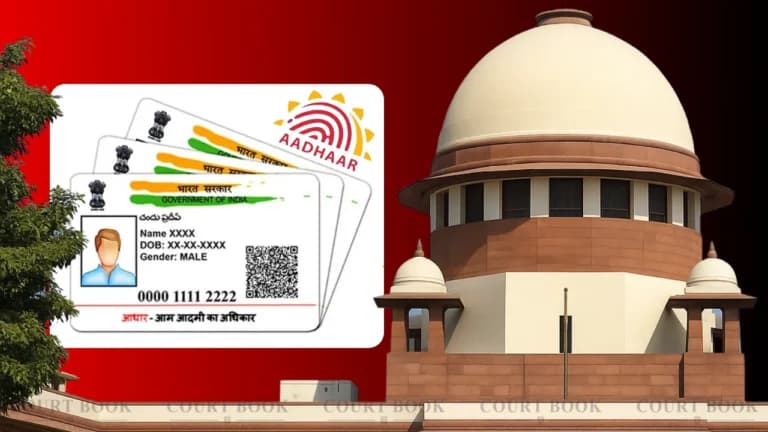
Supreme Court Asks ECI to Consider Aadhaar Card for Voter Verification in Bihar Amid Controversial Electoral Roll Revision
SC Declines to Halt Bihar Voter Roll Revision, Flags Timing, Exclusionary Measures, and Seeks Clarity from Election Commission
KalimNews, New Delhi, July 10, 2025 : In a significant development ahead of the Bihar Assembly elections scheduled later this year, the Supreme Court on Thursday declined to stay the Election Commission of India's (ECI) ongoing "Special Intensive Revision" (SIR) of the state's electoral rolls. While refusing to halt the process, the Court raised pointed concerns about the exclusion of Aadhaar, Voter ID, and ration cards from the list of documents acceptable for verifying voter identity under the revision. It directed the ECI to consider including these commonly held identification documents during the verification drive.
A two-judge bench comprising Justices Sudhanshu Dhulia and Joymalya Bagchi, sitting on a partial working day, was hearing a batch of petitions challenging the legality, timing, and methodology of the SIR initiated in Bihar. These petitions argue that the SIR—lacking statutory recognition under existing electoral laws—could potentially disenfranchise millions, particularly among the poor, Dalits, Muslims, and migrant populations. The Court emphasized that while it was not questioning the sincerity or constitutional mandate of the Election Commission, the timing and execution of the revision exercise were raising serious doubts about procedural fairness and voter rights.
"We cannot stop a constitutional body from doing what it is supposed to do. At the same time, we will not let it do what it is not supposed to do," the bench stated. It instructed the ECI to submit a counter-affidavit by July 21, with rejoinders from the petitioners due by July 28. The next hearing is scheduled for July 28, ahead of the draft roll's anticipated publication on August 1.
Petitioners, including MPs, civil society leaders, and democratic rights organisations, contend that the ECI has, for the first time since electoral digitisation, initiated a non-statutory form of revision—the so-called SIR—targeting voters enrolled after 2003. The exercise, they argue, is unprecedented and lacks legal backing under the Representation of the People Act, 1950 or the accompanying Registration of Electors Rules, 1960.
Senior Advocate Gopal Sankaranarayanan, appearing for the Association for Democratic Reforms (ADR), asserted that the SIR imposes arbitrary and burdensome requirements. He noted that even the Voter ID—issued by the ECI itself—and Aadhaar cards are excluded from the list of 11 accepted documents in the ECI’s June 24 directive. According to him, these exclusions are illogical, as the documents demanded, such as passports or permanent residence certificates, are unavailable to the vast majority of Biharis.
The Court acknowledged these concerns, observing that the matter raised fundamental issues central to democratic governance—specifically, the power of the ECI, the method of implementation, and the tight timelines against the backdrop of impending elections. Justice Dhulia remarked, "We are of the prima facie opinion that three issues are involved in this case: the authority of the ECI to initiate the revision, the procedural integrity of the exercise, and the timing, which appears compressed and potentially disruptive."
During the hearing, Justice Bagchi observed that Section 21(3) of the Representation of the People Act allows the ECI discretion to carry out revisions, but that discretion must not be exercised arbitrarily. He queried why Aadhaar and Voter ID cards, which are widely used and institutionally accepted, were excluded. Justice Dhulia pointed out that several of the accepted documents are themselves based on Aadhaar data, further underlining the inconsistency.
Senior Advocate Rakesh Dwivedi, appearing for the ECI, defended the process, stating that Aadhaar is not a proof of citizenship. To this, Justice Dhulia responded that citizenship determination lies with the Ministry of Home Affairs, not the ECI. Dwivedi assured the Court that no voter's name would be removed without proper notice and hearing, and emphasised that 60% of voters had already verified their credentials. However, the bench questioned why such an exercise, so close to the elections, was initiated without greater lead time and public preparation.
Senior advocates Kapil Sibal, Abhishek Manu Singhvi, Shadan Farasat, and others appearing for petitioners including RJD MP Manoj Jha, activist Yogendra Yadav, and AIMIM MLA Akhtarul Imam, highlighted the disproportionate burden placed on ordinary citizens. Sibal described the directive as “an impossible task,” asserting that over 4 crore voters out of 8 crore would require re-verification. Singhvi pointed out that even a single wrongful deletion harms the democratic process and affects electoral fairness. Jha’s petition alleged that the SIR targets minorities and the socio-economically disadvantaged, while Yadav’s plea called for reverting to the updated electoral roll from January 2025 to prevent mass disenfranchisement.
The bench asked the ECI to respond on three specific points: its authority to conduct the SIR, the rationale for excluding commonly accepted ID documents, and the feasibility of completing the process before elections. It also questioned whether the ECI’s timeline was practical or realistic, and warned that poorly-timed or exclusionary steps might disenfranchise legitimate voters. “You’re giving people very little time to furnish documents. Many of them may not possess what you are demanding,” observed Justice Dhulia.
Dwivedi attempted to discredit the petitions by claiming they were not filed by actual voters, a stance the bench rejected firmly. "Are you serious with this objection?" Justice Dhulia asked, and Justice Bagchi followed up, saying, "This can't be your best point."
The Court also noted that several petitioners have asked for a stay not only on the Bihar exercise but on the possibility of such revisions being introduced in other states, such as West Bengal. Moitra's petition raised concerns that the ECI is attempting to enforce fresh verifications even for voters who have participated in multiple elections over decades—without any provision in the law mandating such a practice. Her plea described the requirement for parental citizenship documents as extra-legal and exclusionary.
Petitions from ADR and the People’s Union for Civil Liberties (PUCL) called the ECI’s action arbitrary and violative of constitutional rights under Articles 14 (equality), 19 (freedom), 21 (life and liberty), 325 and 326 (universal adult suffrage). They contend that the exercise lacks safeguards, transparency, and proportionality, and that it burdens vulnerable populations with unreasonable demands.
While the Court refused to stay the ECI’s process for now, it has asked the poll panel not to publish the draft electoral rolls until further hearing, effectively putting a pause on the timeline while maintaining the integrity of the ECI’s constitutional mandate. The matter remains under active judicial scrutiny, and the July 28 hearing is expected to shape the path forward both for the electoral process in Bihar and potentially for broader electoral reforms across India.
(With inputs from Agencies)
0 Response to "Supreme Court Asks ECI to Consider Aadhaar Card for Voter Verification in Bihar Amid Controversial Electoral Roll Revision"
Post a Comment
Disclaimer Note:
The views expressed in the articles published here are solely those of the author and do not necessarily reflect the official policy, position, or perspective of Kalimpong News or KalimNews. Kalimpong News and KalimNews disclaim all liability for the published or posted articles, news, and information and assume no responsibility for the accuracy or validity of the content.
Kalimpong News is a non-profit online news platform managed by KalimNews and operated under the Kalimpong Press Club.
Comment Policy:
We encourage respectful and constructive discussions. Please ensure decency while commenting and register with your email ID to participate.
Note: only a member of this blog may post a comment.