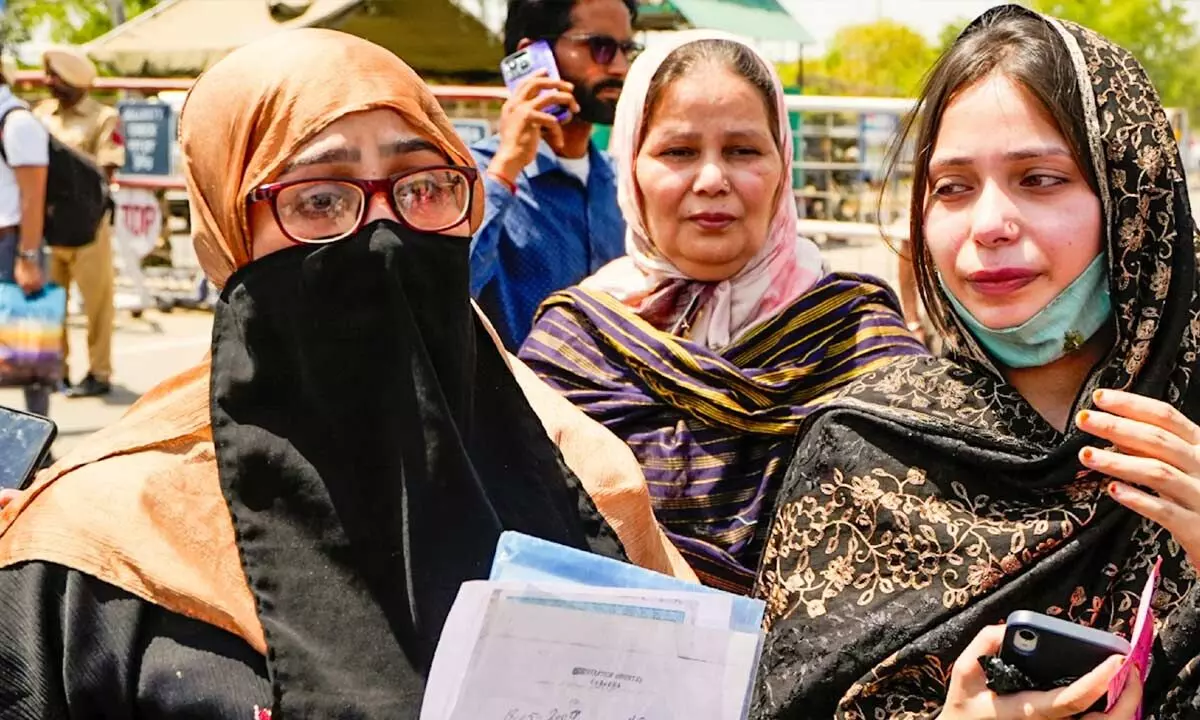
The scene at the Attari-Wagah border was filled with raw emotion as women, children, and families were escorted by police vans, not for a journey home, but for a forced return to a country many of them no longer considered home. Among the deportees was Rakshanda Zahoor, who had lived in Jammu for 36 years and married an Indian national in 1989. Despite never receiving Indian citizenship, Rakshanda’s life was in India—until the police arrived with a notice to leave. "I’ve lived here for 36 years. How can I go back? I have no one in Pakistan; my parents passed away in 1989," she said, tears in her eyes. Her husband, Zahoor Ahmad, expressed the confusion and helplessness they faced, stating, "Where will my wife go in Pakistan? This is tragic for us."
Another heart-wrenching story came from Minal, a Pakistani woman from Sialkot, married in Jammu just two months ago. “This is very unfair that we are being sent back like criminals,” she said, questioning the reason for her deportation. “What is our fault?” Similarly, Saba Kiran, who had been living in India for 15 years, voiced her anguish: “I didn't come here as a tourist; I built a family here. No one wants to leave their home.”
The deportations came after a deadly attack in Pahalgam, where five to six terrorists targeted a group of tourists, resulting in the deaths of 26 people. The attack, claimed by The Resistance Front (TRF), was one of the deadliest civilian attacks in the region in recent years. The Indian government responded by suspending the South Asian Association for Regional Cooperation (SAARC) Visa Exemption Scheme (SVES) and ordering the expulsion of Pakistani nationals under this scheme within 48 hours. This decision sparked anger and fear among those affected, many of whom had no connection to the attack itself.
Muffazla, another deportee who had lived in India legally for six years with a long-term visa, expressed her heartbreak at the sudden reversal of her family's life in India. “Why are we being punished for something we didn't do?” she asked tearfully, holding her young child close. Similarly, Farheen, who was forced to leave her child behind in India as she crossed the border, lamented, “My child has an Indian passport. The Pakistan government won’t let him in, and the Indian government won’t let me stay here. Governments should at least have mercy on small children.” The tearful goodbyes at the border echoed the painful separation of families, as many women were torn from their children and spouses.
This heartache is further compounded by the fact that many of these individuals, such as Farheen and Ira, had lived in India for years, built families, and had no immediate connections in Pakistan. In some cases, they had been married to Indian nationals and were caught in bureaucratic delays. Farheen’s mother-in-law, who watched as her daughter-in-law was separated from her child, questioned, “How will the baby stay without his mother?”
In the midst of the sorrow, some individuals, like Sarita Jaisrani, who has a long-term visa, expressed gratitude for the opportunity to remain in India, citing her children’s Indian citizenship as the basis for her residence. However, for many others, the situation is far less clear-cut. Sameera, a pregnant Pakistani national, and her husband Rizwan, who had been living in India for months, were now faced with the prospect of being torn apart by the policies. “She has been crying ever since we received the call,” Rizwan said, his voice tinged with desperation. “The situation is not good for her. The government should have thought about such cases before issuing a blanket order.”
The diplomatic relations between India and Pakistan have been under severe strain since the attack, with India taking several measures to ramp up pressure, including halting the Indus Waters Treaty, downgrading diplomatic ties, and imposing travel restrictions. These steps follow a growing security concern over terrorist activities and political friction in the region.
For the families caught in this difficult situation, the Attari-Wagah border is not just a place of departure but a symbol of the deep personal and emotional toll that comes with shifting geopolitics. Hundreds of people—Pakistani nationals who had lived in India for years—have now faced the daunting reality of separation from their families and their lives. The government’s move has sparked intense debate over the balance between national security and compassion for families torn apart by political decisions.
As the deportation continues, the question remains: Can there be a compassionate resolution for families caught in such a situation, or will geopolitics continue to dominate the lives of innocent people?

0 Response to " Deportation of Pakistani Nationals Follows Pahalgam Terror Attack, Sparked by Strained Bilateral Tensions"
Post a Comment
Disclaimer Note:
The views expressed in the articles published here are solely those of the author and do not necessarily reflect the official policy, position, or perspective of Kalimpong News or KalimNews. Kalimpong News and KalimNews disclaim all liability for the published or posted articles, news, and information and assume no responsibility for the accuracy or validity of the content.
Kalimpong News is a non-profit online news platform managed by KalimNews and operated under the Kalimpong Press Club.
Comment Policy:
We encourage respectful and constructive discussions. Please ensure decency while commenting and register with your email ID to participate.
Note: only a member of this blog may post a comment.