
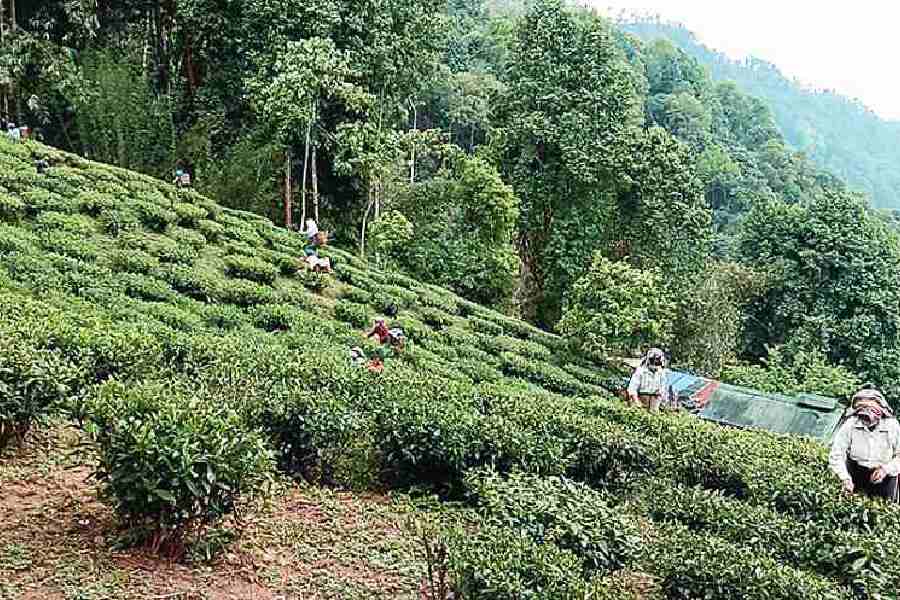
Lack of adequate rainfall results in 38 per cent drop in Bengal's tea production
3 Jun 2023
Comment
Even if the crop is down and there is less tea available in the market, prices in the auction for CTC and dust tea which North Bengal (sans Darjeeling) produce, are trending with a negative bias, leaving the industry worried
The Indian Tea Association, the trade body of large planters, estimates that there has been a 38 per cent drop in crop in north Bengal, mainly due to lack of rainfall, with gardens in the Darjeeling hills being the worst hit.
Even if the crop is down and there is less tea available in the market, prices in the auction for CTC and dust tea which North Bengal (sans Darjeeling) produce, are trending with a negative bias, leaving the industry worried.
“When the production is down and supply is short, one expects prices to remain firm. But we are in a peculiar situation when volume and prices are both down, especially for the Darjeeling and Dooars regions which faced extremely hostile weather conditions this year. This is alarming,” said Atul Asthana, managing director of Goodricke.
Goodricke, part of Camellia PLC, has 12 gardens in the Dooars region and five in Darjeeling, including the world famous Castleton and Margaret’s Hope. It produces 16 million kg in Dooars and about 1 million kg in Darjeeling.
He recalled how during Covid, production shortage due to the lockdown led to a spike in prices, following the usual dynamics of demand-supply mismatch. “This time around there is a glut in the global market, which is weighing down on CTC prices internationally and in auction centres here,” Asthana explained.
Prices are down 5-9 per cent (north India, orthodox and Darjeeling) on an average in the first 20 auctions of 2023.
Tea Research Institute (TRA) estimated that rainfall is down by 50 per cent during May in Dooars. “Dry conditions are prevailing in north Bengal. It is not only the scanty rainfall, lack of relative humidity that is also hurting tea bush growth,” said Jaydeep Phukan, secretary of the TRA. Moreover, there have also been pest attacks taking advantage of hot and dry conditions, he added.
Estimates curated by the ITA from members suggest production in Terai, Dooars and Darjeeling are down by 25 per cent, 30 per cent and 40 per cent, respectively, in May when the first flush tea is produced.
Industry participants put the condition of Darjeeling worrying as many gardens are being forced to sell tea below the cost of production. In the auction earlier this week (sale no 22), broken and fanning teas were sold at an average of Rs 350-550 a kg while the cost of production is around Rs 650 a kg. Moreover, a lot of the teas went unsold, signalling weak demand.
Arijit Raha, secretary general of the ITA, described the condition as ‘precarious’. “While the earnings of the gardens are down due to lower volume and weak prices, the cost is trending up, mainly led by rise in input costs, including wages,” he said.
0 Response to "Lack of adequate rainfall results in 38 per cent drop in Bengal's tea production"
Post a Comment
Disclaimer Note:
The views expressed in the articles published here are solely those of the author and do not necessarily reflect the official policy, position, or perspective of Kalimpong News or KalimNews. Kalimpong News and KalimNews disclaim all liability for the published or posted articles, news, and information and assume no responsibility for the accuracy or validity of the content.
Kalimpong News is a non-profit online news platform managed by KalimNews and operated under the Kalimpong Press Club.
Comment Policy:
We encourage respectful and constructive discussions. Please ensure decency while commenting and register with your email ID to participate.
Note: only a member of this blog may post a comment.