
Probe Report (Of Inquiry Commission and BBC) on the Gen Z Protests: A Nation Awaiting Accountability
The Commission’s Report on Nepal’s Gen Z Protest Crackdown
The government formed the inquiry commission on September 21, 2025, shortly after the protests turned deadly. The three-member panel was chaired by former Supreme Court justice Gauri Bahadur Karki, with members including former police official Bigyan Raj Sharma and legal practitioner Bishweshwar Prasad Bhandari.
The commission was tasked with investigating the killings, destruction of property, and the actions of state authorities during the protests of September 8–9, 2025.
The panel carried out a wide-ranging investigation, recording statements from more than 150–200 individuals, including government officials, eyewitnesses, and security personnel.
The final document, exceeding 1,000 pages, presents detailed findings on the causes of the unrest and makes recommendations for preventing similar incidents in the future.
Chairperson Gauri Bahadur Karki emphasized the integrity of the investigation: “We have fulfilled our duty honestly, recording the facts without prejudice.”
He also clarified that the report contains only facts established during the inquiry and outlines recommendations to ensure such tragedies do not recur.
Key Findings of the Commission
According to the commission, the unrest was largely driven by poor governance, institutional inefficiency, and public frustration with political interference in state institutions.
The report states that the crisis stemmed from:
-
Weak governance structures
-
Politicisation of the bureaucracy and judiciary
-
Delays within executive and judicial systems
-
Public anger over corruption and restrictions on social media
The protests, organised mainly by young activists known as the Gen Z movement, escalated rapidly when thousands gathered in Kathmandu.
Death Toll and Violence
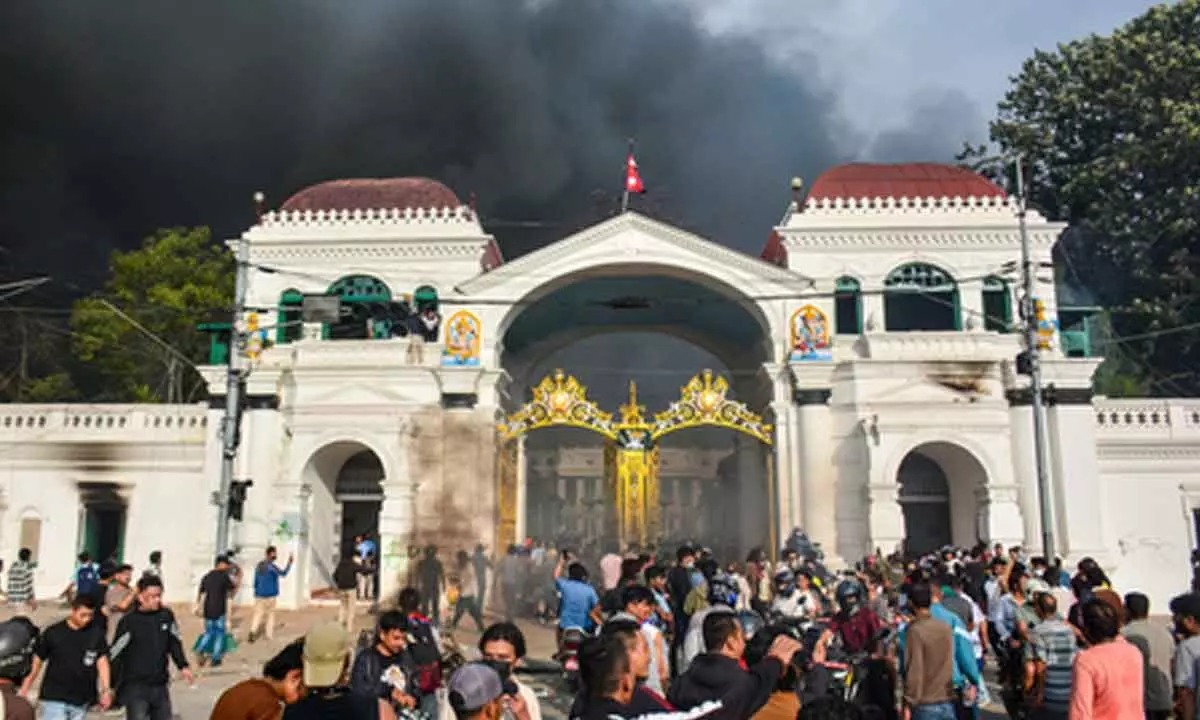
The two-day unrest resulted in at least 76–77 deaths, including dozens of young protesters shot by security forces. The violence also involved arson, vandalism, and attacks on government buildings, while police stations and public infrastructure were damaged during retaliatory protests the following day.
Officials Implicated
Although the full report has not yet been publicly released, sources indicate that the commission has recommended criminal proceedings against several officials involved in the crackdown.
Those reportedly implicated include:
-
Former Police Inspector General Chandra Kuber Khapung
-
Kathmandu Chief District Officer Chhabi Lal Rijal
-
Kathmandu District Police Chief Bishwa Adhikari
The report also examined the roles of political leaders during the crisis, including former Prime Minister K P Sharma Oli, former Home Minister Ramesh Lekhak, and other senior officials.
However, the commission stressed that its mandate was primarily fact-finding, and that it is now up to the government and relevant authorities to initiate legal action.
What Happens Next?
After receiving the report, interim Prime Minister Sushila Karki said the government would study the findings before deciding how to proceed.
According to her press adviser Ram Bahadur Rawal, the government may release at least part of the findings publicly.
“The prime minister has said that even if the entire report cannot be made public, at least some of its key conclusions will be disclosed.”
Officials have indicated that the recommendations may be implemented in stages, including immediate actions, long-term reforms, and further investigations.
The BBC Investigation into the Gen Z Protest Shootings
Separate from the government inquiry, an independent investigation by the BBC revealed new details about how lethal force was authorised during the Gen Z protests.
Published in February 25, 2026, the investigation analysed internal police documents, leaked communication logs, and more than 4,000 videos and photographs to reconstruct the events of September 8, 2025, one of the bloodiest days in Nepal’s recent history.
Order to Use Lethal Force
According to the investigation, a senior police official using the call sign “Peter 1” issued an order allowing security forces to use lethal force against protesters.
Sources identified “Peter 1” as former Police Inspector General Chandra Kuber Khapung.
The order reportedly came 10 minutes after a curfew was imposed in Kathmandu, when officers on the ground repeatedly requested permission to use live ammunition.
The internal log recorded the command: “Curfew already in place. No further need to obtain permission. Deploy necessary force.”
Nepal Police later stated that the order was issued only after authorization from a government security committee, in accordance with Nepali law.
The Casualties
The BBC investigation identified 19 people killed by gunfire on September 8 alone, including the youngest victim, 17-year-old student Shreeyam Chaulagain.
Video evidence examined by investigators suggested that some victims were unarmed and not actively engaged in violence when they were shot.
One video shows Chaulagain walking away from the protest area when a bullet struck the back of his head.
How the Protests Began
The demonstrations were organised primarily by young activists frustrated with:
-
Political corruption
-
Economic inequality
-
Nepotism among political elites
-
Government bans on social media platforms
Young organisers used Discord and other digital platforms to coordinate the protests, which initially gathered at Maitighar Mandala in Kathmandu before moving toward the parliament building.
Police initially expected only a few thousand participants, but the crowd grew to around 30,000 protesters.
Escalation and Chaos
As tensions escalated:
-
Protesters breached police barricades near parliament.
-
Security forces deployed tear gas, water cannons, and batons.
-
Some protesters began throwing stones and setting fires.
-
Police eventually opened fire with live ammunition.
The BBC also found footage showing police firing from inside the parliamentary compound, further escalating the violence.
Nationwide Unrest and Government Collapse
The shootings on September 8 triggered widespread outrage.
On September 9, protests intensified across the country, leading to:
-
attacks on police stations and government buildings
-
large-scale arson and vandalism
-
dozens of additional deaths
Amid the escalating crisis, Prime Minister K P Sharma Oli resigned, causing the government to collapse.
Despite the extensive evidence uncovered by journalists and investigators, no one has yet been held legally accountable for the killings.
Families of victims continue to demand justice, while the official commission’s report now places pressure on the government to act.
For many Nepalis—especially the young generation that led the protests—the outcome of these investigations will determine whether the country’s institutions can deliver transparency, accountability, and democratic reform.
0 Response to "Probe Report (Of Inquiry Commission and BBC) on the Gen Z Protests: A Nation Awaiting Accountability "
Post a Comment
Disclaimer Note:
The views expressed in the articles published here are solely those of the author and do not necessarily reflect the official policy, position, or perspective of Kalimpong News or KalimNews. Kalimpong News and KalimNews disclaim all liability for the published or posted articles, news, and information and assume no responsibility for the accuracy or validity of the content.
Kalimpong News is a non-profit online news platform managed by KalimNews and operated under the Kalimpong Press Club.
Comment Policy:
We encourage respectful and constructive discussions. Please ensure decency while commenting and register with your email ID to participate.
Note: only a member of this blog may post a comment.